Showing posts with label Railways. Show all posts

In a region where traffic congestion is part of daily life, Metro Manila’s railway system remains a lifeline for millions. Whether you're a daily commuter navigating the city’s chaos or a tourist exploring the capital for the first time, learning how to use the city's growing rail transit system can save you time, money, and stress.

From the legacy of the Philippine National Railways to the futuristic North–South Commuter Railway project, here’s everything you need to know to ride the trains of Metro Manila—today and in the years ahead.


Understanding Metro Manila's Current Rail Network

Metro Manila currently operates three main commuter rail lines: MRT-3, LRT-1, and LRT-2, with the aging PNR still servicing longer-distance trips into the southern suburbs.
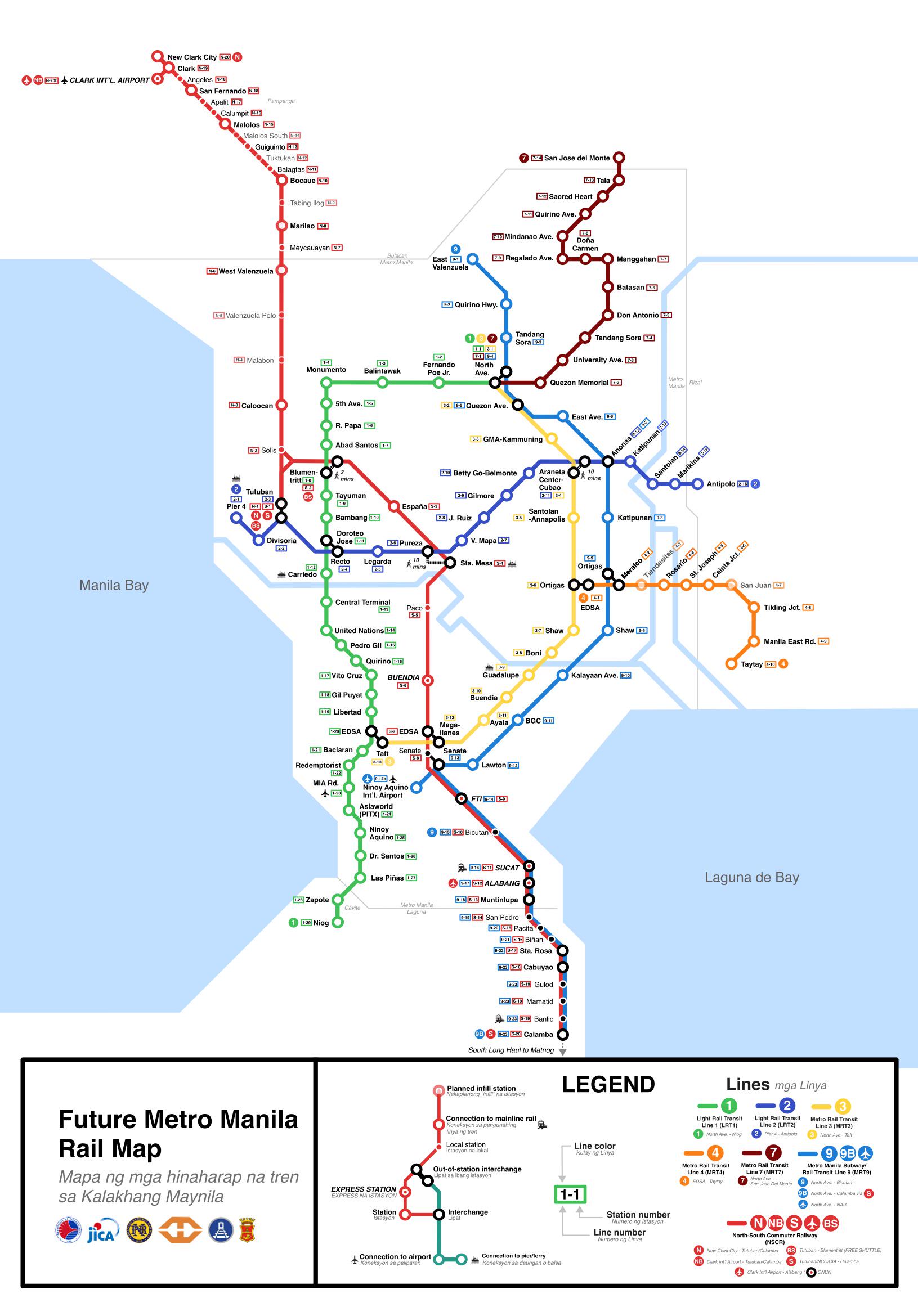

Each line serves a unique corridor of the metropolis, with several interchange stations making transfers possible for cross-city travel.


The MRT-3: Your EDSA Express


The MRT-3 is one of the most vital train lines in Metro Manila, running along the infamous Epifanio de los Santos Avenue, better known as EDSA. This elevated line stretches from North Avenue in Quezon City to Taft Avenue in Pasay. It has 13 stations and links key business and shopping districts such as Cubao, Ortigas, Makati, and MOA.

MRT-3 on EDSA

Open from around 4:30 AM to 10:30 PM, the MRT-3 is a go-to option for commuters looking to avoid EDSA’s gridlock. Fares range from ₱13 to ₱28 depending on distance, and the line is fully integrated with the Beep Card system, which allows tap-in/tap-out convenience across other Metro Manila lines.


MRT-3 (Metro Rail Transit Line 3)

  • Route: North Avenue (Quezon City) to Taft Avenue (Pasay)

  • Stations: 13 stations along EDSA

  • Key Stops: North Avenue (SM North EDSA), Cubao, Shaw Blvd., Ayala, Taft

  • Train Type: Elevated, Light Rail

  • Fare: ₱13–₱28 depending on distance

  • Hours: ~4:30 AM to 10:30 PM

  • Best For: North-South commute along EDSA (bypassing traffic)

  • Tip: MRT-3 connects with LRT-1 (at Taft–EDSA via walkway) and LRT-2 (via Cubao)


Loading...

The LRT-1: A Ride Through Old and New Manila


The Light Rail Transit Line 1, more commonly called the LRT-1, is the oldest mass transit system in Southeast Asia. Operational since 1984, it runs from Roosevelt Avenue in Quezon City to Baclaran in Pasay City. The route cuts through key parts of Manila, including historical sites, universities, and busy commercial zones.

LRT-1

Stations such as Doroteo Jose, Central Terminal, and UN Avenue provide access to the heart of the city, while the EDSA station connects directly to the MRT-3 via a short walkway. Trains run every few minutes, and like the MRT, Beep Cards are accepted.

As of 2025, construction is ongoing for the LRT-1 South Extension, which will connect Baclaran to Niog in Cavite—a long-awaited expansion that’s expected to partially open by late 2025 or early 2026.


LRT-1 (Light Rail Transit Line 1)

  • Route: Roosevelt (Balin­tawak) to Baclaran

  • Stations: 20 stations

  • Key Stops: Monumento, Blumentritt, Doroteo Jose (near Recto), EDSA (near MRT Taft), Baclaran

  • Train Type: Elevated, Light Rail

  • Fare: ₱15–₱30

  • Hours: ~4:30 AM to 10:30 PM

  • Best For: Traveling between northern and southern Manila (Manila–Pasay–Caloocan)

  • Extension in Progress: LRT-1 South Extension Project (Baclaran to Niog in Cavite) is ongoing and expected to open partially by late 2025 or 2026.


The LRT-2: Linking East and West


LRT-2 is the shortest of the three lines, but arguably one of the most scenic. Stretching from Recto in Manila to Antipolo in Rizal, this east-west route serves the university belt, government buildings, and residential hubs like Marikina and Masinag.

LRT2 offers free rides on March 8, International Women’s Day
LRT-2

The ride is smooth, relatively less crowded, and features longer trains compared to LRT-1. LRT-2 also intersects with both MRT-3 (via Araneta Center-Cubao) and LRT-1 (via Doroteo Jose and Recto stations). It’s particularly useful for students and professionals commuting from the eastern suburbs into Manila.


LRT-2 (Light Rail Transit Line 2)

  • Route: Recto (Manila) to Antipolo (Rizal)

  • Stations: 13 stations

  • Key Stops: Recto, Legarda, Cubao (connects to MRT), Marikina, Antipolo

  • Train Type: Elevated and Underground combo

  • Fare: ₱15–₱30

  • Hours: ~5:00 AM to 9:30 PM

  • Best For: East-West routes (Manila to Marikina, Antipolo)

  • Tip: If you're visiting universities in Manila (e.g., UST, FEU), LRT-2 Recto is your go-to.


The PNR: A Glimpse into the Past—and Future


The Philippine National Railways, or PNR, still operates several diesel-powered trains that travel from Tutuban in Manila to Calamba in Laguna. Though slower and less modern than its light rail counterparts, PNR provides essential connectivity to southern Metro Manila, with stops in Sta. Mesa, Paco, Alabang, and beyond.

PNR

However, the PNR as we know it is slowly being phased out. In its place will rise one of the country’s most ambitious infrastructure projects—the North–South Commuter Railway (NSCR).


PNR (Philippine National Railways)

  • Route: Tutuban (Manila) to Calamba (Laguna), with stops in Paco, Sta. Mesa, Alabang

  • Fare: ₱15–₱60 depending on distance

  • Train Type: At-grade (street-level), older diesel locomotives

  • Best For: Budget long-distance travel south of Metro Manila

  • Note: PNR trains are slower and less modern. This line is slated for retirement once the NSCR (North–South Commuter Railway) becomes fully operational.


How to Transfer Between Lines

Metro Manila’s train system isn’t a unified subway like in Tokyo or Singapore—but there are key transfer points that make multi-line commuting possible. For instance, passengers can walk from MRT-3's Taft Avenue station to LRT-1's EDSA station, or switch from MRT-3 to LRT-2 at Cubao via Gateway Mall. LRT-1’s Doroteo Jose station also connects to LRT-2’s Recto station via a footbridge.

An LRT-1 train approaching EDSA via Taft Avenue Station

These connections aren’t always seamless, but they do allow commuters to switch directions without going above ground or taking other vehicles.


Fares and Tickets: What You Need to Know

All three major lines (MRT-3, LRT-1, and LRT-2) now use the Beep Card—a reloadable contactless smart card that lets you tap in and out without lining up for tickets each ride. A card costs ₱50 (reloadable at stations, convenience stores, and online via apps).

Fares range from ₱13 to ₱30 depending on distance traveled. PNR, meanwhile, still uses traditional paper tickets and charges ₱15 to ₱60 based on your destination.

Visit my LRT and MRT Fare Types Guide to learn more.


Big Changes Are Coming: Future Rail Projects

If you think Metro Manila’s current system is limited, you’re not wrong. But change is on the way, and it’s coming fast.


The North–South Commuter Railway (NSCR)


The NSCR is a game-changing project that will stretch over 147 kilometers—from Clark International Airport in Pampanga, through Metro Manila, down to Calamba in Laguna. The rail will be fully electric, modern, and designed for high-speed travel (up to 160 km/h). The Tutuban to Malolos segment in the north is expected to open by 2026 or 2027, with full operations targeted by 2029.

North–South Commuter Railway

Once complete, this new system will replace the aging PNR and integrate with LRT-1, LRT-2, MRT-3, and the Metro Manila Subway—forming the backbone of a fully connected urban rail network.


The Metro Manila Subway


Dubbed “the country's first real subway,” the Metro Manila Subway (also known as Line 9) will be fully underground and run from North Avenue in Quezon City to the FTI complex (now Arca South) in Taguig, with a spur line leading directly to NAIA Terminal 3. Construction is currently underway, and partial operations are expected by 2027.

Metro Manila Subway Project

This subway will dramatically cut travel time—what would normally be a two-hour journey by car from Quezon City to the airport will take just 35 minutes by train.


Tips for First-Time Commuters and Tourists

For tourists visiting Metro Manila, trains are not only fast but also a great way to see a slice of daily life. However, it’s important to plan ahead:

  • Avoid peak hours (6–9 AM, 5–8 PM) when possible, as trains can get extremely packed.

  • Keep your belongings secure in front of you, and use anti-theft bags if possible.

  • If you're a woman traveling alone, take advantage of the women-only train cars, available during rush hours.

  • Always bring a Beep Card, and top it up with at least ₱100 to cover round trips and transfers.

  • Check apps like Sakay.ph or Google Maps Transit to plan your routes in real-time.


Final Thoughts: A Changing Commute for a Growing Metro

Metro Manila’s train system is far from perfect, but it’s improving—and fast. With the NSCR and Metro Manila Subway on the horizon, commuters will soon have access to a modern, high-speed, and more reliable public transit system that rivals those of other Asian capitals.

In the meantime, navigating the MRT, LRT, and PNR remains a practical and budget-friendly option for both locals and tourists. With some planning, patience, and a Beep Card in hand, you’ll be able to get around the city’s urban sprawl with surprising ease.

As Metro Manila transforms, so will its transport—and in just a few years, hopping from Quezon City to Calamba, or from Makati to Clark Airport, could be as simple as riding one train.


Philippine National Railways

How to Utilize the Metro Manila Railway System (Commuting Guide for Tourists and Locals)


The much-anticipated LRT-1 Cavite Extension Phase 1 project is nearing completion, marking a significant milestone in improving transportation infrastructure in southern Metro Manila. With the project now 98.2% complete, it is on track to start commercial operations in the last quarter of this year.


LRMC President and CEO Jose Ma. K. Lim, along with LRMC General Manager Enrico Benipayo, recently welcomed various government partners during a high-level site inspection conducted by the Department of Transportation (DOTr).

LRT-1 Dr. Santos Station

The inspection was led by DOTr Secretary Jaime J. Bautista and Assistant Secretary for Railways Jorjette Aquino, highlighting the collaborative efforts to ensure the project's timely completion.

Loading...

Enhancing Connectivity in Metro Manila

The LRT-1 Cavite Extension Phase 1 project extends the existing line by 6.2 kilometers, significantly enhancing connectivity for residents in the southern part of Metro Manila. This extension is set to ease the daily commute for thousands of passengers, providing a faster and more efficient mode of transportation.


The new extension includes five strategically located stations:

  • Redemptorist
  • MIA
  • Asia World
  • Ninoy Aquino
  • Dr. Santos

These stations are expected to serve as vital transit points, improving access to key areas and boosting economic activities along the route.


High-Level Government Support

The site inspection saw the participation of several high-ranking officials, underscoring the project's importance. Joining the inspection were Finance Secretary Ralph Recto, Department of Public Works and Highways (DPWH) Undersecretary Maria Catalina Cabral, Metro Manila Development Authority (MMDA) Chairman Romando Artes, Paranaque City District 1 Representative Congressman Edwin Olivarez, Paranaque City Mayor Eric Olivarez, Japan International Cooperation Agency (JICA) Philippines Chief Representative Takema Sakamoto, Light Rail Transit Authority (LRTA) Administrator Atty. Hernando Cabrera, and Embassy of Japan Representative Masahi Ide.

LRT-1 Dr. Santos Station

Their presence highlights the broad support and collaborative effort across various government departments and international partners to bring this project to fruition.


Future Phases and Long-Term Vision

While Phase 1 of the LRT-1 Cavite Extension is set to begin operations in the fourth quarter of 2024, the development does not stop there. Phases 2 and 3 of the extension are planned to commence operations by 2031, further extending the line and continuing to enhance the transportation network in the region.


The completion of Phase 1 is a significant step towards a more connected and efficient Metro Manila, promising to improve the quality of life for commuters and support the area's economic growth. As the project moves closer to its operational phase, the anticipation among the public and the commitment from government and private sector partners remain high.


This development not only marks an achievement in infrastructure but also represents a stride towards a more sustainable and accessible public transportation system in the Philippines.


ATTRACTIONS TO SEE IN MANILA 

Klook.com

OTHER INFRASTRUCTURE PROJECTS IN THE PHILIPPINES


5 More LRT-1 Stations to Open in Q4 of 2024


The first underground railway system in the Philippines, the Metro Manila Subway Project (MMSP), is expected to operate fully in 2029, according to the Department of Transportation (DOTr).


The Metro Manila Subway Project (MMSP), the Philippines' first underground railway system, is progressing under the ambitious “Build, Better, More” Program of the Marcos Administration.


Spanning 33 kilometers and connecting eight local government units in Metro Manila, the MMSP aims to revolutionize urban transit in one of Southeast Asia's most congested cities.

Loading...

The subway will traverse three major central business districts, enhancing connectivity and easing traffic woes. It will seamlessly integrate with existing rail systems, including LRT-1, MRT-3, and MRT-7 at the Common Station, LRT-2 at Anonas Station, and the North-South Commuter Railway Extension (NSCR-EX) at FTI and Bicutan Stations. This integration will allow passengers to travel from North Avenue Station to the NSCR-EX's Calamba Station—nearly 100 kilometers apart—without changing trains.


One of the notable features of the MMSP is a dedicated spur line to Ninoy Aquino International Airport (NAIA) Terminal 3. This will make the airport accessible from Quezon City in as little as 40 minutes, significantly reducing travel time for both commuters and tourists.

Metro Manila Subway Project map from DOTr

Equipped with 8-car trainsets capable of carrying up to 2,200 passengers per trip and reaching speeds of 80 kilometers per hour, the subway promises efficiency and comfort. Trains are scheduled to arrive at five-minute intervals, ensuring minimal wait times and a reliable commuting experience.


As of now, the MMSP's physical progress stands at 14%, with full operational capacity expected by the latter part of 2029. Upon completion, this transformative project is anticipated to alleviate the chronic traffic congestion in Metro Manila, boost economic productivity, and provide a sustainable, efficient mode of transportation for millions of residents.


ATTRACTIONS TO SEE IN MANILA 

Klook.com

The Metro Manila Subway Project represents a significant leap forward in the Philippines' infrastructure development, poised to enhance the daily lives of commuters and contribute to the nation's long-term growth and modernization.


Metro Manila Subway Aims for Full Operations by 2029


No, this is not April Fool's—the Philippine National Railways (PNR) is officially reintroducing the Calamba-Lucena route.


Commencing today, April 1st, the reinstated route will offer a single daily trip from Lucena to Calamba at 5 a.m. and from Calamba to Lucena at 5:45 p.m. It's a limited schedule, but certainly a welcome return.

Loading...

The fare from Lucena, Quezon to Calamba, Laguna starts at P20, with discounts available for seniors, students, and persons with disabilities. According to the PNR, the journey time from Lucena to Calamba is approximately two hours and 33 minutes.


The reason behind the PNR's operational hiatus stems from early 2023 when certain train-line operations, such as the Malabon and Muntinlupa to Laguna route, were suspended for about five years. This suspension was to facilitate the construction of the North-South Commuter Railway (NSCR) project, aimed at expediting the massive construction endeavor by eight months and saving approximately P15 billion, as reported by the Department of Transportation (DOTr).


As of March, operations within Metro Manila have been officially halted. Concerns regarding the PNR's continued operation alongside the NSCR construction include heightened risks of debris-related incidents due to the predominantly elevated structure of the NSCR.

The NSCR, spanning 147 kilometers of urban rail transit from New Clark City to Calamba, promises to reduce travel time from four hours to under two hours upon completion, slated for either 2028 or 2029.

RELATED: LRT-1 Cavite Extension is now 97% complete


ATTRACTIONS TO SEE IN MANILA 

Klook.com


PNR Calamba to Lucena Route Reopens on April 1


The Makati Intra-city Subway, or MkTr, is poised to revolutionize public transportation in Metro Manila's bustling business district.


Spearheaded through a public-private partnership between the Makati City Government and a consortium led by Philippine Infradev Holdings, this ambitious underground rapid transit line aims to provide efficient connectivity across key areas of Makati.


Makati Subway in Details

  • Name: Makati Intra-city Subway
  • Status: Construction on-hold
  • Owner: Makati City Government
  • Line number: 5
  • Locale: Makati
  • Termini: Amorsolo, Sampaguita
  • Stations: 10
  • Service Type: Rapid transit
  • System: Manila Metro Rail Transit System
  • Services: 1
  • Operator(s): Philippine Infradev Holdings, Inc.
  • Rolling stock: Electric multiple units
  • Daily ridership: 700,000 (projected)
  • Planned opening: 2025
  • Line length: 10 km (6.2 mi)
  • Character: Underground
  • Track gauge: 1,435 mm (4 ft 8+1⁄2 in) standard gauge
  • Minimum radius: 300 m (980 ft)
  • Electrification: 1,500 V DC overhead lines
  • Operating speed: 80 km/h (50 mph)

Loading...

Origins and Ambitions

Initiated with much fanfare, the Makati Subway Project was slated for construction commencement in December 2018, under the vision of Makati Mayor Abigail Binay. With an estimated cost of $2.5 billion (₱125 billion), this extensive infrastructure endeavor is projected to serve a staggering 700,000 passengers on a daily basis. Envisioned as a modern marvel, it promises nine strategically located stations, seamlessly integrating with existing transit systems such as the MRT Line 3 and the Pasig River Ferry Service, while also synergizing with the upcoming Metro Manila Subway.

However, the project faced a significant setback in 2023 when the jurisdictional transfer of ten EMBO barangays from Makati to Taguig was finalized. This development necessitated a reevaluation of the project's alignment, as the planned depot and several stations were originally intended for the disputed area. Consequently, construction activities were put on hold pending a revised plan to accommodate the altered territorial landscape.


Route and Connectivity

Spanning a distance of 10 kilometers, the Makati Subway line was initially slated to culminate at the Ayala station, fostering connectivity with the existing MRT Line 3. However, plans were subsequently revised in favor of a new terminus at the Mile Long Property along Amorsolo Street. The proposed route boasts a strategic alignment, linking key destinations within Makati, including the Central Post Office, Circuit Makati, Makati City Hall, Rockwell, Guadalupe, the University of Makati, and Kalayaan Avenue.

Stations and Interchanges


The Makati Subway Project promises a network of nine stations strategically positioned to facilitate seamless transit across the city. Notable interchanges include connections to the Manila MRT at Guadalupe and the forthcoming Metro Manila Subway at the University of Makati station. Additionally, the project aims to integrate with the burgeoning Bus Rapid Transit system along EDSA Carousel, further enhancing accessibility for commuters.


Fares and Ticketing

The upcoming line will use a distance-based fare structure and will be charged 20% to 25% higher than the fares of LRT Line 1 and MRT Line 3. A 25 percent premium will bring the subway's rate to about ₱38 (69 U.S. cents) for 10 stops.


Conception and Construction

Embarking on a journey towards modernizing its transportation infrastructure, the Makati City Government, in collaboration with a consortium led by Philippine Infradev Holdings, initiated preparatory work for the groundbreaking Makati Subway Project on December 12, 2018. This pivotal moment was marked by a ceremonial drilling ceremony held in front of the Makati City Hall, symbolizing the commencement of a transformative endeavor aimed at revolutionizing public transit in Metro Manila.


The signing of a memorandum of understanding between the Makati city government and the consortium, which included prominent Chinese firms such as Greenland Holdings Group, Jiangsu Provincial Construction Group Co. Ltd., and China Harbour Engineering Company Ltd., underscored the project's collaborative nature. This momentous occasion laid the foundation for extensive preparatory work, encompassing soil testing and feasibility studies to ascertain the viability of proposed station locations along the subway line.


As of June 2019, significant progress has been made, with eight out of the ten proposed stations finalized. However, challenges arose with the remaining two stations along Ayala Avenue due to difficulties in securing responses from property owners. In response, proponents entertained the possibility of redirecting the subway towards alternative locations, including the Philippine National Railways Buendia station or the Mile Long property in Legazpi Village.

In July 2019, critical milestones were achieved as soil testing related to the subway was successfully completed, paving the way for further advancements. A joint venture agreement between Philippine Infradev and the Makati LGU further solidified the project's trajectory, signaling a shared commitment to its realization.

By October 2019, plans to relocate the line's terminus to the Mile Long property along Amorsolo Street were finalized, buoyed by favorable soil test results and route diversions. This strategic decision not only optimized project efficiency but also presented the prospect of cost reduction, potentially lowering the project's overall expenses to $2.5 billion.

With construction activities on the horizon, the project attained significant momentum. Environmental compliance clearance was secured from the Department of Environment and Natural Resources, setting the stage for imminent commencement of construction works.

On July 20, 2020, a significant milestone was reached with the signing and awarding of the Engineering, Procurement, and Construction (EPC) contract to China Construction Second Engineering Bureau Ltd. (CCSEB) and Shanghai Electric Automation Group. The groundbreaking ceremony for Station 3's transit-oriented development further underscored the project's tangible progress, marking a transition from preparatory phases to substantive construction activities.

Amidst property acquisitions and demolition efforts to clear construction sites, the project's timeline continued to take shape. The acquisition of properties near Makati City Hall and the assembly of the tunnel boring machine at Station 5 exemplified the project's multifaceted approach towards execution.

Looking ahead, the Makati Subway Project holds immense promise for revolutionizing public transit in the Philippines. Despite challenges posed by territorial disputes and logistical complexities, stakeholders remain committed to realizing this transformative vision.


ATTRACTIONS TO SEE IN MANILA 

Klook.com

Despite the setbacks encountered, Mayor Abigail Binay remains steadfast in her commitment to realizing the Makati Subway Project. As efforts continue to realign the project and address logistical challenges, stakeholders are optimistic about the transformative impact this innovative transit system will have on easing congestion and enhancing mobility within Makati.

In conclusion, the Makati Subway Project stands as a testament to the city's vision for progressive urban development and sustainable transportation solutions. With perseverance and strategic planning, it is poised to emerge as a cornerstone of Metro Manila's evolving transit landscape, catering to the diverse needs of commuters and fostering economic growth in the heart of the Philippines' premier business district.


MAKATI SUBWAY: Intra-City Underground Metro Rail Transit System


Here's all you need to know about LRT-1 Cavite Extension!


Amidst the excitement surrounding upcoming public transportation projects like MRT-4, MRT-7, and the Metro Manila Subway Project, the expansion of the LRT-1 line is generating considerable buzz for the future of transportation in the metro. Known as the LRT-1 Cavite Extension, this project aims to elongate the existing LRT-1 route, stretching from Baclaran in Pasay to Bacoor in Cavite, covering approximately 11.8 kilometers of new railway tracks.

Once completed, the Cavite Extension will bolster the total number of LRT-1 stations from 20 to 28. Five stations will be strategically located in Parañaque City, with an additional one in Las Piñas and two in Bacoor, Cavite. This expansion has led to the project being commonly referred to as the South Extension Project.

Here's a comprehensive overview of the key details concerning the LRT-1 Cavite Extension.

Loading...

What is LRT-1 Cavite Extension Project?

The Cavite Extension project will expand the LRT-1 network from 20 to 28 stations, spanning key cities such as Quezon City, Caloocan, Manila, Pasay, and Paranaque, extending all the way to Bacoor, Cavite. Once operational, the travel time from Pasay to Cavite is projected to be reduced to just 25 to 30 minutes, a significant improvement from the current duration of one hour and 30 minutes. With an estimated daily ridership of around 800,000 passengers, the extended route is poised to efficiently serve a large volume of commuters.


As of November 10, Phase 1 of the Cavite Extension has reached a progress rate of 94%, with the initial five stations nearing completion at rates of 70% and above. According to the Light Rail Manila Corporation, if the current pace is maintained, Phase 1 is anticipated to commence operations by the fourth quarter of 2024, with full operations expected by 2027.


LRT-1 Cavite Extension Stations

Introducing the new stations on the upcoming LRT-1 Cavite Extension:

  • Redemptorist Station
  • MIA Station
  • Asiaworld Station
  • Ninoy Aquino Station
  • Dr. Santos Station
  • Las Piñas Station
  • Zapote Station
  • Niog Station


Each of these stations is strategically situated to offer convenient access to various key areas within the city. For instance, the MIA Station will serve as the closest stop to the Ninoy Aquino International Airport (NAIA), while the Asiaworld Station will be linked to the Paranaque Integrated Terminal Exchange (PITX) for seamless intermodal transportation.

Moreover, the Dr. Santos Station will feature a bus terminal, sports facility, and connectivity to SM City Sucat for added convenience and accessibility.


Timeline of the LRT-1 Cavite Extension

The LRT-1 Cavite Extension project is divided into two phases. Phase 1 encompasses five stations from Redemptorist to Dr. Santos, while Phase 2 covers the remaining three stations from Las Piñas to Niog. Once completed, the extension will add 32.4 kilometers to the LRT-1 railway network.

Construction for the Cavite Extension commenced in 2019, with Phase 2 construction scheduled to commence upon the completion of Phase 1. It is anticipated that Phase 1 will be operational by the fourth quarter of 2024.


ATTRACTIONS TO SEE IN MANILA 

Klook.com

OTHER INFRASTRUCTURE PROJECTS IN THE PHILIPPINES


Everything You Should Know About LRT-1 Cavite Extension (Stations & Timeline)


Pasig City, a bustling urban hub known for its vibrant commercial districts and dynamic residential communities, is set to become even more accessible with the construction of two new stations for the Metro Manila Subway. This landmark project, a pivotal part of the Philippines' infrastructure development plan, promises to revolutionize public transportation in the metropolis, easing congestion and providing a more efficient travel option for millions of commuters.


A Transformative Project

The Metro Manila Subway, touted as the country's first underground railway system, is a flagship project under the Duterte administration's "Build, Build, Build" program.


Its ambitious scope includes 17 stations stretching from Valenzuela City to the Ninoy Aquino International Airport (NAIA), spanning approximately 36 kilometers. Among these, the two new stations in Pasig are crucial nodes that will significantly enhance connectivity within the city and to other key areas in Metro Manila.

DOTr said earlier this year that they aim to finish the Metro Manila Subway Project in 2029.

Loading...

Strategic Locations

The planned stations in Pasig are strategically located to serve densely populated areas and key commercial zones.


The first station, Ortigas Avenue Station, will be located at the present-time Metro Walk Ortigas along Meralco Avenue corner Ortigas Avenue in Barangay Ugong. This site is central to Ortigas Center, one of Metro Manila's premier business districts, known for its high-rise offices, shopping malls, and entertainment venues. The introduction of a subway station here will provide a much-needed alternative to the often congested roadways, making commuting more efficient and less stressful.


The second station, Shaw Boulevard Station, will be situated at the corners of Meralco Avenue and Shaw Boulevard near Capitol Commons in Barangay Oranbo. This area is characterized by a mix of residential communities and commercial establishments. The station is expected to serve as a crucial interchange, providing residents with easy access to the broader subway network and facilitating smoother travel across the city.


Economic and Social Impact

The construction of these subway stations is anticipated to bring significant economic benefits to Pasig. During the construction phase, the project will create numerous jobs, providing opportunities for local workers and boosting the local economy. Once operational, the subway stations are expected to attract more businesses to the area, enhancing the city's commercial appeal and potentially increasing property values.


From a social perspective, the new subway stations will greatly improve the quality of life for Pasig residents. The reduction in travel time and the availability of a reliable public transport option will alleviate the daily struggles associated with commuting in Metro Manila. Additionally, the subway is expected to reduce the number of vehicles on the road, contributing to lower traffic congestion and air pollution.


Environmental Considerations

The Metro Manila Subway project also emphasizes sustainability. By providing a mass transit option that reduces the reliance on private cars, the subway is expected to help decrease greenhouse gas emissions. Furthermore, the design and construction of the subway incorporate advanced technologies to minimize environmental impact, ensuring that the development aligns with global standards for sustainable infrastructure.


Challenges and Future Prospects

While the project brings hope and excitement, it is not without its challenges. The construction of underground stations in a densely populated and built-up area like Pasig poses significant engineering and logistical hurdles. The government and its partners must navigate issues such as land acquisition, traffic management during construction, and the relocation of existing utilities.

However, the long-term benefits far outweigh these challenges. Once completed, the Metro Manila Subway will mark a new era in the city's transportation landscape, providing a fast, efficient, and environmentally friendly alternative to road-based transport.


Also in Pasig


ATTRACTIONS TO SEE IN MANILA 

Klook.com

Conclusion

The ongoing construction of the two Metro Manila Subway stations in Pasig is a testament to the city's progress and the government's commitment to improving urban infrastructure. As the project advances, it brings with it the promise of a more connected, economically vibrant, and livable Pasig City. Residents and visitors alike can look forward to a future where commuting is no longer a daily ordeal but a smooth, efficient, and even pleasant experience.


Metro Manila Subway to Open 2 Stations in Pasig City