

Showing posts sorted by relevance for query work-from-home. Sort by date Show all posts
Showing posts sorted by relevance for query work-from-home. Sort by date Show all posts


Buying your dream home, building a house, or tapping into your home's equity for financial needs—whatever your goal, HSBC Home Loan has you covered.
This comprehensive guide will walk you through the features, benefits, and application process of HSBC’s Home Loan, ensuring you make informed decisions on your homeownership journey.

Loading...
Why Get a Home Loan?
Buying a home
Buying a home might just be the largest investment you will ever make. Shopping for a house is filled with excitement, yet when the final decision needs to be made, it is normal to feel anxiety or apprehension. As a home buyer, you have a lot of questions and a lot of important decisions to make.
Building a home
Building your home draws you closer to the life of your dreams. The process of constructing your house takes a lot of time, patience, and most importantly, money. Planning wisely makes you see the impact of the many factors you should consider.
Home Equity Loan
Your home can be a source of extra financing to help meet your financial goals. Whether you want to invest in a business, make home improvement or pay for your child´s education. No matter the reason, they have a convenient, affordable way to turn your home's equity into ready cash.
Refinancing a Loan
Lighten your burden, enjoy additional savings and gear up on benefits by refinancing your mortgage with us. Whether you're looking to lower your monthly mortgage payment, switch to a fixed rate, or even get cash out to finance a major expense, they have just the information you need. They can work with you when you decide to move your home loan with them from another bank
If you have currently been down paying your existing mortgage, HSBC allows you to borrow back some of the equity you have in your property.
Top-up Loan
If you’ve already got a home loan with HSBC, you can top-up your loan up to 70% of your property’s current value. Manage your financial options by making the most of what you have already accumulated.
HSBC Home Loan Features
Flexible repayment schemes
Opt for their Straight-Line Scheme, which allows you to forecast your expenses easily, or go for their Reducing Balance Scheme and save on interest payments.
Friendly interest review dates
Select from annual, 2 years, 3 years, or 5 years interest rate for your initial repricing options. Choose which arrangement best fits your assessment of the interest rate trends.
Wide range of loanable amounts
You can borrow as low as PHP700,0001 and as high as PHP50,000,000.
Fast processing
Get quick feedback about the status of your loan. Jumpstart your plans of moving in to your dream house by setting an appointment with their Home Loan Specialist.
Personalised service
Take advantage of their team of dedicated Home Loan Specialists who will help you get the best deal and assist you in your home loan application.
Appropriately-timed loan releases
For constructions loans, use the funds based on your needs throughout the entire period of construction. On the first release, you can enjoy the portion of your loanable amount attributed to the value of your lot. The remaining loan balance shall be distributed equally in 3 batches matching the stages of completion of your construction.
Loan amounts less than PHP6,000,000 are only allowed for top-up of existing home loan customers. New loans must be at least PHP6,000,000 or higher.
For either calculation method, interest shall be computed based on the outstanding balance of the loan at the beginning of an interest period.
Who can Apply for HSBC Home Loan?
- Filipinos residing in the Philippines or Overseas Filipino Workers
- At least 21 years old upon loan application and at most 65 years old upon loan maturity
- With a gross monthly income of at least PHP300,000 per month
HSBC Home Loan Requirements
- Accomplished Home Loan application form
- 1 valid government-issued ID
For employed applicants, any one of the following:
- Latest 3 months’ payslip
- Latest income tax return
- Certificate of employment with details on salary, position, and length of service
For Self-employed Professionals:
- Latest three (3) years ITR (BIR Form 1701)
For OFWs both of the following:
- Proof of employment abroad (either employment contract or certificate of employment with details on salary, position, and length of service)
- Proof of permission to work abroad (working visa or work permit or POEA ID or POEA certificate)
Other supporting documents:
- Copy of Title (TCT or CCT, for purchase of completed properties, home equity loan, or refinance loan)
- Offer to purchase (for purchase of completed properties)
- Contract to sell or reservation agreement, and statement of account from developer (for purchase of pre-sell properties)
- Building plans and bill of materials (for construction)
- Statement of account from other bank with payment history for last 12 months (for refinancing)
ATTRACTIONS TO SEE IN MANILA
Klook.comHow to Apply for HSBC Home Loan?
Apply online
- Simply fill in the form below and we'll be in touch.
Request a callback
- Request a callback for HSBC Home Loan This link will open in a new window
Apply by phone
- Speak to our team of dedicated Home Loan Specialists who will help you come up with a custom loan package that best fits your needs. Call on:
- (02)8858-0000 or (02)7976-8000 (Metro Manila)
- 1-800-1-888-8555 (Provincial)
- +632-8580000 (Abroad)
HSBC Home Loan empowers you to achieve your homeownership dreams with ease and efficiency. With personalized service and competitive features, HSBC is your trusted partner in the journey to your dream home.
If you are looking to apply for a credit card, here are my Tips to Get Approved for a Credit Card Application.
Also check out the 5 Credit Cards with No Annual Fees in the Philippines
ACTIVITIES AND TOURS IN MANILA
Home Loans in the Philippines
Here's a list of banks that offer best home loans in the Philippines:
- AUB Home Loan
- BPI Housing Loan
- China Bank HomePlus Loan
- HSBC Home Loan
- Maybank MaxiHome Loan
- Metrobank Home Loan
- PNB Housing Loan
- RCBC Housing Loan
- Security Bank Housing Loan
- UnionBank Home Loan
Also check my list of Top Digital Savings Banks in the Philippines


The digital nomad lifestyle has gained immense popularity in recent years, allowing individuals to work remotely while exploring the world.
Digital nomads leverage technology to create a work-life balance that suits their adventurous spirit, enabling them to travel, experience new cultures, and work from various locations worldwide. Here's a glimpse into the digital nomad lifestyle and ten remote work jobs, along with estimated monthly earnings for each profession.
Loading...
What is a Digital Nomad?
A digital nomad is an individual who utilizes digital technology to work remotely and live a nomadic lifestyle, traveling from one place to another while continuing their professional pursuits. Digital nomads rely on the internet to perform their job duties, allowing them the flexibility to work from anywhere with a reliable internet connection. They often leverage various digital tools and communication platforms to collaborate with clients or colleagues, manage projects, and stay connected with their work responsibilities.
Key characteristics of digital nomads include:
1. Remote Work: Digital nomads perform their work tasks online, allowing them to work from different locations, such as cafes, co-working spaces, hostels, or even exotic destinations around the world.
2. Flexibility: Digital nomads have the freedom to set their own schedules, allowing them to balance work and personal life according to their preferences. This flexibility enables them to explore new places and cultures while earning a living.
3. Diverse Professions: Digital nomads can be professionals in various fields, including writers, designers, developers, marketers, consultants, and more. Almost any job that can be done online has the potential for a digital nomad lifestyle.
4. Entrepreneurship: Many digital nomads are entrepreneurs or freelancers who run their businesses online. They may offer services, sell products, or create content, sustaining their income while traveling.
5. Travel Enthusiasts: Digital nomads have a passion for travel and adventure. They often seek new experiences, immerse themselves in different cultures, and explore the world while working remotely.
6. Adaptability: Digital nomads are adaptable individuals who can work in various environments, handle different time zones, and adjust to changing circumstances. They often embrace challenges and learn to navigate unfamiliar situations.
7. Minimalism: To facilitate their nomadic lifestyle, digital nomads often adopt minimalist living, focusing on experiences over material possessions. They travel light and prioritize essentials, allowing them to move easily from one place to another.
Careers You Can Have as a Digital Nomad
1. Content Writer/Blogger
Monthly Earnings: PHP 20,000 - PHP 60,000
A content writer/blogger crafts compelling and engaging written material for online platforms, helping businesses and individuals communicate effectively with their audience. They research, create, and edit content, ensuring it is informative, entertaining, and optimized for search engines to enhance online visibility and engagement.
RELATED: The 10 Benefits of Daily Blogging
2. Graphic Designer
Monthly Earnings: PHP 25,000 - PHP 70,000
A graphic designer is a professional who combines art and technology to create visually appealing designs that communicate a specific message or idea. They use various software tools and artistic skills to design layouts, illustrations, and other visual elements for print, digital media, or websites.
3. Web Developer
Monthly Earnings: PHP 30,000 - PHP 80,000
A web developer is a professional who specializes in creating and maintaining websites and web applications. They are skilled in programming languages such as HTML, CSS, JavaScript, and often work with frameworks and libraries to build responsive, user-friendly websites for clients and businesses.
4. Social Media Manager
Monthly Earnings: PHP 25,000 - PHP 50,000
A social media manager is responsible for creating, curating, and managing content across various social media platforms to enhance brand visibility and engagement. They analyze audience insights, track performance metrics, and implement strategies to build and maintain a strong online presence for businesses or individuals.
5. Virtual Assistant
Monthly Earnings: PHP 20,000 - PHP 50,000
A Virtual Assistant (VA) is a highly skilled professional who provides administrative, technical, or creative assistance to individuals or businesses remotely, usually from a home office. Virtual Assistants leverage technology and communication tools to collaborate with clients and perform various tasks, similar to an in-house administrative or executive assistant.
6. Online Tutor
Monthly Earnings: PHP 25,000 - PHP 70,000
Online teachers and tutors play a pivotal role in bridging learning gaps, offering personalized guidance, and fostering academic growth, all within the virtual confines of the internet. Online teachers/tutors employ various techniques to engage and educate their students.
7. Digital Marketing Specialist
Monthly Earnings: PHP 30,000 - PHP 80,000
A Digital Marketing Specialist is a professional skilled in developing and implementing online marketing strategies to promote businesses, products, or services. They are experts in utilizing various digital channels such as social media, email marketing, search engine optimization, and paid advertising to drive brand awareness, customer engagement, and sales growth.
8. SEO Consultant
Monthly Earnings: PHP 25,000 - PHP 60,000
An SEO consultant is a professional who specializes in optimizing websites to improve their visibility and rankings on search engines like Google. They analyze website content, structure, and user experience to develop strategies that increase organic traffic and enhance online presence for businesses.
9. Project Manager
Monthly Earnings: PHP 40,000 - PHP 100,000
A Project Manager is a professional responsible for planning, executing, and closing projects, ensuring they are completed on time, within budget, and meet the specified requirements. They oversee the entire project lifecycle, coordinate team members, and facilitate communication to achieve project goals and objectives.
10. Online Marketer/Sales Specialist
Monthly Earnings: PHP 30,000 - PHP 70,000
An Online Marketer/Sales Specialist is a digital expert proficient in leveraging online platforms and marketing techniques to drive sales and increase brand visibility. They analyze market trends, optimize digital campaigns, and employ persuasive communication skills to engage potential customers and boost online revenue.
Please note that these salary ranges are approximate and can vary based on factors such as experience, expertise, client demand, and the specific industry or location. Digital nomads often have diverse income streams, combining multiple remote jobs or freelancing gigs to sustain their travel lifestyle.
Additionally, the cost of living in the destination country significantly influences a digital nomad's financial stability and budgeting. Digital nomads should research job opportunities and cost of living in potential destinations to plan their remote work journey effectively.
ATTRACTIONS TO SEE IN MANILA
Klook.comDigital nomadism has become a popular lifestyle choice, especially among freelancers, creatives, and professionals who value freedom, flexibility, and the opportunity to explore the world while maintaining their careers. The rise of remote work opportunities and advancements in technology have further enabled the growth of the digital nomad community, allowing individuals to pursue their passions and work remotely from virtually anywhere on the globe.
ACTIVITIES AND TOURS IN MANILA
Freelancing Careers in the Philippines
- Graphic Designer
- Content Writer
- Virtual Assistant
- Digital Marketer
- SEO Specialist
- Social Media Manager and Marketer
- Email Marketer
Visit my list of 10 Freelancing Jobs You Should Try!


Following calls of health workers for a timeout after a spike in COVID-19 cases to more than 100,000, President Rodrigo Duterte approved the Department of Health's proposal to reintroduce a more rigid lockdown in Metro Manila, Laguna, Cavite and Bulacan from August 4 till August 18.
Here are the guidelines for an modified enhanced community quarantine, or MECQ, which is the second strictest form of lockdown by the Philippine government. The guidelines were first released in May and updated on July 16.
What you need to know about the MECQ reversion
What is MECQ?
The MECQ is the second strictest community quarantine, just next to the enhanced community quarantine.
Under the MECQ, strict home quarantine is required for all households with trips limited to accessing essential goods or services, and for work in industries that are permitted to operate.
What areas will revert back to MECQ?
Areas that will revert back to MECQ are Metro Manila, Laguna, Cavite, Rizal, and Bulacan.
How long is the MECQ?
President Duterte approved the reversion to MECQ from Aug. 4 to 18.
Who can go out of their homes during MECQ?
Only authorized persons outside of their residences can go out of their homes during the MECQ period to access basic goods and services, or go to work.
Individuals working in industries that are permitted to operate may also travel to and from their work.
Senior citizens, those below 21 years old, pregnant women, and those with immunodeficiencies or comorbidities are not allowed to go out unless there is a valid reason.
Are quarantine passes needed again?
Quarantine passes are needed again for those going out of their homes. IATF passes, previously issued during the enhanced community quarantine period, will also be honored, said Roque.
ALSO READ: Taguig City MECQ Guidelines
ALSO READ: Taguig City MECQ Guidelines
Loading...
Personal mobility
- Minimum public health standards shall be complied with at all times for the duration of the MECQ.
- Strict home quarantine shall be observed in all households, and the movement of all residents shall still be limited to accessing essential goods and services, and for work in permitted offices or establishments or such other activities listed hereunder.
- Any person below twenty-one (21) years old, those who are sixty (60) years old and above, those with immunodeficiency, comorbidity, or other health risks, and pregnant women, including any person who resides with the aforementioned, shall be required to remain in their residences at all times, except when indispensable under the circumstances for obtaining essential goods and services, for work in industries and offices or such other activities permitted in this Section.
Allowed industries, establishments and offices: Full operational capacity
The following shall be allowed to operate at full operational capacity: Omnibus Guidelines on Community Quarantine with Amendments as of July 16, 2020:a. All establishments, persons, or activities permitted to operate, work, or be undertaken under Section 2(4) of these Guidelines;
b. Media establishments, without need of PCOO accreditation;
c. BPOs and export-oriented establishments, without need to set up onsite or near-site accommodation arrangements;
d. E-commerce companies;
e. Other postal and courier services, as well as delivery services for articles or products not mentioned under Section 2 of these Omnibus Guidelines;
f. Rental and leasing, other than real estate, such as vehicles and equipment for permitted sectors;
g. Employment activities that involve the recruitment and placement for permitted sectors; and
h. Housing services activities, such as but not limited to plumbing, roofing, and electrical works.
Presidential spokesperson Harry Roque also announced at a regular press briefing on Monday, August 3, that the following industries are included among those allowed to operate under MECQ:
- Agriculture
- Forestry and fisheries
- Manufacturing of essential goods
- Essential retail such as supermarkets, markets, convenience stores and drug stores
- Food preparation for take-out and delivery services
- Water refilling stations
- Laundry services
- Public and private hospitals
- Logistics service providers
- Delivery and courier services
- Water supply and sanitation
- Repair and maintenance of machinery and equipments
- Telecommunications
- Energy and power
- Gasoline stations
- Airline and airline maintenance
- Pilots and crew and employees of aviation schools for purposes
- Private and public construction services that are essential
- Manufacturing companies and suppliers of equipment or products necessary to perform construction such as cement and steel
- BPO and export-oriented companies including mining and quarrying
- Printing presses authorized by the BIR or other appropriate agencies to print receipts
Industries, establishments and offices: 50% operational capacity
The following offices, establishments or individuals conducting or providing the following activities or services are allowed to operate at fifty percent (50%) operational capacity, while encouraging work-from-home and other flexible work arrangements, where applicable:- Other manufacturing industries classified as beverages, including alcoholic drinks; electrical machinery; wood products and furniture; non-metallic products; textiles and clothing/wearing apparels; tobacco products; paper and paper products; rubber and plastic products; coke and refined petroleum products; other non-metallic mineral products; computers, electronic and optical products; electrical equipment; machinery and equipment; motor vehicles, trailers and semi-trailers; other transport equipment; and others;
- Other real estate activities;
- Administrative and office support such as, but not limited to, providing photocopying and billing services;
- Other financial services not mentioned in Section 2 of these Omnibus Guidelines, such as, money exchange, insurance, reinsurance and non-compulsory pension funding;
- Legal and accounting services;
- Management consultancy services or activities;
- Architectural and engineering activities, including technical testing and analysis; Science and technology, and research and development;
- Recruitment and placement agencies for overseas employment.
- Advertising and market research;
- Computer programming and information management services; Publishing and printing services;
- Film, music and television production;
- Photography, fashion, and industrial, graphic and interior design; Wholesale and retail trade of vehicles and their parts and components; Repair and maintenance of vehicles as well as its parts or components, including car wash services;
- Malls and commercial centers, subject to the guidelines issued by the DTT, Dining establishments and restaurants, but for delivery and take-out only; Hardware stores;
- Clothing and accessories;
- Bookstore and school and office supplies;
- Baby or infant care supplies;
- Pet food and pet care supplies;
- Information technology, communications and electronic equipment; Flower, jewelry, novelty, antique and perfume shops; and Toy stores, Provided, that their playgrounds and amusement areas, if any, shall remain closed;
aa. Firearms and ammunition trading establishments, subject to strict regulation of the PNP-Firearms and Explosives Office; and
bb. Pastors, priests, rabbi, imams, and other religious ministers insofar as providing home religious services to households. Provided that proper protocols shall be observed, such as social distancing, wearing of face masks and the like.

Industries, establishments and offices: Skeletal workforce
Agencies and instrumentalities of the government, including GOCCs, as well as LGUs may operate with a skeleton workforce in combination with other alternative work arrangements as approved by the head of agency unless a different operational capacity is required in agencies providing health and emergency frontline services, border control, and other critical services.Accredited diplomatic missions and international organizations shall be advised to operate under a skeleton workforce, without prejudice to alternative work arrangements as the said missions or organizations may deem proper.
Industries, establishments and offices: Limited operations and exemptions
Hotels or accommodation establishments shall not be allowed to operate, except those accommodating the following:For guests who have existing booking accommodations for foreigners as of 17 March 2020 for Luzon and 01 May 2020 for other areas;
- Guests who have existing long-term bookings;
- Distressed OFWs and stranded Filipinos or foreign nationals;
- Repatriated OFWs in compliance with approved quarantine protocols; Omnibus Guidelines on Community Quarantine with Amendments as of July 16, 2020.
- Non-OFWs who may be required to undergo mandatory facility-based quarantine; and
- Health care workers and other employees, whether private or public, from exempted establishments under these Omnibus Guidelines and applicable Memoranda from the Executive Secretary.
- Provided that accommodation establishments may operate only upon the issuance of a Certificate of Authority to operate by the DOT; Provided further, that in all of the foregoing, hotel operations shall be limited to the provision of basic accommodation services to guests through an in-house skeleton workforce Ancillary establishments within the premises, such as restaurants, cafés, bars, gyms, spas, and the like, shall not be allowed to operate or to provide room service; Provided finally, that accommodation establishments may prepare: (a) packed meals for distribution to guests who opt for the same; and (b) food orders for take-out and delivery only. (As amended by Paragraph A(2) of IATF Resolution No. 43, June 03, 2020)
Mass gatherings such as but not limited to, movie screenings, concerts, sporting events, and other entertainment activities, community assemblies, and non-essential work gatherings shall be prohibited.
Gatherings that are for the provision of critical government services and authorized humanitarian activities while adhering to the prescribed minimum health standards shall be allowed. Religious gatherings shall be limited to not more than five (5) persons until otherwise modified through subsequent issuances of the IATF.
Face-to-face or in-person classes at all levels shall be suspended.
Public transportation shall be suspended. This notwithstanding, commissioned shuttle services for employees of permitted offices or establishments, as well as point-to-point transport services provided by the government shall be allowed to operate, giving priority to healthcare workers.
Private transportation such as company shuttles and personal vehicles utilized by persons authorized outside their residences are allowed subject to the guidelines provided by DOTr. The use of bikes and other non-motorized transportation is strongly encouraged.
Limited operations in malls and shopping centers shall be allowed, except for leisure establishments and services which shall continue to be closed. Provided, that establishments and services allowed to operate in malls and shopping centers may only operate at a capacity consistent with items (4) and (5) of this Section.
Provided, further, those below twenty-one (21) years old, and those sixty (60) years old and above and those with immunodeficiency, comorbidity, or other health risks, and pregnant women including any person who resides with the aforementioned, may not enter malls and shopping centers except when indispensable under the circumstances for obtaining essential goods and services or for work in establishments located therein. Provided, finally, that such operations must comply with the guidelines of the DTI until otherwise modified through subsequent issuances of the IATF.
In addition to those allowed and enumerated construction projects under Section 2 of these Guidelines, other essential and priority public and private construction projects shall be allowed, subject to compliance with the DPWH construction safety guidelines: Provided, however, that small scale-projects as defined by the DPWH shall not be allowed.
Klook.com
Not allowed to operate
The following shall not be allowed to operate within an area under MECQ:- Tourist destinations such as water parks, reservation service and related services
- Entertainment industries such as cinemas, theaters, and karaoke bars;
- Kid amusement industries such as playroom and kiddy rides; d. Libraries, archives, museums and cultural centers;
- Gyms, fitness studios and sports facilities; and
- Personal care services such as massage parlors, sauna, facial care and waxing.
Other exemptions
The provisions relative to processing of payrolls, the RapidPass system, use of government owned or hired vehicles and identification cards for humanitarian assistance actors and public and private employees in areas under ECQ shall likewise apply in areas under MECQ.Individual outdoor exercise such as outdoor walks, jogging, running or biking are allowed within MECQ areas. Provided, that the minimum health standards and precautions such as the wearing of masks and the maintenance of social distancing protocols are observed.
Other exemptions from the ECQ through previous IATF resolutions or issuances by the Office of the President shall also be applied in MECQ.


The Philippines has emerged as one of the top destinations for freelancers, thanks to its skilled workforce, excellent English proficiency, and a thriving digital landscape.
What are the Benefits and Advantages of a Freelancer in the Philippines
Being a freelancer in the Philippines offers several benefits, making it an attractive career choice for many individuals. Here are some advantages of freelancing in the Philippines:
Flexibility: Freelancing allows you to set your own schedule and work from the comfort of your home or any location with an internet connection. This flexibility enables a better work-life balance and the freedom to choose when and where you work.
Diverse Job Opportunities: Freelancers in the Philippines can find diverse job opportunities in fields such as writing, graphic design, programming, digital marketing, virtual assistance, and more. There is a high demand for freelancers with various skills and expertise.
Income Potential: Freelancers have the potential to earn a competitive income, especially if they specialize in high-demand skills. Many freelancers charge rates in international currencies, allowing them to earn in dollars, euros, or other strong currencies, which can be advantageous given exchange rates.
Reduced Commuting Costs: Freelancers save money on commuting, as they can work from home. This reduces transportation expenses, allowing freelancers to allocate their resources more efficiently.
Skill Enhancement: Freelancers often work on various projects, which provides opportunities to enhance their skills and learn new technologies and techniques. Continuous learning and upskilling are integral parts of the freelancing journey.
Independence: Freelancers have the freedom to choose their clients, projects, and work methodologies. They can maintain independence and autonomy in their professional lives.
It's important to note that while freelancing offers numerous advantages, it also requires self-discipline, time management skills, and the ability to handle administrative tasks such as invoicing and client communication effectively. Freelancers in the Philippines, like anywhere else, need to carefully manage their careers to enjoy the benefits of this flexible and rewarding work arrangement.
If you are looking for the highest number of job offer, here's a list of 10 Most In-Demand Jobs in the Philippines
Freelancing Jobs in the Philippines
Here are 10 of the best freelancing jobs in the country, offering diverse opportunities for individuals seeking flexible and rewarding careers:
Loading...
1. Graphic Design
Entry-Level: PHP 15,000 - PHP 30,000 per month
Experienced: PHP 25,000 - PHP 60,000 per month
Graphic designers are in high demand for creating visually appealing content for websites, social media, marketing materials, and more. Skills in Adobe Photoshop, Illustrator, and other design tools are essential.
Go to my list of 10 Best Graphic Design Software That You Must Have!
2. Content Writing
Entry-Level: PHP 15,000 - PHP 30,000 per month
Experienced: PHP 25,000 - PHP 50,000 per month
Content writers generate engaging and informative articles, blogs, website content, and marketing materials. Strong writing skills, creativity, and research abilities are crucial for success in this field.
3. Web Development
Entry-Level: PHP 20,000 - PHP 40,000 per month
Experienced: PHP 30,000 - PHP 80,000 per month
Web developers design and create websites, ensuring they are functional, user-friendly, and visually appealing. Proficiency in programming languages such as HTML, CSS, JavaScript, and knowledge of web development frameworks are essential.
4. Virtual Assistance
Entry-Level: PHP 15,000 - PHP 30,000 per month
Experienced: PHP 25,000 - PHP 50,000 per month
Virtual assistants provide administrative support to businesses and entrepreneurs remotely. Tasks include email management, scheduling, data entry, and customer service. Excellent organizational and communication skills are key for virtual assistants.
5. Social Media Management
Entry-Level: PHP 15,000 - PHP 30,000 per month
Experienced: PHP 25,000 - PHP 50,000 per month
Social media managers handle businesses' online presence, creating content, managing posts, and engaging with the audience on platforms like Facebook, Instagram, Twitter, and LinkedIn. Knowledge of social media trends and marketing strategies is important.
6. Digital Marketing
Entry-Level: PHP 20,000 - PHP 40,000 per month
Experienced: PHP 30,000 - PHP 70,000 per month
Digital marketers promote products or services online through various channels such as social media, email marketing, search engine optimization (SEO), and pay-per-click (PPC) advertising. Skills in online advertising platforms and analytical tools are valuable.
7. Video Editing
Entry-Level: PHP 15,000 - PHP 30,000 per month
Experienced: PHP 25,000 - PHP 60,000 per month
Video editors edit and enhance video content for various purposes, including YouTube channels, marketing campaigns, and social media. Proficiency in video editing software like Adobe Premiere Pro, Final Cut Pro, or DaVinci Resolve is essential.
ATTRACTIONS TO SEE IN MANILA
Klook.com8. Programming and Software Development
Entry-Level: PHP 25,000 - PHP 50,000 per month
Experienced: PHP 40,000 - PHP 100,000+ per month
Programmers and software developers create applications, websites, and software solutions. Proficiency in programming languages such as Python, Java, C++, or others, depending on the project requirements, is necessary.
9. SEO Specialist
Entry-Level: PHP 20,000 - PHP 40,000 per month
Experienced: PHP 30,000 - PHP 60,000 per month
SEO specialists optimize websites to improve their visibility on search engines like Google. They analyze website performance, conduct keyword research, and implement SEO strategies to increase organic traffic. Knowledge of SEO tools and algorithms is crucial.
10. Online Tutoring
Entry-Level: PHP 20,000 - PHP 40,000 per month
Experienced: PHP 30,000 - PHP 70,000 per month
Online tutors provide educational support to students in various subjects, languages, or skills. Strong expertise in the subject matter, excellent communication skills, and patience are essential for online tutoring.
Upgrade your skills with these online courses and tutorials!
ACTIVITIES AND TOURS IN MANILA
Freelancing offers Filipinos the opportunity to work from the comfort of their homes, manage their schedules, and earn a competitive income. With the right skills, dedication, and professionalism, individuals can thrive in these diverse freelancing roles and build successful online careers.If you think you are ready for freelancing, here's a list of 10 Job Search Websites for Freelancers


In a virtual presser, Presidential Spokesperson Harry Roque said additional restrictions were approved by President Rodrigo Duterte through Inter-Agency Task Force Resolution No. 104 due to a spike in coronavirus disease 2019 (Covid-19) cases in the country.
Loading...
Starting Monday, Roque said Bulacan, Cavite, Laguna and Rizal will be joining Metro Manila under the GCQ classification.
He dismissed as “fake news” that there would be hard lockdown in Metro Manila and neighboring provinces.
"Wala po tayong lockdown. Fake news po yung sinasabi na magkakaroon tayo ng circuit breaker. Hindi po totoo ‘yan. Ang Metro Manila po ay manananitili under GCQ kasama po ang mga probinsya ng Bulacan, Cavite, Laguna, at Rizal (We won’t have a lockdown. Reports about a circuit breaker lockdown are fake news. That’s not true. Metro Manila will remain under GCQ along with the provinces of Bulacan, Cavite, Laguna, and Rizal),” he said.
Under IATF Resolution No. 104, he said only essential travel into and out of Metro Manila, Bulacan, Cavite, Laguna, Rizal will be allowed.
Roque described this as a “travel bubble” where residents will only be allowed to travel within their respective provinces.
“Bawal po ang pagbibiyahe papunta sa Metro Manila at mga probinsya ng Bulacan, Cavite, Laguna, Rizal at bawal din po lumabas ng Metro Manila at ng Bulacan, Cavite, Laguna, Rizal. Magkakaroon po tayo ng parang bubble dito sa NCR at probinsya ng Bulacan, Cavite, Laguna, Rizal (Traveling into and out of Metro Manila and the provinces of Bulacan, Cavite, Laguna, Rizal will be prohibited. We will have a sort of bubble in NCR, and the provinces of Bulacan, Cavite, Laguna, Rizal,” he said.
Travel of authorized persons outside their residences (APORs) such as essential workers, health and emergency frontline services personnel; government officials and government frontline personnel; duly-authorized humanitarian assistance actors; persons traveling for medical or humanitarian reasons; persons going to the airport for travel abroad, returning overseas Filipinos and overseas Filipino workers (OFWs) will be unimpeded for as long as they show their respective work identification cards.
Individuals crossing zones for work or business and going back home will also be allowed to travel to and from the said areas.
“Kung kayo ay uuwi, essential travel po ‘yun. Kailangan lang magpakita ng ID kung saan ka talaga nakatira (If you’re going back home that’s essential travel. All you need to do is show your ID to prove that you live there),” he said.
He expressed hope the public would understand that additional restrictions in the said areas were being done “for the common good.”
Public transportation retains capacity
Despite these additional restrictions, Roque said public transportation will retain current capacity subject to minimum health standards.
“Wala pong pagbabawas sa public transportation (There will be no limit to public transportation),” he said.
Biking and walking, he said, will also be encouraged.
Scheduled flights will not be canceled, however, he said non-essential travel including that for tourism, will be prohibited.
Public gatherings limited
All public gatherings, including religious gatherings, will be prohibited but weddings, baptism, and funerals will be allowed but must observe a 10-person venue capacity.
Current operational capacities of essential and non-essential services and industries will remain.
However, face-to-face meetings, group meals in workplaces will be prohibited. Instead, work-from-home and virtual meetings are encouraged.
Roque said the IATF resolution also enjoins the private sector to adopt similar alternative working arrangements as those in place in the executive branch of government such as operating on a 30 to 50 capacity.
Only outdoor dining allowed
As for dining, Roque said only outdoor dining will be allowed in areas under GCQ while indoor dining will be strictly prohibited.
“Pagdating po sa mga restaurants, ang papayagan lang po yung mga outdoor dining (When it comes to restaurants, we will only allow those with outdoor dining),” he said.
Outdoor dining must observe a maximum of 50 percent venue capacity.
Take out and delivery is encouraged, he added.
Klook.com
Wear masks at home
Although the economy will stay open, Roque said the IATF resolution will require persons below 18-years-old and above 65-years-old, those with comorbidities, and pregnant women to remain inside their residences at all times.
The IATF resolution also advises the wearing of face mask at home especially when living with elderly and vulnerable.
Accepting of visitors outside immediate family or household is strongly discouraged.
Operations of driving schools, traditional cinemas and video and interactive game arcades, libraries, archives, museums, and cultural centers, limited social events at accredited tourism establishments and limited tourism attractions will be temporarily suspended except open-air tourism attractions.
Via PNA



The Department of Education (DepEd) issued guidelines on the cancellation or suspension of classes and work in schools in the event of Natural Disasters, Power Outages/Power Interruptions, and other Calamities under DepEd Order No. 37, Series of 2022.
This policy promotes the safety and protection and guidance of both private and public institutions, learners and personnels against danger due to natural disasters and calamities, ensuring their constitutional rights to life, health, safety, and property are always protected.
 |
| DepEd Order No. 37 series 2022 |
Visit my list of class cancellation or walangpasok announcements.
Loading...
EMERGENCY KIT AND ESSENTIALS
Here are the best options to shop for your emergency kit and life essentials:
Shopee is my go-to app for things I needed like the ones above. If you'd like discounts and vouchers, you may get the best offers here:

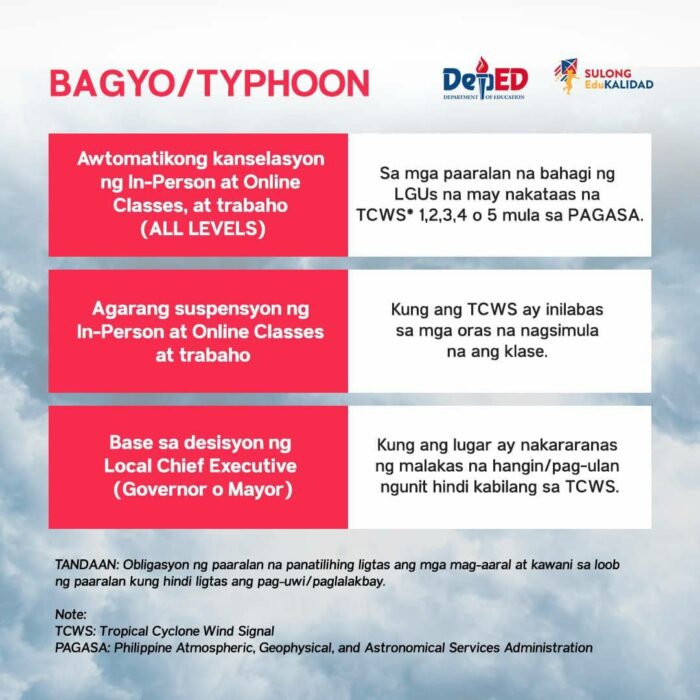
Here are the guidelines with regards to typhoon; In-person, online classes and work from Kindergarten to Grade 12 and Alternative Learning System (ALS) are automatically cancelled in schools situated in Local Government Units (LGUs) issued with Tropical Cyclone Wind Signals (TCWS) 1, 2, 3 ,4 or 5 by the Philippine Atmospheric, Geophysical, and Astronomical Services Administration (PAGASA).
You can get the latest weather updates and reports from PAGASA.
If the TCWS is issued at a time when classes have already begun, the school shall immediately suspend the classes and work and send everyone home, if it is safe to do so.
However, schools are obligated to keep the students and personnel safely in school if travelling has become unsafe.
1. Typhoon
 |
| Automatic Class Cancellation when there's a typhoon |
In-person and online classes at all levels are automatically canceled in schools situated in Local Government Units (LGUs) issued with Tropical Cyclone Wind Signals (TCWS) 1, 2, 3,4, or 5 by the Philippine Atmospheric, Geophysical, and Astronomical Services Administration (PAGASA).
If the TCWS is issued at a time when classes have already begun, the school shall immediately suspend the classes and work and send everyone home if it is safe to do so. However, schools must keep students and personnel safe in school if traveling has become unsafe.
Local Chief Executives shall decide on the cancellation or suspension of classes in cases where there are strong winds in specific or all areas of the LGU but is not due to a typhoon.
2. Heavy Rainfall
 |
| Automatic Class Cancellation during Heavy Rainfall |
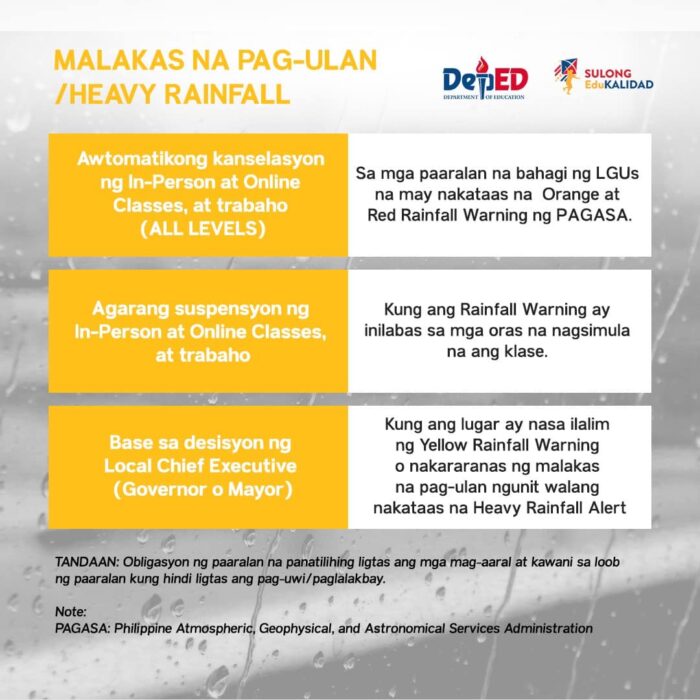
In-person and online classes at all levels are automatically canceled in schools situated in LGUs issued with Yellow, Orange, and Red Rainfall Warnings by the PAGASA.
If the Warning is issued when classes have already begun, the school shall immediately suspend the classes and work and send everyone home if it is safe to do so. However, schools are obligated to keep the students and personnel safely in school if traveling has become unsafe.
Local Chief Executives shall decide on the cancellation or suspension of classes in cases where there are torrential rains in specific or all areas of the LGU but is not issued a Heavy Rainfall Alert by PAGASA.
3. Flood
 |
| Class Cancellation when there’s a Flood |
In-person and online classes in all levels are automatically canceled in schools situated in LGUs issued with a Flood Warning by the PAGASA.
If the Flood Warning is issued at a time when classes have already begun, the school shall immediately suspend the classes and work and send everyone home, if it is safe to do so. However, schools are obligated to keep the students and personnel safely in school if traveling has become unsafe.
Local Chief Executives shall decide on the cancellation or suspension of classes in cases where there is flooding in specific or all areas of the LGU but is not issued a Flood Warning by PAGASA.
ATTRACTIONS TO SEE IN MANILA
Klook.com4. Earthquakes
 |
| Class Suspension / Earthquake |
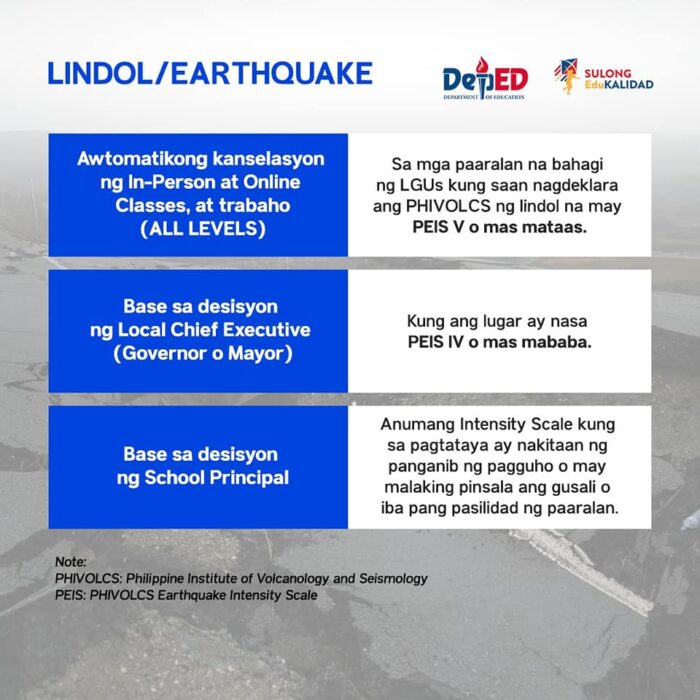
In-person and online classes in all levels are automatically canceled in schools situated in LGUs where the Philippine Institute of Volcanology and Seismology (PHILVOCS) declares an earthquake with PHILVOCS Earthquake Intensity Scale (PEIS) V or above.
Local Chief Executives shall decide on the cancellation or suspension of classes in cases where the PEIS is IV and below.
School Principals can cancel classes at any Intensity Scale if in their assessment, building and other structures are seen to be in danger of collapsing or is found to have major damage.
The School Disaster Risk Reduction and Management (DRRM) Team Head should clear the return of students and personnel in buildings and other structures.
5. Power Outages/ Power Interruptions/ Brownouts
 |
| Class Suspension during Power Outages |
There will be no automatic cancellation or suspension of classes if there are power outages/power interruptions/brownouts in schools. If power outages/power interruptions and brownouts have resulted in a poor learning environment, school officials can cancel or suspend classes at their discretion.
6. Adjustments to Learning Delivery Due to Suspensions/Cancellations of Classes
If canceled or suspended classes occur, distance learning or make-up classes shall be implemented to ensure that learning competencies and objectives are still met.
In adherence to the provision of DepEd Order No. 14, s. 2021, learners who miss learning activities due to class suspensions brought about by various disruptions like disasters and/or emergencies due to natural or human-induced hazards shall be accorded due consideration in the completion of their learning tasks.
7. Maintenance of Workforce and Activation of DRRM Teams
Teaching school personnel, including ALS teachers, and non-teaching school personnel in schools, Division Offices, Regional Offices, and the Central Office, shall not be required to report to work, except those who are mandated to render security, safety, finance, engineering, sanitation, health, and disaster response duties.
Schools, on the other hand, must always be ready to implement remote work with measured output.
Central, Regional, and Schools Division Offices and schools shall activate their DRRM Teams to prepare, monitor, and respond to the situation. DRRM Team members, particularly DRRM Coordinators and Engineers, shall be required to report to work in the aftermath of the disaster to continue undertaking response, early recovery, and reporting based on established DRRM protocols (e.g., an inspection of school facilities to vet damages as reported by School DRRM Coordinators, detailed assessment of damaged facilities for purposes of developing the Program of Works for infrastructure costing in rehabilitation and recovery plans, and participation in coordination meetings with LDRRMCs). Other DRRM Team members may likewise be required to report to work as needed.
Officials of private schools shall exercise discretion relative to the work arrangement of their DRRM personnel.
ACTIVITIES AND TOURS IN MANILA
8. Use of schools as Evacuation Center or COVID-19 Quarantine and/or Isolation Facility/Vaccination Center
Schools shall not be used as quarantine and/ or isolation facilities or vaccination centers. The authority given to Regional Directors in allowing schools to be designated as quarantine and/or isolation facilities/ vaccination centers under Office Memorandum OM-Osec-2020-004 (Guidance to Regional Directors for Action Requests by Local Government Units to Use DepEd Schools and Engage DepEd Personnel in Activities Related to COVID-19), is hereby lifted. Office Memorandum OM-OSEC- 2021-03-003 (Use of DepEd Classrooms and Other Facilities as Vaccination Centers) is likewise hereby repealed.
In other disasters, schools may be used as an immediate evacuation site that should not last more than fifteen days. LGUs should not use schools as long-term shelters for evacuees.
9. Conduct of Psychological First Aid
As the maintenance of a conducive learning environment requires addressing the immediate needs of affected learners and personnel in the aftermath of disasters, all Schools Division Offices, with the support of Regional Offices, shall assess Mental Health and Psychosocial Support needs and services and lead the conduct of Psychological First Aid (PFA). This shall include the mobilization of trained PFA providers and partners and if needed, referral pathways for learners and personnel identified for further specialized psychological support services. Required health standards shall always be applied.
10. Responsibility of Parents or Guardians
The DepEd still maintains that parents or guardians are responsible for determining whether their children should attend classes considering their physical and/or mental health during disasters and calamities. This applies even if no order for cancellation or suspension of classes has been issued.
However, it is also the responsibility of the parents or guardians to ensure that their child can catch up with the needed competencies that the learners should master.
For more information, read DO 37, s. 2022: https://bit.ly/DEPEDOR37
READ NEXT

Subscribe to:
Posts (Atom)


