Welcome to the Walled City in Manila!
In this guide, you will learn about the rich history of the Philippines with a tour of the Walled City of Intramuros in Manila.
It wasn't my first time visiting Intramuros, but I have only came here twice yet. Both of my visits were limited of time and my ability to walk further. So far, I have explored the northern part of the wall where most of the notable structures can be found, the eastern wall on my recent trip and the heart of Intramuros where Casa Manila and San Agustin Church are located at.
Find out which buildings, churches, plazas, and museums offer the best history lessons about the Spanish colonial era in the capital city of the Philippines. Read this travel guide to help you plan your Intramuros tour.
Loading...
ABOUT INTRAMUROS
Located south of the Pasig River and east of Manila Bay, the Walled City of Intramuros in Manila City was built by the Spaniards some 400 years ago as their political and military base in Asia. It is one of the top tourist spots in Manila, the capital of the Philippines.
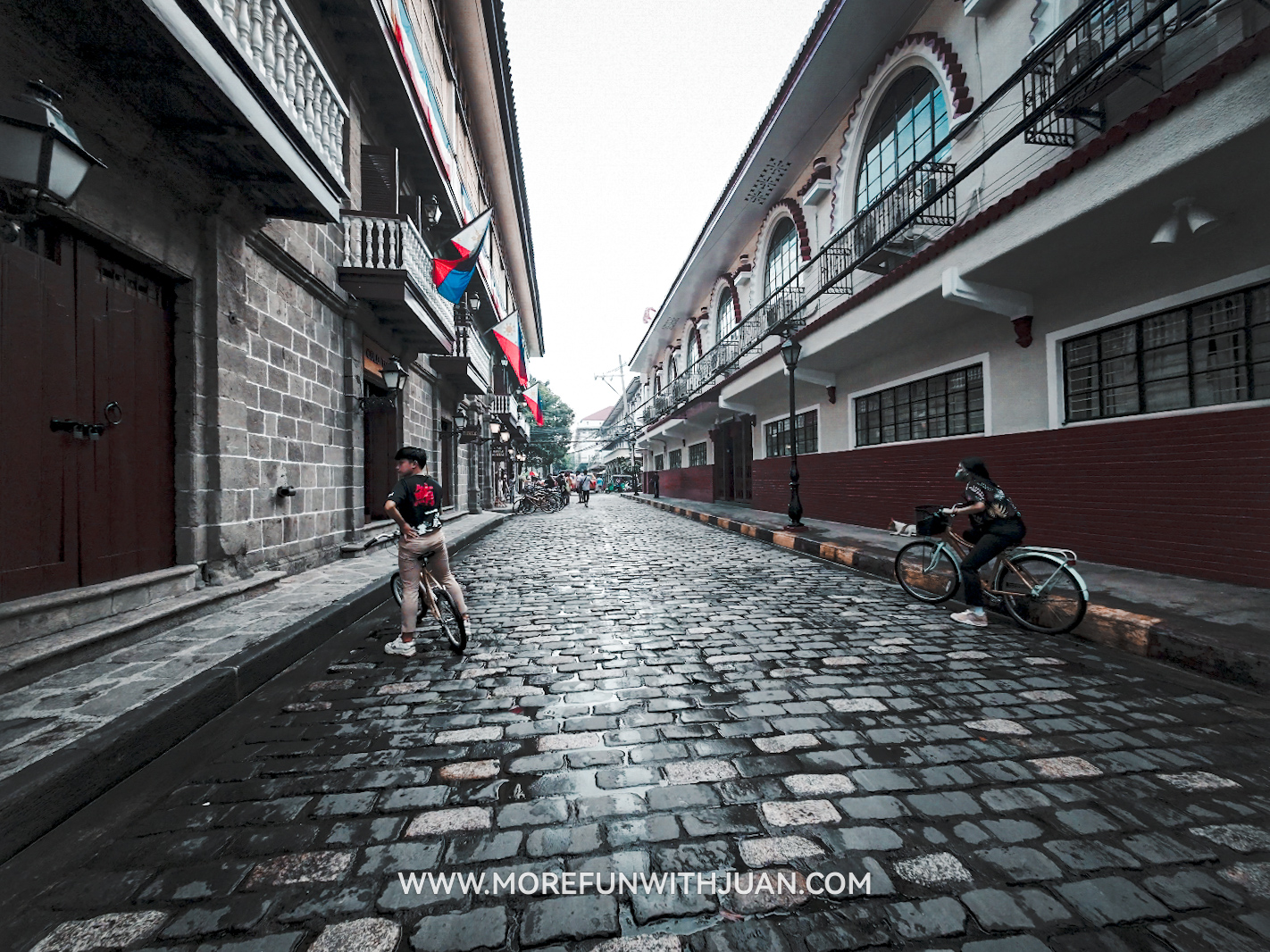 |
| Real St. with cobblestone |
Apart from the 4.5-km. wall, from where the name came from (“within the walls”), other defensive structures used to surround the city, like moats, cannons, bulwarks, and javelins. Not only did it protect Intramuros from man-made disasters, but it also fended off threats from Chinese pirates, Dutch forces, and other invaders.
 |
| Aduana Ruins |
Despite being heavily influenced by Spanish architecture (think grandiose baroque church designs), renovations made also revealed its Chinese influences. Some structures, however, were not restored after the destruction of multiple wars and remained today as ruins.
WHAT TO BRING FOR MANILA
Here are some things you might consider bringing with you for your day tour / adventure:
- Stylish face mask
- Water container/tumbler to rehydrate
- Sunscreen for skin protection
- Travel backpack / luggage
- Reusable vacuum storage packs
- Selfie stick
- Acion cam
- WiFi kit
- Power bank
Shopee is my go-to app for things I needed like the ones above. If you'd like discounts and vouchers, you may get the best offers here:

Not that it became an eyesore, though. In fact, the history behind the ruins is what made Intramuros a must-see destination in Manila today, despite the modernization it has since undergone.
In addition, the rampart, fortresses, and gates from yesteryears remain accessible and are a mainstay of today’s walking tours and cultural performances for visitors who want to understand the country’s past.
Best Time to Go to Intramuros
While there are destinations in Intramuros that are under a roof, walking or biking around the walled city is still the best way to explore and learn more about its rich history. Here are the best months to take a tour of Intramuros.
Dry Season | December – May
The dry season in the Philippines can mean either cool dry or hot dry, both of which fall between December to May. Both dry seasons are also ideal times to walk around Intramuros because there’s little to no rain. Though, be cautious of doing it between March to May, or the hot dry season, because it does get crazy hot in the city.
Holidays | September – December
With the majority of the population being of the Catholic faith, the celebration-loving Filipinos go all out for Christmas; so much so, that decorations and Christmas songs abound as early as September. The months leading up to the holidays starting in September are dubbed as the -ber months.
What to wear for Intramuros Tour
If you’re planning to visit during the cool dry months or holidays, opt for comfortable sneakers or sandals for footwear. Carrying an umbrella wouldn’t hurt, especially if light showers are expected. Bring a jacket or raincoat to protect yourself from the rain or low temperatures at night, too.
 |
| Me walking along Muralla St. |
For visitors during hot dry months, make sure to wear light clothing, especially if you’re planning to do a walking tour. Expect to sweat it out, so bring towels, handkerchief, umbrella, and a change of clothes. Of course, stay hydrated and always bring a bottle of water to drink.
How to get to Intramuros
Since Intramuros is in the heart of the bustling city of Manila, land transportation is the most convenient means of getting there. But if you’ll be coming from locations outside Metro Manila or another country, don’t fret, it is still very accessible thanks to its proximity to airports and terminals.
 |
| NAIA Terminal 3 |
There are two international and domestic airports near Intramuros: Ninoy Aquino International Airport (NAIA) in Parañaque (for Terminal 1) and Pasay (for Terminals 2, 3, and 4) and Clark International Airport in Pampanga.
For visitors coming from other domestic and international locations, opt for flights that will land on either NAIA or Clark for faster access to the city of Manila.

By Private Car
Getting a car rental in Manila and driving yourself is possible. Book a car in advance, or you can avail of one if you arrive through NAIA Terminals 1, 2, or 3. Just be mindful that traffic in Manila is no cakewalk—you’ll need patience and skills.
By Taxi
The easiest and most convenient way to go to Intramuros is by hailing a taxi cab. Taxi cabs in Manila have a flag down rate in addition to the distance rate. The prices may be relatively cheap, but considering the heavy congestion of traffic in Metro Manila, you’ll likely incur quite a hefty fare.
There are three kinds of taxis you will find in NAIA: regular (white, metered cabs with fixed flag down and per kilometer rates), coupon (blue-marked white taxis dispatched by airport personnel with a fixed price), and yellow airport (metered taxi with fixed flag down and per kilometer fees that are twice the price of the regular).
Be very careful and ask questions first before getting into any of the cabs in the airport.
By Train
The three main train lines running in Metro Manila can take you near Intramuros: Light Rail Transit (LRT) 1 and 2, and the Manila Metro Rail Transit. MRT and LRT1 connect at Baclaran and North Avenue Stations, MRT and LRT2 meet at Araneta-Cubao, and LRT1 and 2 are joined at Doroteo Jose.
 |
| LRT1 Central Terminal Station |
The station closest to Intramuros is the LRT1 Central Terminal Station. LRT1 runs from Baclaran to Monumento. Although it is the nearest, you still need to do a big deal of walking to get to the eastern side of Intramuros, that’s why some opt to hail a cab from here.
If you do decide to walk, head to the Manila City Hall first, then take the pedestrian underpass that will help you get across to Padre de Burgos Street. Upon exiting, you'll see Victoria Street, which will lead you right into Intramuros. From here, you’ll have to walk to reach the western side where many of the sights are located.
By Ferry
If you are from Pasig or Makati, you can take a ride on Pasig River Ferry to bring you to Escolta (ferry station) which is a bridge away from Intramuros. The good news is it is for FREE!
By Bus
Buses are the best way to get to Intramuros, Manila if you’re coming from farther places, although there are also bus lines that loop just around Metro Manila. Keep in mind that there is no public transportation that stops directly in front of the gates itself, so you still need to do some walking from the closest unloading areas.
Getting around Intramuros
Despite its relatively small land area (approximately 67 hectares), it can still get tiring to explore the entirety of Intramuros in one day on foot.
While you can definitely walk to sights that are at least 10 to 15 minutes away from each other, such is still quite a feat if you’re planning to explore different locations in a day, especially under the sweltering heat.
 |
| Intramuros Map Guide |
Pedicabs
Pedicabs are almost similar to tricycles, but think bicycle instead of a motorcycle. They are comparable to rickshaws, with a side compartment attached on one side of the bike. And, like tricycles, pedicabs are often used to pass through inner, narrower roads.
In Intramuros, pedicab terminals are everywhere. If there’s a line, line up and wait for your turn to be serviced. You can also hail and ride if you happen to spot one while strolling, as long as there’s no passenger in it, of course.
Kalesa
Horse-drawn carriages or kalesa/karwahe were prominent in the 18th century. Understandably, today, it isn’t the most efficient land transportation anymore; and so, these remnants of the past are now mainly used for tourism purposes only.
 |
| Kalesa spotted along Muralla St. |
Riding a kalesa is perfect for a leisurely, old-fashioned trip around Intramuros. Similar to pedicab drivers, the kalesa’s coachman can also guide you to the sights you want to visit when you book a kalesa tour in Intramuros. Kalesas can accommodate 1–3 passengers.
E-trike
If the kalesa ride lets you experience the golden years of the humble carriage, then a ride in the modern e-trike should snap you right back into the present time. The three-wheeled electric vehicles (EV) were launched in 2016 and stop at 13 spots with the trip spanning around in 25 minutes.
The stops are as follows: Round Table, Pamantasan ng Lungsod ng Maynila, San Diego Gardens, the office of the Department of Labor and Employment, San Agustin Church, Manila Cathedral, Plaza Roma, Lyceum of the Philippines University, Mapua University, Manila High School, Colegio de San Juan de Letran, National Press Club, and the office of Bureau of Immigration.
Bambike
While it does sound like fun to roam around Intramuros on a bike—one made of bamboo, to boot—the only way to do so is to join an Intramuros tour. Bambike Ecotours offers this one-of-a-kind bamboo bike tour in Intramuros that is both exciting and educational.
 |
| Bambike (bike rental) |
Bambike is a socio-ecological enterprise, with the bicycles being made by the “Bambuilders” of Gawad Kalinga, a community development organization for the poor.
On foot
Lastly, if you’re up for the challenge, grab an Intramuros map and do a walking tour from one attraction to another. Aside from the unpredictable weather, you also need to mind the cars passing by, as some streets almost have no pavements for pedestrians to walk on. This means that you have to share the road with automobiles.
What to See and Do in Intramuros
The walled city isn’t that big, and compared to other tourist destinations in Metro Manila, there are limited activities and sights that you can go to within the walls.
However, the great thing about exploring Intramuros is that every site that you go to is rich in significant history, and they’re just a walk away from each other, to boot.
Appreciate the stone walls, gates, and forts
he outline of the defensive wall of Intramuros is irregular in shape, following the contours of Manila Bay and the curvature of the Pasig River. The Muralla walls covered an area of 64 hectares (160 acres) of land, surrounded by 8 feet (2.4 m) thick stones and high walls that rise to 22 feet (6.7 m).
 |
| Walls along Muralla St. |
The walls stretched to an estimated 3-5 kilometers in length. An inner moat (foso) surrounds the perimeter of the wall and an outer moat (contrafoso) surrounds the walls that face the city.
The most popular of the forts would have to be Fort Santiago in the northwestern end. It’s the former seat of power of the Spanish military, where many prisoners were taken into its jails and dungeons.
Baluarte
Several bulwarks (baluarte), ravelins (ravellin) and redoubts (reductos) are strategically located along the massive walls of Intramuros following the design of medieval fortifications.
 |
| Baluarte de San Diego |
The seven bastions (clockwise, from Fort Santiago) are the following:
- Baluarte de Tenerias,
- Baluarte de Aduana
- Baluarte de San Gabriel
- Baluarte de San Lorenzo
- Baluarte de San Andres
- Baluarte de San Diego
- Baluarte de Plano
The bastions were constructed at different periods of time, the reason for the differences in style. The oldest bastion is the Bastion de San Diego, which was built in 1587.
Forts
The fortifications of Intramuros comprises several parts, the front facing the sea and the river, which were less elaborate and complex, and the three-sided land front with its corresponding bastions. Fort Santiago was built at the northwest tip where the sea and river converge, and this functioned as a citadel. Fort Santiago has significantly served as military headquarters of Spanish, British, United States and Japan during different eras throughout the Philippine history.
 |
| Fort Santiago |
In Fort Santiago, there are bastions on each corner of the triangular fort. The Baluarte de Santa Bárbara faces the bay and Pasig River; Baluarte de San Miguel, faces the bay; and the Medio Baluarte de San Francisco, which faces the Pasig River.
Gates
Before the American Era, entrance to the city was through eight gates or Puertas namely (clockwise, from Fort Santiago):
- Puerta Almacenes
- Puerta de la Aduana
- Puerta de Santo Domingo
- Puerta Isabel II
- Puerta del Parian
- Puerta Real
- Puerta Sta. Lucia
- Puerta del Postigo
Three of the gates were destroyed. Two of them, the Almacenes Gate and the Santo Domingo/Customs Gate, were destroyed by the American engineers when they open up the northern part of the walls to the wharves. The Banderas Gate was destroyed during an earthquake and was never rebuilt.
 |
| Puerta de Isabel II |
Formerly, drawbridges were raised and the city was closed and under sentinels from 11:00 pm till 4:00 am. It continued so until 1852, when, in consequence of the earthquake of that year, it was decreed that the gates should thenceforth remain open night and day.
Go to open parks, squares and other notable structures
It’s no surprise that there are many public squares inside Intramuros where people can spend their leisure time. From then until now, Plaza de Roma is considered the most popular of these town squares.
Plaza Roma is bound by other notable destinations such as the Manila Cathedral, Palacio del Gobernador, and Ayuntamiento. It’s considered as the city’s plaza mayor or main square, where many public events like bullfights were held. It was turned into a garden in 1797, with a monument of King Carlos IV of Spain at the center. The king was regarded for having dispatched a shipment of smallpox vaccine to the Philippines.
Other squares and buildings that you can visit include the Palacio del Gobernador, Plaza Moriones, Plaza México, Plaza Sto. Tomas, and Plazuela de Sta. Isabel, where a memorial monument for the civilian victims of World War II is located.
ATTRACTIONS TO SEE IN MANILA
Klook.comLearn more Intramuros history at these museums
When in Intramuros, it is a must to learn as much as you can not only about the rich history of the walled city but also of Manila as a whole—and there’s are no better locations to educate yourself than in these Intramuros museums.
Casa Manila
The place can be best described as a recreation of the home of a typical upper-class family in the 18th century, or the Ilustrados. These are the highly-educated and wealthy class who wielded great influence both in the government and the masses. The casas are filled with furniture, artwork, and other artifacts from the colonial era.
Bahay Tsinoy
Here, you get to learn the history and contributions of the Chinese-Filipino community, including those who aided the Filipinos revolution against the Spaniards. It houses other galleries, too, like the Bahay na Bato (Chinese settlement in Manila), Ching Ban Lee Ceramics Gallery, Martyrs Hall, and Batang Tiaong.
San Agustín Museum
Houses a collection of Spanish colonial-era ecclesiastical garments, sacred vessels, manuscripts, wooden and ivory statues, Dominican paintings and sculptures, and many other religious relics.
Light and Sound Museum
In this interactive museum, visitors can experience Philippine history under the Spanish rule and the life of Rizal through images, sounds, and animatronics.
Visit the old and historical churches
As the Spaniards were responsible for the burgeoning of Christianity in the Philippines, it also made sense for Intramuros to house a few churches where the colonizers living inside can continue practicing their faith. The two most notable are Manila Cathedral and San Agustin Church.
Manila Cathedral
The Minor Basilica of the Immaculate Conception or Manila Cathedral is the seat of the Roman Catholic Archdiocese of Manila, making it one of the most important churches in the country.
Since its inception in 1581, the church has been renovated and restored multiple times (most remarkably after the 1945 Battle of Manila), with the current style being Neo-Romanesque. It was consecrated in 1958.
San Agustin Church
Consecrated in 1607, it reportedly survived WWII and is said to be the oldest stone church in the Philippines. Miguel López de Legazpi, the first Spanish Governor-General of the Philippines, is buried near the high altar of the church.
San Agustin Church is the epitome of Spanish Baroque style with its Trompe-l'œil ceilings and high altar. Its rich history made it a UNESCO World Heritage Site in 1993 under the group Baroque Churches of the Philippines.
Intramuros Walking Tour Map
Here's a map guide for Intramuros:
You can also download a copy of any of the following maps for your Intramuros tour:
Or you can conveniently hire and book an Intramuros Tour Guide.
ACTIVITIES AND TOURS IN MANILA
Sample Itinerary in Intramuros
Since the walled city isn’t that vast, to begin with, a day or two is more than enough to see its notable locations. However, if you want to also get an overview of its neighboring districts and other parts of Manila, you would want to stay for one more day.
Make sure, though, to allot at least an hour for traveling to your next destination, especially if you have to take public transportations—and don’t forget your Intramuros map!
Day 1: Intramuros Church and History
08:00 AM - Fort Santiago and Rizal Shrine
10:00 AM - Plaza Roma: Manila Cathedral, Ayuntamiento, and Palacio del Gobernador
12:00 NN - Lunch at Coco Bango Café
01:00 PM - Casa Manila
02:00 PM - Bahay Tsinoy
04:00 PM - San Agustin Church and Museum
07:00 PM - Dinner at Barbara’s
Day 2: A Tour of the Wall and Dinner at Bayleaf Intramuros
08:00 AM - Plazuela de Santa Isabel
08:30 AM - Puerta de San Lucia
09:00 AM - Light and Sound Museum
11:00 AM - Baluartillo de San Jose
12:00 NN - Lunch at Ilustrado
01:00 PM - Baluartillo de San Diego and Puerta Real
02:30 PM - Baluarte de San Andres
03:30 PM - Puerta del Parian
04:00 PM - Puerta de San Isabela II
05:00 PM - Bamboo Bike tour with sunset viewing at Sky Deck
Where to Stay in Intramuros
Here's a list of hotels and accommodation inside and nearby Intramuros:
- Octagon Mansion Hotel - Check Rates and Availability!
- Bayview Park Hotel - Check Rates and Availability!
- Go Hotels Ermita - Check Rates and Availability!
- City Garden Suites Hotel - Check Rates and Availability!
- Pearl Manila Hotel - Check Rates and Availability!
- Sunny Bay Suites - Check Rates and Availability!
Up to now, renovations and improvements are still being made to maintain and reinforce the aesthetics and timelessness of Intramuros. It’s always a good idea to come back and experience what’s new if it’s something you look forward to.
Intramuros is a constant reminder for Filipinos that there is beauty amidst the chaos—perhaps not in terms of looks, but being able to withstand the harsh conditions of history and time, and to grow from it, are still worth celebrating.
MANILA TOUR
Some other attractions to see and things to do near Intramuros:
- Visit Arroceros Forest Park
- Food crawl in Binondo
- Visit the Dolomite Beach in Manila Bay
- Have fun at Star City
- Have a relaxing staycation at SMDC Breeze Residences
- Go shopping in Divisoria
INTRAMUROS SCHEDULE
 |
| Fort Santiago |
The following Intramuros sites are open to all visitors:
FORT SANTIAGO
- Regular operating hours: 9am - 830pm, weekdays | last entry: 7pm
- Weekends: 6am - 930 pm | last entry: 8pm
- Entrance fee: PHP 75 - adults | PHP 50 - seniors, students, children, and PWD
- Payment options: Cash, PayMaya
- Maximum Capacity: 150 pax at a time
CASA MANILA MUSEUM
- Saturday-Sunday, 9am - 5pm (closed on weekdays)
- Entrance fee: PHP 75 - adults | PHP 50 - seniors, students, children, and PWD
- Maximum Capacity: 15 pax at a time / 5 pax per group
BALUARTE DE SAN DIEGO
- Regular operating hours: 8am - 5pm, weekdays | last entry: 4pm
- Entrance fee: PHP 75 - adults | PHP 50 - seniors, students, children, and PWD
- Payment options: Cash, PayMaya
- Maximum Capacity: 80 pax at a time
ALSO IN MANILA
- MANILA TRAVEL GUIDE: Tourist Spots, Things To Do, Where To Eat and Where to Stay
- REDISCOVER MANILA: 20+ Tourist Spots To Visit At Night (Things To Do & New Places To Go)
- BINONDO FOOD CRAWL: DIY Food Trip Guide to Manila Chinatown, the oldest in the world (Map & Budget)
- RIZAL PARK: Guide to Luneta, the Largest Urban Park in Manila, Philippines (Attractions to See & Things to Do)
- MANILA OCEAN PARK: Attractions Map Guide, Activities & How to get Discounted Pass Online Tickets
- DOLOMITE BEACH: Everything you need to know about this new attraction at Manila Baywalk (Operating Hours, Directions & FAQs)
- INTRAMUROS GUIDE: Historic Walled City in Manila (What to See & to Do)
- ARROCEROS FOREST PARK: Guide to the Last Lung of Manila (Description, History and Schedule)
- The historical Jones Bridge in Manila got a new look
- LRT-1 Guide (Stations, Schedule, Fare Matrix)
- WHERE TO EAT SAMGYUPSAL: 10 Korean BBQ Restaurants in Metro Manila (YOU MUST TRY)
- INSTAGRAMMABLE CAFES: 10 Unique Places to Have Coffee in Manila
- Manila City Zip Codes & Phone Area Codes (Complete List)
- List of Palawan Pawnshop Branches (Pera Padala) in Manila
- List of Mercury Drug Branches in Manila City (with Store Hours & Contact Details)
- List of Watsons Branches in Manila City (with Store Hours & Contact Details)
 IMPORTANT NOTE: The rates, contact details and other information indicated in this post are accurate from the time of writing but may change without IMFWJ's notice. Should you know the updated information, please let us know by leaving a message in the comment box below.
WHERE TO STAY IN MANILA
intramuros history intramuros entrance fee intramuros map intramuros schedule how to go to intramuros who built intramuros intramuros architecture intramuros administration intramuros tour 2022 intramuros tour package intramuros tour map diy intramuros tour intramuros tour itinerary intramuros tourist spot at night intramuros tour guide script intramuros tour guide celdran Intramuros Sechedule