Showing posts sorted by relevance for query investment. Sort by date Show all posts

The Caribbean has long been a popular destination, reeling in visitors with its white sandy beaches, laid-back island charm and vibrant local scene. However, today, people’s interest in this region has gone beyond seeking a temporary stop on a travel itinerary and more towards setting down permanent roots. 


This is primarily due to the Caribbean citizenship by investment programs most of these small island nations offer. It’s a mutually beneficial situation where, as a foreigner, you can contribute to the economy of one of these countries (in a few different ways) and, in exchange, be granted citizenship and all the perks that come with it.

Loading...

3 Popular Caribbean Citizenships by Investment Programs 

If you’re considering obtaining a second citizenship in the Caribbean, you must meet two main eligibility requirements. The first is making a qualifying investment, which can be done through several routes like donations to a government fund, real estate purchases, business ventures, university endowments or investments in government bonds. The second involves complying with a few general conditions.

These criteria differ for each country, so let’s take a look at three of the most straightforward citizenship by investment programs in the Caribbean and their requirements. 


1. Saint Kitts and Nevis

St. Kitts and Nevis was the first Caribbean country to introduce a citizenship by investment program in 1984. Over the decades, the St. Kitts and Nevis program has become a model of continuous development and improvement.


The general requirements for St. Kitts and Nevis citizenship:
  • Be at least 18 years old
  • Complete a criminal background check
  • Demonstrate good character through bank statements and employer references

The investment requirements for St. Kitts and Nevis’ citizenship (choose one of the following options):
  • Contribute a minimum of $250,000 to support the Sustainable Island State program in St. Kitts and Nevis
  • Purchase real estate in joint ownership with a minimum value of $400,000 or invest at least $800,000 as an individual applicant
  • Make a non-refundable donation of at least $250,000 to a Public Good Project


2. Antigua and Barbuda

Antigua and Barbuda’s Citizenship by Investment program is considered one of the fastest in the Caribbean, with a simple application process of about four to six months.


The general requirements for Antigua and Barbuda citizenship:
  • Be at least 18 years of age
  • Have a good character
  • Have a clean criminal record
  • Be in good health
  • Stay in Antigua and Barbuda for at least five days within five years of registering as a citizen
  • Be ready to take the oath of allegiance in Antigua and Barbuda or at an Embassy, High Commission or Consulate of Antigua and Barbuda

The investment requirements for Antigua and Barbuda’s citizenship (select one of the below options):
  • Contribute at least $100,000 to the National Development Fund
  • Acquire government-approved real estate (or shares) valued at a minimum of $200,000
  • Donate $150,000 or higher to the University of the West Indies Fund
  • Invest $400,000 in a joint enterprise valued at $5 million or pursuing a solo business venture with an investment of $1.5 million


3. Saint Lucia

In 2015, St. Lucia decided to follow in the footsteps of its sister islands and launched its Citizenship by Investment Program. Since then, this paradisiacal nation has gone from being the world’s top honeymoon destination to a citizenship by investment haven.


The general requirements for Saint Lucia’s citizenship:
  • Must be 18 years or older
  • Demonstrate exemplary character
  • Possess excellent health
  • Have a clean criminal record
  • Successfully pass a comprehensive background check
  • Pay the non-refundable processing fee, due diligence fee and any other administrative fees upon applying

The investment requirements for Saint Lucia’s citizenship (pick only one of the following options):
  • Contribute a minimum of $100,000 to the St. Lucia National Economic Fund
  • Invest at least $200,000 in a pre-approved, high-end real estate project, such as luxurious hotels and resorts or boutique properties (and hold it for five years)
  • Make an enterprise investment of at least $3,500,000 into approved commercial or industrial ventures. In the case of a joint venture valued at $6,000,000, each contributor must make a minimum investment of $1,000,000.
  • Purchase $300,000 in National Action Government Bonds (NAB), which is fully recovered after five years.


Benefits of Obtaining a Second Citizenship in the Caribbean

Citizenship by investment programs in the Caribbean presents foreign nationals and their families with many benefits, including:


1. Global Mobility

Most Caribbean nations offer visa-free or visa-on-arrival access to over 140 countries, including the Schengen area and the UK.


2. Tax Exemptions

Taxation rules vary from one Caribbean country to another, but residents are generally not required to pay taxes on foreign capital, income and dividends.


3. Plan B

In case of political turmoil or natural disasters in your home country, having a second citizenship can provide you and your family with a safe sanctuary.


4. Better Quality of Life

In the Caribbean, you can have access to excellent healthcare facilities, a higher standard of living and a quality education system for your children.


5. Improved Business Opportunities

If you currently have a business or are in the process of starting one, the Caribbean offers a climate that nurtures foreign investment and entrepreneurship through lenient tax laws and business-friendly policies.


Apply for a Caribbean Citizenship by Investment 

Whether you’re looking to retire by the beach, own a second home in an idyllic destination or diversify your investment portfolio, Caribbean citizenship by investment is the shortest route to achieving those goals. 

Be sure to rely on a reputable, experienced citizenship by investment consulting firm to guide you through the application process and enhance your chances of securing that second passport.

Caribbean Calling: 3 Citizenship by Investment Programs and Their Benefits


When starting an investment journey, the terms "mutual funds" and "exchange-traded funds (ETFs)" are often encountered. Both are popular investment vehicles that allow you to diversify your portfolio by pooling money with other investors.


This pooled money is then professionally managed to buy a basket of stocks, bonds, or other securities. While they share this fundamental concept, they have key differences in how they are managed, traded, and priced.

This article will break down what mutual funds and ETFs are, their pros and cons, and which might be the better choice depending on your investment style and goals.

Loading...

What is a Mutual Fund?

A mutual fund is a type of investment where a fund manager actively or passively manages a portfolio of assets on behalf of many investors. When you buy into a mutual fund, you are buying a share of the entire portfolio. The price of a mutual fund share is calculated once at the end of each trading day, based on its Net Asset Value (NAV).


Pros


  • Professional Management: You benefit from the expertise of a professional fund manager who makes all the buying and selling decisions, saving you time and effort.

  • Instant Diversification: With a single investment, you gain exposure to a wide range of securities, which helps to mitigate risk.

  • Variety of Funds: There is a vast array of mutual funds available, each with a different investment objective (e.g., growth, income, specific sectors), allowing you to find a fund that aligns with your goals.

  • Convenience: You can often invest in mutual funds with a relatively low minimum investment, and transactions are handled directly with the fund company.


Cons


  • Daily Pricing: You can only buy or sell shares once a day after the market closes, which means you cannot react to intraday market movements.

  • Higher Fees: Actively managed mutual funds often have higher expense ratios (fees) to cover the costs of the fund manager's research and trading activities.

  • Tax Inefficiency: Because fund managers actively buy and sell securities within the fund, it can trigger capital gains distributions to investors, even if the investor hasn't sold any of their shares.


What is an Exchange-Traded Fund (ETF)?

An ETF is a type of fund that trades on a stock exchange just like an individual stock. Most ETFs are passively managed and designed to track a specific market index, such as the S&P 500 or a local index like the Philippine Stock Exchange Index (PSEi). When you buy an ETF, you are buying a share that represents a stake in the basket of assets held by the fund.


Pros


  • Real-Time Trading: Unlike mutual funds, ETFs can be bought and sold throughout the trading day at market prices, giving you greater flexibility to react to market changes.

  • Lower Costs: Because most ETFs are passively managed and simply track an index, they generally have significantly lower expense ratios compared to actively managed mutual funds.

  • Tax Efficiency: The passive nature of most ETFs results in fewer capital gains distributions, making them more tax-efficient for investors.

  • Transparency: You can see the price of an ETF in real-time, giving you a clear view of its market value throughout the day.

  • Low Entry Barrier: You can start investing in an ETF with as little as the cost of a single share plus brokerage fees.


Cons


  • Brokerage Fees: Since ETFs trade like stocks, you may incur brokerage commissions each time you buy or sell shares. These fees can add up if you trade frequently.

  • Potential for Price Discrepancies: The price of an ETF can sometimes trade at a slight premium or discount to its actual NAV due to market demand and supply.

  • Less Control: While there are actively managed ETFs, most are passively managed, meaning you have no say in the asset allocation.


Mutual Funds vs. ETFs: Which is Right for You?

The choice between mutual funds and ETFs largely depends on your investment style, goals, and how actively you want to manage your portfolio.

Choose a Mutual Fund if... you prefer a hands-off approach and are comfortable with a professional making the decisions for you. Mutual funds are a good fit for investors who want to invest for the long term and don't need the flexibility of intraday trading.

Choose an ETF if... you are a more active investor who wants the flexibility to trade throughout the day. ETFs are also an excellent choice for cost-conscious investors who prefer the tax efficiency and transparency of a passively managed index fund.


Ultimately, both mutual funds and ETFs are powerful tools for diversification and long-term wealth building. It is crucial to conduct thorough research, understand the fees, and choose an investment that aligns with your financial objectives before making a decision.


Understanding Mutual Funds and Exchange-Traded Funds (ETFs): A Guide for Filipino Investors


The Pag-IBIG MP2 Savings Program has gained a strong following for being a safe, tax-free, and government-backed investment. With historical dividends averaging 6–8% in recent years, it’s no wonder many Filipinos treat it as a cornerstone of their savings plan. The low entry requirement of just ₱500 and the ability to contribute anytime also make it very accessible.


However, it comes with limitations. The five-year lock-in period means you can’t freely withdraw your funds without sacrificing some or all of your earnings. Dividend rates are not guaranteed and can drop during weaker economic years.

Inflation can eat into your real returns, and pre-termination withdrawals may take weeks to process. For those who want better liquidity, more predictable returns, or higher growth potential, here are five alternatives worth exploring.


Loading...

1. Retail Treasury Bonds (RTBs)

Retail Treasury Bonds are peso-denominated debt securities issued by the Philippine government to fund its projects. They offer fixed interest payments, making them predictable and easy to understand. Because they’re backed by the government, the risk of losing your principal is extremely low, which makes RTBs a favorite among conservative investors who want security and a stable income stream.

RTBs typically have maturities of 3 to 10 years, but you can sell them in the secondary market before they mature. While this offers some liquidity, the price you sell at can be higher or lower than your purchase price depending on interest rate movements. Also, interest income is subject to a 20% withholding tax, so your net earnings will be lower compared to MP2’s tax-free dividends.


2. High-Interest Digital Bank Savings Accounts

Digital Banks such as SeaBankMaya Savings, and CIMB GSave have been attracting savers with interest rates of 4–6% per year—much higher than the 0.25% or less offered by traditional banks. These accounts are easy to open using just your smartphone, and you can deposit or withdraw anytime without penalties. The convenience and instant access to funds make them ideal for emergency savings or short-term goals.

However, interest rates in digital banks can change at any time, depending on the bank’s business strategy and prevailing market conditions. Unlike MP2, the interest is taxable, which slightly reduces your take-home earnings. While they may not offer long-term investment-level growth, they’re a solid option for safe, liquid storage of your cash.


3. Equity Index Funds (Mutual Funds or ETFs)

Equity index funds track a market index such as the PSEi (Philippine Stock Exchange Index), giving you instant diversification across the country’s top companies. They’re ideal for long-term investors because, historically, stock markets tend to deliver higher returns than fixed-income investments over time. You can invest in them through mutual funds or exchange-traded funds (ETFs) with relatively low starting amounts.

The trade-off is volatility. The value of your investment can rise or fall sharply in the short term, depending on market conditions. This makes them unsuitable for short-term needs, but if you can leave your money invested for 5–10 years, you stand a good chance of beating inflation and growing your wealth significantly more than you could with MP2 alone.


4. Corporate Bonds

Corporate bonds are loans you provide to companies in exchange for fixed interest payments over a set period. They often offer higher yields than government bonds, especially if issued by companies with slightly higher credit risk. For investors seeking steady cash flow with better returns than savings accounts, corporate bonds can be a strong choice.

However, they carry more risk than RTBs since companies can default on their debt—especially those without high credit ratings. It’s important to assess the issuer’s financial health before investing. If you stick to bonds from well-established, profitable companies, you can balance safety and returns more effectively than with purely government-backed options.


5. Real Estate Investment Trusts (REITs)

REITs are companies that own and manage income-generating properties such as malls, offices, and warehouses. They pay out most of their rental income as dividends, providing investors with regular cash flow. Because they’re traded on the stock exchange, they’re much easier to buy and sell than physical real estate. This allows you to gain exposure to property investments without needing millions in capital.

That said, REIT prices can be volatile, influenced by interest rates, property market trends, and overall economic performance. Dividends may also fluctuate depending on rental income. Still, for investors who want the potential for both dividend income and capital appreciation, REITs offer a unique blend of real estate and stock market advantages.


My Personal Picks

While all these alternatives have their merits, my personal favorites are High-Interest Digital Bank Savings Accounts and Real Estate Investment Trusts. I like digital banks because they give me the flexibility to move my money anytime without waiting years for maturity, while still earning better-than-average interest.

On the other hand, REITs give me a chance to tap into the real estate market without the hassle of buying, maintaining, or renting out a property. The regular dividend payouts are a plus, and the possibility of capital appreciation makes them an exciting medium- to long-term investment. Together, these two options give me both liquidity and growth potential.


Final Thoughts

Pag-IBIG MP2 is still an excellent choice for those seeking safe, government-backed savings with tax-free returns. But it doesn’t have to be your only investment. By exploring options like RTBs, digital bank accounts, equity index funds, corporate bonds, and REITs, you can build a portfolio that balances safety, income, and growth potential.

The key is diversification—spreading your money across different asset types helps you protect your capital, fight inflation, and access funds when you need them. While no investment is perfect, combining the stability of MP2 with the opportunities from other instruments can put you on a faster and more secure path to financial freedom.


Read Next . . .


Here's Why I Do Not Invest in PAGIBIG's MP2 Savings (5 Investments to Try in the Philippines)


For Filipino investors seeking passive income and a way to diversify their portfolios, Real Estate Investment Trusts (REITs) have become a highly attractive option. REITs allow you to invest in a portfolio of income-generating real estate assets—such as office buildings, malls, and industrial properties—without the need to directly purchase or manage the properties yourself.


Under Philippine law, REITs are mandated to distribute at least 90% of their distributable income as dividends to shareholders on a quarterly basis. This makes them an excellent vehicle for those looking for a regular income stream. As the Philippine economy continues to recover, the REIT sector has shown strong performance, with many companies demonstrating robust growth and promising outlooks for the year. Here is a guide to some of the top-performing and most promising Philippine REITs to consider investing in this 2025.


Note: The stock prices and dividend information provided are based on data available from July to August 2025. This information is subject to change based on market movements and company announcements. Dividends, in particular, can vary and are not guaranteed. It is highly recommended to perform your own research and consult with a financial advisor before making any investment decisions.


1. AREIT, Inc. (AREIT)

As the country's first-ever REIT, AREIT has a solid reputation backed by its sponsor, Ayala Land, Inc. Its portfolio is a mix of high-quality office, retail, and industrial properties, primarily located in prime business districts. AREIT has shown consistent growth through strategic acquisitions, which has helped to increase its rental portfolio and dividend payouts. Its stability and strong sponsor make it a top choice for conservative investors.

Current Stock Price: As of August 12, 2025, the stock price for AREIT is not publicly available.

Average Dividends and Frequency: AREIT consistently pays dividends on a quarterly basis. Recent payouts have been approximately ₱0.58 per share per quarter.


2. RL Commercial REIT, Inc. (RCR)

Backed by Robinsons Land Corporation, RCR has been one of the top performers in the REIT sector this year. RCR has a geographically diversified portfolio of office and commercial properties. Its strong performance is driven by the improving office market and strategic asset infusions, which are expected to further boost its dividend growth. RCR's push to include malls in its portfolio also makes it less vulnerable to potential oversupply in the office market.

Current Stock Price: The stock price for RCR is not publicly available as of August 12, 2025.

Average Dividends and Frequency: RCR typically pays dividends on a quarterly schedule. Recent payouts have been around ₱0.10 per share per quarter.


3. Citicore Energy REIT Corp. (CREIT)

CREIT stands out as the country's first and only renewable energy REIT. Its assets are primarily in solar and wind power, offering investors a way to participate in the growing green energy sector. This unique asset class provides a stable income stream from long-term power supply agreements, and the company's commitment to sustainability aligns with global investment trends. CREIT is a great option for investors who want to diversify beyond traditional real estate.

Current Stock Price: The last traded price for CREIT was ₱3.64 on August 7, 2025.

Average Dividends and Frequency: CREIT distributes dividends on a quarterly basis. A recent payout was ₱0.049 per share.


4. MREIT, Inc. (MREIT)

Sponsored by Megaworld Corporation, MREIT holds a portfolio of prime office buildings, many of which are accredited by the Philippine Economic Zone Authority (PEZA). The improving demand for office spaces and MREIT's strategic acquisitions and growth plans position it for continued dividend growth. Its portfolio of high-quality assets in key business hubs makes it a stable long-term investment.

Current Stock Price: As of August 11, 2025, MREIT closed at ₱14.34.

Average Dividends and Frequency: MREIT has a history of paying dividends quarterly. Its recent annual dividend was approximately ₱0.9973 per share.


5. Filinvest REIT Corp. (FILRT)

FILRT's portfolio is composed of office properties, many of which are also PEZA-accredited. The company has a solid pipeline of assets from its sponsor, Filinvest Land, which are expected to support future growth. FILRT's performance has been strong, with a notable increase in its share price and a healthy dividend yield, making it an attractive option for investors looking for both income and capital appreciation.

Current Stock Price: The stock price for FILRT is ₱3.57 as of August 12, 2025.

Average Dividends and Frequency: FILRT distributes dividends quarterly. A recent dividend payout was ₱0.25 per share.


6. VistaREIT, Inc. (VREIT)

VistaREIT is backed by Vista Land, with a portfolio of retail properties that includes shopping malls. With its strong connection to the Villar Group's ecosystem, VREIT is well-positioned to benefit from the post-pandemic recovery in consumer spending. The company has high future growth potential as its sponsor continues to inject more retail assets, making it a promising investment for those bullish on the retail sector.

Current Stock Price: The stock price for VREIT is not publicly available as of August 12, 2025.

Average Dividends and Frequency: VREIT has consistently paid dividends on a quarterly basis since its IPO. Payouts have been in the range of ₱0.08 to ₱0.10 per share per quarter.


7. DDMP REIT, Inc. (DDMPR)

DDMPR's assets are primarily in office properties located in the DoubleDragon Plaza in the Bay Area of Pasay City. While the company's performance has been volatile, its high dividend yield can be attractive for investors seeking a high-income stream. Investors should keep a close eye on the company's occupancy rates and future growth plans.

Current Stock Price: As of August 8, 2025, DDMPR closed at ₱1.07.

Average Dividends and Frequency: DDMPR distributes dividends on a quarterly basis. Its last annual dividend was approximately ₱0.0928 per share, with recent quarterly payouts around ₱0.02 to ₱0.03 per share.


8. Premiere Island Power REIT Corp. (PREIT)

PREIT is a specialized REIT whose assets are primarily used for social and missionary electrification projects. The company's unique position allows it to benefit from the growing demand for energy in the country. PREIT offers a reliable dividend yield and has the potential for capital appreciation as the company expands its renewable energy portfolio.

Current Stock Price: The last traded price for PREIT was ₱2.19 as of August 8, 2025.

Average Dividends and Frequency: PREIT has a history of distributing dividends on a quarterly basis. It has paid out a significant portion of its distributable income since its listing.


Important Considerations Before Investing

Before investing in any REIT, it's essential to conduct thorough research and consider the following:

  • Dividend Yield: While a high dividend yield is attractive, it's crucial to look at the sustainability of the dividends. A company with a stable and growing income stream is often a better long-term investment.

  • Sponsor and Portfolio: The strength and reputation of the sponsor and the quality of the underlying real estate assets are key indicators of a REIT's stability.

  • Growth Potential: Look for REITs with clear plans for asset acquisitions and expansion, as this will drive future dividend growth and capital appreciation.

  • Interest Rate Sensitivity: REITs are sensitive to interest rate changes. A low-interest rate environment can make REITs more attractive, while rising rates can have the opposite effect.


Conclusion

The Philippine REIT market in 2025 offers a diverse range of investment opportunities for both beginners and seasoned investors. From traditional office and retail properties to emerging renewable energy assets, REITs provide a powerful way to earn passive income and participate in the country's real estate growth. By carefully researching and diversifying your portfolio across these promising REITs, you can build a stable and profitable investment strategy.


Read Next . . .


Top Philippine REITs to Watch in 2025: A Guide to Real Estate Investing


In the world of finance and business regulation, the acronym "SEC" is a powerful one, standing for the Securities and Exchange Commission. This agency plays a pivotal role in overseeing and regulating the securities industry, ensuring transparency, investor protection, and market integrity.

In this article, we will delve into the functions, significance, and key aspects of the Securities and Exchange Commission.


What is the SEC?

The Securities and Exchange Commission (SEC) is a governmental body established in many countries, including the United States, to supervise and regulate the securities industry and protect investors. It acts as a vital guardian of the financial markets, ensuring that they operate fairly and efficiently.

Loading...

Functions of the SEC


Regulation of Securities: One of the primary functions of the SEC is to regulate the issuance and trading of securities, including stocks, bonds, and mutual funds. It reviews and approves securities offerings to ensure that they provide adequate information to investors.

Enforcement of Securities Laws: The SEC enforces securities laws to prevent fraud, market manipulation, and insider trading. It investigates and takes legal action against those who violate these laws.

Market Oversight: The SEC monitors and supervises securities exchanges, ensuring they maintain transparent and efficient markets. It also oversees securities professionals, such as brokers, investment advisors, and rating agencies.

Investor Protection: The SEC's mission is to protect investors by requiring public companies to disclose meaningful financial information and by promoting transparency in the financial markets.

Education and Advocacy: The SEC provides resources and information to help investors make informed decisions. It also advocates for investor rights and financial literacy.


Structure of the SEC

The SEC is typically structured into several divisions or offices, each with its own specific responsibilities:

Division of Corporation Finance: This division reviews registration statements for securities offerings and sets disclosure requirements for public companies.

Division of Trading and Markets: Responsible for overseeing securities exchanges, brokers, and other market participants to ensure fair and efficient markets.

Division of Enforcement: Investigates and takes enforcement actions against violations of securities laws.

Division of Investment Management: Regulates investment companies, including mutual funds and exchange-traded funds (ETFs), as well as investment advisors.

Office of Compliance Inspections and Examinations (OCIE): Conducts examinations of securities firms to ensure compliance with laws and regulations.


Registration and Reporting

Public companies in many countries are required to register with the SEC and provide regular financial reports, including annual reports (Form 10-K), quarterly reports (Form 10-Q), and other disclosures. These reports offer transparency into a company's financial health, operations, and risk factors, enabling investors to make informed decisions.


International Cooperation

The SEC collaborates with regulatory authorities in other countries to oversee the global securities industry effectively. It works to harmonize regulations and promote consistent standards to protect investors in cross-border transactions.


ATTRACTIONS TO SEE IN MANILA 

Klook.com

The SEC and Economic Stability

The SEC plays a crucial role in maintaining financial stability by ensuring that markets are transparent, fair, and free from fraudulent activities. Its actions and regulations can have a significant impact on the overall economy, as seen during the financial crises of the past.


ACTIVITIES AND TOURS IN MANILA


Conclusion

The Securities and Exchange Commission is a cornerstone of financial markets, working diligently to safeguard investors, maintain market integrity, and facilitate capital formation. Its regulatory oversight and enforcement actions play a pivotal role in the stability and transparency of the financial industry, ultimately benefiting both individual and institutional investors. Understanding the functions and significance of the SEC is essential for anyone involved in financial markets or considering investments in securities.


Securities and Exchange Commission (SEC): Meaning and Functions


For investors in the Philippine Stock Exchange (PSE), a well-diversified portfolio is key to navigating market volatility and achieving long-term financial goals. Beyond real estate investment trusts (REITs), the PSE offers a wide range of companies across various sectors that can provide a balance of steady dividends and strong potential for capital appreciation.


This guide highlights ten of the top stocks to watch in 2025, offering a snapshot of their recent performance, dividend history, and what makes each a compelling investment.

Note: The stock prices and dividend information provided are based on data available from July to August 2025. This information is subject to change based on market movements and company announcements. Dividends, in particular, can vary and are not guaranteed. It is highly recommended to perform your own research and consult with a financial advisor before making any investment decisions.

RELATED: Do Not Put Your Money on PAGIBIG MP2 Savings - Here are the Alternatives


1. Aboitiz Equity Ventures, Inc. (AEV)

As a diversified conglomerate, AEV offers a balanced exposure to the Philippine economy, with major investments in power, banking, and food. This diversification provides a hedge against downturns in any single sector.

  • July 2025 Stock Price: AEV's stock price ranged from a high of ₱35.05 to a low of ₱28.90 in July 2025, closing the month at ₱31.50.

  • Average Dividends and Frequency: AEV pays dividends twice a year. Their March 2025 dividend was ₱1.54 per share.


2. Ayala Corporation (AC)

Ayala Corporation is a respected holding company and a bellwether of the Philippine economy. Its portfolio includes market leaders in high-growth sectors, making it a strong long-term investment.

  • July 2025 Stock Price: AC closed at ₱586.50 on July 11, 2025.

  • Average Dividends and Frequency: AC typically pays dividends twice a year. In July 2025, a regular cash dividend of ₱4.605 per common share was declared for the first semester.


3. BDO Unibank, Inc. (BDO)

As the largest bank in the country, BDO is a powerhouse in the financial sector. Its extensive branch network and robust financial performance make it a stable stock for investors seeking consistent dividends.

  • July 2025 Stock Price: BDO's stock price for July 2025 is not publicly available.

  • Average Dividends and Frequency: BDO pays dividends quarterly. Their second quarter 2025 cash dividend was ₱1.10 per share, payable on June 30, 2025.


4. Bank of the Philippine Islands (BPI)

BPI is one of the most trusted and oldest banks in the country. Its strong balance sheet and focus on digital innovation make it a competitive player in the evolving banking landscape.

  • July 2025 Stock Price: BPI's stock price for July 2025 is not publicly available.

  • Average Dividends and Frequency: BPI generally pays dividends twice a year. Their cash dividend of ₱2.08 per common share was payable on June 30, 2025.


5. International Container Terminal Services, Inc. (ICT)

ICT is a global port operator, offering a unique opportunity to invest in international trade and logistics. Its dividends are paid in US dollars, which can serve as a hedge against the volatility of the Philippine Peso.

  • July 2025 Stock Price: The share price of ICT ranged from a high of ₱499.00 to a low of ₱420.00 in July 2025. On July 17, 2025, it was trading at ₱445.00.

  • Average Dividends and Frequency: ICT typically pays dividends annually, often with a regular and a special cash dividend. The March 2025 payout was ₱14.16 per share.


6. PLDT, Inc. (TEL)

PLDT is the dominant player in the telecommunications sector. Its continuous investments in expanding its fiber network and 5G infrastructure position it for long-term growth as the country's demand for data and connectivity increases.

  • July 2025 Stock Price: TEL's stock price fluctuated between ₱1,225.00 and ₱1,317.00 in July 2025. On July 10, 2025, it closed at ₱1,225.00.

  • Average Dividends and Frequency: PLDT pays dividends quarterly. The dividends are based on a payout policy of 60-75% of its core earnings.


7. Manila Electric Company (MER)

Meralco is a defensive stock, meaning it's less affected by economic downturns. As the country's largest power distributor, its essential services ensure a stable and predictable revenue stream.

  • July 2025 Stock Price: MER's price ranged from ₱528.00 to ₱550.50 in July 2025, with a closing price of ₱535.50 on July 31, 2025.

  • Average Dividends and Frequency: Meralco consistently pays dividends quarterly, providing a stable income stream for investors. A recent dividend yield was approximately 4.45%.


8. San Miguel Corporation (SMC)

SMC is a diversified powerhouse with a wide range of products and services, from food and beverages to infrastructure and fuel. Its broad market reach and essential products make it a resilient company.

  • July 2025 Stock Price: SMC's stock price closed at ₱71.90 on July 31, 2025.

  • Average Dividends and Frequency: SMC generally pays dividends twice a year for its common shares.


9. Universal Robina Corporation (URC)

URC is a leader in the food and beverage industry, with a portfolio of well-known and loved brands. Its strong consumer base and market dominance provide a solid foundation for consistent earnings.

  • July 2025 Stock Price: URC closed at ₱85.20 on August 8, 2025.

  • Average Dividends and Frequency: URC typically pays dividends annually, and its March 2025 payout was ₱2.00 per share.


10. SM Prime Holdings, Inc. (SMPH)

SM Prime is the Philippines' largest and most dominant integrated property developer. Its large-scale portfolio of malls, residential projects, and hotels gives investors a direct stake in the country's consumer and real estate growth.

  • July 2025 Stock Price: SMPH's estimated share price was ₱33.54 as of July 17, 2025.

  • Average Dividends and Frequency: SMPH has a history of paying dividends annually, with its payouts linked to the company's strong earnings and growth.


Tips for Investors 📈

Before you invest, remember that past performance is not a guarantee of future results. It's essential to conduct your own research, consider your personal risk tolerance, and diversify your portfolio. Stocks like BDO and Meralco are good for those who prioritize regular income through dividends, while companies like PLDT and SM Prime offer a mix of growth and dividends. Always read a company's financial reports and stay updated on market news to make informed decisions.


A Guide to Top Philippine Stocks in 2026


Maybe you have already heard about Pag-IBIG MP2 Savings but you are still unsure if you wanted to enroll for it. No worries, in this guide, you will learn about PAG-IBIG Fund's MP2, how it works and how to apply for it.


Similar to investing in mutual funds, Modified Pag-IBIG II famously known as MP2, allows members to save money and earn high dividends in addition to their regular savings. Compared to the regular PAG-IBIG savings, the MP2 program lets members have access to funds for as early as five years.

Loading...

HELPFUL ITEMS YOU CAN USE TO SAVE MONEY!

Here's my list of useful items for you to save or earn money wisely:

Shopee is my go-to app for things I needed like the ones above. If you'd like discounts and vouchers, you may get the best offers here:

What is PAG-IBIG MP2?

The Modified Pag-IBIG II (Pag-IBIG MP2) Savings Program is a special voluntary savings facility with a 5-year maturity, designed for active Pag-IBIG Fund members who wish to save more and earn higher dividends, in addition to their Pag-IBIG Regular Savings.


Pag-IBIG MP2 Savings Benefits

The MP2 program makes saving and investing money easy, affordable, and profitable for Filipinos. If you're not sure whether to open an MP2 account, check out some basic information about the savings program:

  • Budget-friendly investment - For as low as ₱500 monthly, you can invest in MP2. No penalties if you miss a contribution for certain months (though it's best to regularly remit your MP2 contributions).

  • Government-guaranteed savings - You won't lose your principal since the Philippine government guarantees it.

  • Tax-free dividends - Receive your MP2 dividends without tax deductions either every year or in five years.

  • Up to 6% annual dividend rate - The Pag-IBIG MP2 interest rate is higher than the regular Pag-IBIG savings program and even those of bank accounts, time deposits, and other investment vehicles.

  • No limit to the amount you can save - Remit as much money into your MP2 account as your budget allows. For one-time payments exceeding ₱500,000, a personal/manager's check is required.

  • Multiple MP2 savings accounts - You can open as many MP2 accounts as you'd like. This is ideal if you're saving money for different goals, like emergencies, tuition, travel, retirement, etc.

  • Five-year maturity period - Your MP2 savings will mature in five years, after which you can withdraw your money. This makes the MP2 savings program ideal for medium-term investment goals.


PAG-IBIG MP2 Computation

Since dividend earnings under PAG-IBIG's MP2 program are free, members will receive the full amount without paying the final 20% withholding tax. To compute your MP2 dividend, just multiply the dividend rate for the year by your monthly balance.

Here’s the formula: Dividend = Dividend rate x Average monthly balance. Note that PAG-IBIG usually announces the dividend rate during the first or second quarter of the following year through its official website.


Who Can Invest Under PAG-IBIG MP2?


You qualify for the MP2 savings program if you belong to any of the following groups:

  • Active Pag-IBIG Fund members with at least one monthly Pag-IBIG contribution within the last six months

  • Former Pag-IBIG members with other sources of monthly income and at least 24 monthly Pag-IBIG contributions

  • Pensioners, regardless of age, with at least 24 monthly Pag-IBIG contributions before retirement

  • Natural-born Filipinos who reacquired their Filipino citizenship, with at least 24 monthly Pag-IBIG contributions

  • Inactive members who have stopped paying Pag-IBIG contributions may enroll in MP2 by resuming their payments until they reach the minimum 24-monthly contribution requirement.

Not registered with the Pag-IBIG Fund yet? You can register online as a Pag-IBIG member and pay contributions for at least 24 months before opening an MP2 savings account.


How to Apply for Pag-IBIG MP2

You can apply for the MP2 savings program online or in person at a Pag-IBIG Fund office.


MP2 Online Enrollment Procedure


Here are the steps to applying for the MP2 savings program online:

  1. Visit the Modified Pag-IBIG II Enrollment page at www.pagibigfundservices.com/MP2Enrollment.

  2. Enter your Pag-IBIG Membership ID (MID) number, last name, first name, and birthdate (MM/DD/YYYY).

  3. Type the CAPTCHA code.

  4. Click the Submit button.

  5. In the Desired Monthly Contribution field, enter the amount you wish to remit every month for your MP2 savings.

  6. Select your preferred option from the following dropdown menus:

    • Preferred Dividend Payout: Whether you'd like to receive your MP2 dividends every year or by the end of the five-year term

    • Mode of Payment: Whether you prefer to pay your MP2 contributions through salary deduction, over-the-counter at any Pag-IBIG branch, or through any Pag-IBIG Fund-accredited collecting partners

    • Source of Funds: Your main income source where your MP2 payments will come from

  7. Click the Submit button.

  8. Your completed Modified Pag-IBIG II Enrollment Form will be displayed, which contains your 12-digit MP2 savings account number. You may save this form as a PDF file or print it.


ATTRACTIONS TO SEE IN MANILA 

Klook.com

MP2 Manual Enrollment Procedure

If you have other transactions you need to complete at the nearest Pag-IBIG office, then you might as well open your MP2 savings account there. Make sure to check the Pag-IBIG office's operating hours as they can change anytime.


Pag-IBIG MP2 Requirements

Simply submit the following documents for your MP2 application:

  1. Valid ID
  2. Accomplished Modified Pag-IBIG II Enrollment Form
  3. ATM card or passbook of your bank account where you'd like to receive your MP2 savings and dividends


How to Invest in the MP2 Program

As soon as you're done with your MP2 enrollment, you can start saving under the investment program. You can either make a one-time lump sum payment or a monthly contribution of smaller amounts to your MP2 savings account.


Modes of Payment

There are three major ways to pay your MP2 contribution:

  • Salary deduction by your employer
  • Personally at any Pag-IBIG branch
  • Or through any accredited collection partner

For employees, the best Pag-IBIG MP2 mode of payment is through salary deduction, as MP2 savings are automatically deducted from the salary and remitted to the MP2 account.

For freelancers, entrepreneurs, and unemployed Pag-IBIG members, the most convenient payment mode is through third-party payment channels, especially online facilities.


ACTIVITIES AND TOURS IN MANILA


Where to Pay Your MP2 Contributions

Over-the-Counter Payment Centers:

  • Bayad Center
  • ECPay
  • M. Lhuillier
  • SM Business Centers, including Savemore and SM Hypermarket bills payment counters

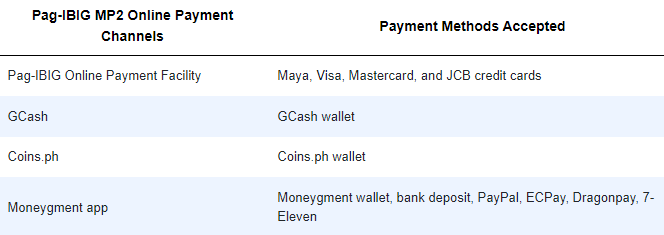
Online Payment Channels:


Whatever online payment facility you use, choose Modified Pag-IBIG 2 as your payment type and provide your MP2 account number.


How Can I Check My MP2 Online?

You may monitor your posted MP2 contributions through Virtual Pag-IBIG. But before you can do that, you have to create a Virtual Pag-IBIG account first.

Virtual Pag-IBIG

After your Virtual Pag-IBIG account is activated, you can already verify your MP2 savings online. Here's how:

  1. Log in to your Virtual Pag-IBIG account.

  2. On the left menu, select MP2 Savings under the Products tab.

  3. View your MP2 contribution payments on the screen.


MP2 Savings Program FAQs


1. How much is the Pag-IBIG MP2 contribution?
The minimum amount you can save in your MP2 account is ₱500 per month. This makes Pag-IBIG's savings program one of the most affordable for Filipinos who want to start investing small.


2. Where are contributions invested?
MP2 contributions paid by Pag-IBIG members are invested in Pag-IBIG housing loans (which earn interest paid by member-borrowers), government securities, and corporate bonds. Investing money in fixed securities makes the MP2 a less risky investment compared to stocks and other high-risk instruments.


3. How much dividends will I earn from my MP2 savings?
The annual MP2 dividends you'll receive will depend on the dividend rate set by Pag-IBIG for a particular year during your investment term. The annual rates vary depending on Pag-IBIG Fund’s financial performance and other factors.

According to a sample MP2 computation at the Pag-IBIG website, if you've been saving ₱500 from 2020 to 2024, you're likely to receive a total dividend of ₱5,718.75 (if you chose to get your dividends annually). Your total dividend will be higher (₱6,266.14) if you opt to get paid the lump sum after your MP2 account's five-year term.


4. What is the interest rate of MP2 in Pag-IBIG for 2022?
The final MP2 dividend rate for 2022 hasn't been announced yet as of this writing. But for 2021, it was 6%.


5. How will I receive my MP2 dividends?
You can claim your MP2 Savings after its five-year maturity through the Virtual Pag-IBIG facility. You can also claim it in person. Fill out the Application for Provident Benefits form[8] and submit it to the nearest Pag-IBIG Fund branch.


6. Can I withdraw my MP2 savings before its maturity?
Ideally, like in other investments, it's best to just let the funds in your MP2 account grow until your account matures. This way, you get to maximize your profits.

However, an unfortunate life situation might make withdrawing your MP2 savings necessary. The Pag-IBIG Fund allows early withdrawal under any of the following scenarios:

  • Total disability or insanity
  • Termination from employment due to health reasons
  • Death/critical illness of the MP2 account holder or an immediate family member
  • Retirement
  • Migration to another country
  • Unemployment due to layoff or company closure
  • OFW repatriation from the host country

You may withdraw your savings for a reason other than those allowed by Pag-IBIG. But you'll only receive half of the total dividend earned (if you chose to receive dividends after five years) or only your contributions (if you chose the annual dividend payout option).


7. Can I enroll a new MP2 savings account after maturity?
Yes, you can open new MP2 savings accounts once your existing account matures. This is a good strategy if you wish to invest your money in the long term, like for retirement.


8. What will happen if I don't claim my dividends?
Unclaimed MP2 savings after the five-year maturity will keep on earning dividends (based on the dividend rates of the Pag-IBIG Regular Savings Program). After two years, it will no longer earn dividends. You should just withdraw your contributions.


Pag-IBIG MP2 Guide: How to Apply and Invest in MP2 Savings Program