Showing posts sorted by date for query Camp John Hay. Sort by relevance Show all posts

Thousands of visitors, residents, and workers at Camp John Hay can now enjoy a free, eco-friendly ride with the launch of the new John Hay Loop.


This six-month pilot shuttle service uses electric vehicles (EVs) and is a joint initiative of the Bases Conversion and Development Authority (BCDA), its subsidiary John Hay Management Corporation (JHMC), and private partners DeviceDesign Co. Ltd., LexSwitch, and the Cordillera Basic Sector Transport Cooperative.


The project aims to improve mobility, reduce traffic congestion, and promote sustainable transportation in one of Baguio's most popular destinations. The service is set to benefit the nearly four thousand people who live and work in the area, as well as the increasing number of eco-conscious tourists visiting the city.


John Hay Loop Route and Stops

Three EV units are now operating, each capable of accommodating 22 seated and nine standing passengers. They serve eight designated stations throughout Camp John Hay, including:

  • Main Gate Station – John Hay Trade and Cultural Center

  • Filling Station A – near Le Monet Hotel

  • Scout Hill Station A – near Camp John Hay Grounds

  • Mile Hi Station A – from Forest Lodge

  • Gate 4 Station – to South Drive and Outlook Drive

  • Sheridan Station – near John Hay Golf

  • Mile Hi Station B – going to Forest Lodge

  • Filling Station B – going to Main Gate


Each unit is powered by a 70-kilowatt-hour (kWh) lithium-ion battery with fast-charging capability, allowing it to fully recharge in just 90 minutes. A 7kWh onboard slow charger is also available as a backup.

According to BCDA President and CEO Engr. Joshua M. Bingcang, “The John Hay Loop moves us toward a cleaner, faster, and more connected Baguio. Through this collaboration with the private sector and the international community, we are building a sustainable transport model that will benefit residents, workers, and tourists for years to come.”


The partnership was formalized in June 2025 when BCDA and JHMC signed a memorandum of understanding with DeviceDesign, LexSwitch, and the Cordillera Basic Sector Transport Cooperative. LexBuild Group and LexSWITCH EcoMobility Inc. provide the EV units and charging stations, while DeviceDesign supplies the station signages and tracking technology.


DeviceDesign and the Cordillera Basic Sector Transport Cooperative will evaluate the pilot service by monitoring passenger experience, ridership levels, and overall system operations. They will then provide recommendations for the long-term implementation of the John Hay Loop.


This initiative underscores BCDA’s commitment to making destinations more accessible while protecting the environment. By integrating clean transportation solutions in Camp John Hay, BCDA aims to promote a greener future for Baguio and set a national benchmark for sustainable mobility in tourism areas. The John Hay Loop aligns with the BCDA’s commitment to the United Nations Sustainable Development Goals, specifically Goal 11: Sustainable Cities and Communities, and Goal 13: Climate Action.


THINGS TO DO IN BAGUIO

If you plan to visit Baguio City, here are top activities you shouldn't miss:


WHERE TO STAY IN BAGUIO

Here are some of the many top hotels with Certificate of Authority to Operate (CAO) from the Department of Tourism in Baguio:

You may also check the full list of hotels and lodging in Baguio. I also wrote Top10 hotels in Baguio on a separate blog.

For directions and bus schedules, check out my Manila to Baguio guide. For those who are driving to Baguio, you may check the fastest way to Baguio. Read my COMPLETE BAGUIO TRAVEL GUIDE to know more about Baguio City.

JOHN HAY LOOP: Catch a Free Shuttle Ride in Baguio


Imagine gliding through the picturesque hills of Camp John Hay in Baguio City on a cable car. This vision could soon become a reality—or spark debate—as the Bases Conversion and Development Authority (BCDA) partners with Japanese company Zip Infrastructure Co. to explore this innovative transportation option.


During a recent visit to Tokyo, BCDA President Joshua Bingcang and Zip Infrastructure CEO Takamasa Suchi signed an agreement to evaluate the feasibility of introducing Zippar, a self-driven cable car system, in Camp John Hay. This initiative aims to provide an alternative transportation solution to ease traffic congestion in the area.


Loading...

Zippar, designed to navigate curves and branches while being controlled from a centralized hub, promises to enhance urban mobility and promote environmentally sustainable transportation solutions within Camp John Hay.

Artist rendition of Zippar at Camp John Hay

Bingcang highlighted the potential impact of this technology, stating, "This technology could enhance urban mobility, reduce traffic congestion, and promote environmentally sustainable transportation solutions. By leveraging Zippar technology, we can create a seamless and efficient transport system within Camp John Hay, making it more accessible and enjoyable for residents and visitors alike."


Transportation Secretary Jaime Bautista expressed cautious optimism about the project. "Zippar could be a game-changer for urban public transport while presenting an ideal green transport model. But we choose to temper our excitement with the need to first undertake the requisite feasibility studies. We hope to determine the possibility of adopting Zippar to a highly congested metropolis like Metro Manila," Bautista said.

In 2019, DOTr has offered Baguio City a partner deal for a cable car system from La Union to Baguio


What is Zippar?

Launched in 2018, Zippar is a system of capsule cars running on zip lines designed to alleviate traffic congestion. It offers a cost-effective alternative to traditional, more expensive railway systems. Currently being tested in Odawara City, Kanagawa Prefecture, Japan, these trials are crucial for assessing the system's practicality and performance in real-world conditions. If successful, Zippar could be implemented in various urban settings by 2025.

A sample of Zippar

Cable Cars: An Ongoing Discussion in the Philippines

The idea of using cable cars to solve the Philippines' transportation issues has been considered since 2018 under President Rodrigo Duterte’s administration. The concept gained renewed attention when Senator Robin Padilla advocated for the revival of the Manila Urban Car Cable Project in 2022.


The Manila Urban Car Cable Project is a 4.5-kilometer cable car system proposed to link Marikina City to Pasig City, featuring six stations:

  • LRT-2 Santolan Station, Marikina City
  • Libis, Quezon City
  • Eastwood, Quezon City
  • Santolan, Pasig City
  • Manggahan, Pasig City
  • Rosario, Pasig City

The Department of Transportation (DOTr) endorsed the Manila Urban Car Cable Project to the National Economic and Development Authority-Investment Coordination Committee (NEDA-ICC) in 2021. However, it is still awaiting evaluation and approval, with no updates since then.


ATTRACTIONS TO SEE IN MANILA 

Klook.com

As BCDA and Zip Infrastructure embark on this exploratory phase for Zippar in Camp John Hay, the prospect of cable cars in the Philippines continues to capture the public's imagination, promising both excitement and skepticism.


BCDA, Japanese Firm Exploring Cable Car System in Baguio


Nestled amidst the cool embrace of the Baguio mountains, Choco-late de Batirol stands as a true gem among the city's charming cafes.


A delightful fusion of Filipino tradition and heavenly flavors, this café invites locals and travelers alike to experience the rich heritage of Tsokolate de Batirol—a traditional Filipino hot chocolate—like never before.

Loading...

A Legacy of Tradition

Choco-late de Batirol owes its name and inspiration to the time-honored Filipino tradition of making Tsokolate de Batirol. In this quaint café, tradition reigns supreme, and every cup of hot chocolate served is a tribute to the flavors of the past.


The first-time (I remember) I have tried tsokolate de batirol was the time I visited Choco-late de Batirol, a cafe in Baguio during my second travel to the city in 2012.


Tsokolate de Batirol for me is a better version of instant hot chocolate drink we usually make at home. This one is a bit thicker, it may depends on how they make it, but most of the time it is. It gives me a different feeling in the mouth, that's why whenever I visit a cafe that serves tsokolate de batirol, I always order one.


The Art of Preparation

Stepping into Choco-late de Batirol feels like entering a time machine. The café's rustic interior, adorned with native Filipino decor, sets the stage for an authentic experience. Here, the preparation of Tsokolate de Batirol is a meticulously crafted art form.


The process begins with roasted cacao beans, ground to perfection to create a rich and aromatic cacao paste. This paste is then mixed with water, sugar, and sometimes a pinch of salt, just as it has been for generations.

But what truly sets Choco-late de Batirol apart is the use of the traditional "batirol" - a wooden whisk with a wide base - to froth the hot chocolate. This age-old technique creates a velvety, frothy beverage that's a harmonious blend of sweet and slightly bitter flavors.


What to Food and Drink to Try

Choco-late de Batirol in Baguio City is a charming café known for its traditional Filipino hot chocolate, Tsokolate de Batirol, as well as a range of other delightful Filipino snacks and beverages. When you visit Choco-late de Batirol, here are some must-try food and drink options:

  • Tsokolate de Batirol: This is the star of the show at Choco-late de Batirol. It's a thick and rich hot chocolate made from freshly roasted cacao beans. Served in a traditional wooden batirol, it's a velvety and slightly bitter-sweet drink that's perfect for sipping and savoring.

  • Bibingka: A classic Filipino rice cake, bibingka is a must-try at Choco-late de Batirol. It's made from rice flour, coconut milk, and sometimes salted duck egg. The result is a slightly sweet and savory cake, often topped with cheese and coconut shavings.

  • Suman: Suman is a sticky rice cake wrapped in banana leaves. It's often served with a sweet coconut sauce. The combination of the sticky rice and the sweet sauce is delightful.


  • Turon: Turon is a sweet snack made by wrapping sliced bananas and sometimes jackfruit in a spring roll wrapper, then frying it to a crispy golden brown. It's often glazed with caramelized sugar, giving it a sweet and crunchy exterior.

  • Coffee: While Tsokolate de Batirol is the highlight, Choco-late de Batirol also offers a range of coffee options for those who prefer a caffeine fix. Try their local brews or specialty coffee drinks.

  • Local Herbal Teas: Some branches of Choco-late de Batirol also offer a variety of local herbal teas, perfect for those looking for a non-caffeinated beverage option.


Menu

Here's the latest Choco-late de Batirol menu:


The Perfect Setting

Choco-late de Batirol's location in Baguio City is no accident. The cool, misty mountain air, lush greenery, and the café's serene garden setting provide an enchanting backdrop for sipping on a steaming cup of Tsokolate de Batirol. It's the ideal spot to unwind, relax, and savor the flavors of the Philippines.


Local Delicacies and Souvenirs

As if the delightful hot chocolate and mouthwatering dishes weren't enough, Choco-late de Batirol offers an assortment of local delicacies and souvenirs to take a piece of Baguio home with you. You can pick up traditional woven products, native crafts, and even cacao-related goodies as mementos of your visit.


Choco-late de Batirol

Address: Igorot Garden, Gate 4, Camp John hay, Baguio City
Opening Hours: 7:00 AM - 9:00 PM (Last call of orders is from 8:00 PM - 8:30 PM)
Contact Number: +63 966 415 9942
Email: chocolatedebatirolcldb@gmail.com

Payment Methods: CASH, DEBIT CARD, CREDIT CARD, and G CASH.

Pets are allowed provided they are on a leash and wearing diapers.


How to Get There

Because Camp John Hay is a vast, forested property, getting there from downtown Baguio depends on whether you are commuting or driving.


1. By Taxi (Most Convenient)
Taking a cab is the easiest way to reach the café, especially since public jeepneys do not go deep inside Camp John Hay.

Simply hail any white Baguio taxi and tell the driver you are heading to "Choco-late de Batirol in Camp John Hay."

Most drivers know exactly where it is. It is roughly a 10 to 15-minute ride from Session Road or Burnham Park, depending on traffic.


2. By Jeepney (Commuter Route + Walk)
If you prefer to take a jeepney, you will need to do a bit of walking to get to the actual café.

Where to line up: Go to the jeepney terminal near SM City Baguio or along Plaza/Session Road and look for jeepneys bound for Scout Barrio.

Where to drop off: Tell the driver to drop you off at the Camp John Hay Gate 2 / Loakan Road entrance.

The Walk: From the gate, you will need to walk scenic, pine-lined roads inside the camp toward the Igorot Park area to reach the restaurant. The walk takes about 10–15 minutes.


3. By Private Car or Motorcycle
If you are driving yourself, navigating the camp is fairly straightforward:

From Session Road, head toward Loakan Road via the rotunda near the Baguio General Hospital.

Turn left into Camp John Hay Gate 2.

Follow the main road (Loakan Road turning into Sheridan Drive). Keep an eye out for signs pointing toward Igorot Park or the Mile Hi Center area—Choco-laté de Batirol will be on your right, nestled under a canopy of trees. There is dedicated roadside parking nearby.


ATTRACTIONS TO SEE IN MANILA 

Klook.com

For those seeking a taste of nostalgia and a glimpse into the rich cultural tapestry of the Philippines, Choco-late de Batirol in Baguio is a must-visit destination. Here, tradition, flavor, and ambiance combine to create an unforgettable experience that will leave you with memories as sweet as the Tsokolate de Batirol itself.

So, whether you're a traveler exploring the beauty of Baguio or a local longing for a taste of home, Choco-late de Batirol promises a heartwarming journey through time and taste.

Me at Choco-late De Batirol in 2012


ACTIVITIES AND TOURS IN MANILA


IMPORTANT NOTE: The rates, contact details and other information indicated in this post are accurate from the time of writing but may change without IMFWJ's notice. Should you know the updated information, please message us on Facebook.

WHERE TO STAY IN BAGUIO:

Choco-late de Batirol: Where Tradition Meets Heavenly Hot Chocolate in Baguio

Image of Cordillera Administrative Region map Cordillera Administrative Region map Feedback cordillera administrative region provinces how many provinces are in the cordillera administrative region cordillera administrative region number cordillera administrative region colleges and universities cordillera administrative region destinations cordillera administrative region festival cordillera philippines

In this guide, you will learn about Philippine's Cordillera Administrative Region.


The Cordillera or CAR is a massive mountain range situated in the northern central part of the island of Luzon, in the Philippines and the only landlocked region in the country. It is bordered by the Ilocos Region to west and southwest, and Cagayan Valley to the north, east, and southeast.

The region was officially created on July 15, 1987, and covers most of the Cordillera Mountain Range of Luzon and is home to numerous ethnic peoples. The Nueva Vizcaya province has a majority of Igorot population, but was placed by the American colonial government in the Cagayan Valley Region instead during the early 20th century.


PROVINCES UNDER CORDILLERA ADMINISTRATIVE REGION

is cordillera in luzon provinces in cordillera administrative region cordillera provinces cordillera administrative region provinces cordillera central (luzon) cordillera mountain range provinces of cordillera car region provinces provinces of cordillera administrative region what are the provinces of cordillera administrative region cordillera region provinces bundok ng cordillera how many provinces are in the cordillera administrative region provinces in cordillera 6 provinces in cordillera cordillera province history of cordillera administrative region how many provinces does cordillera administrative region have? how many provinces in cordillera administrative region landlocked province in the philippines
The region comprises six provinces with its regional center, the highly urbanized city of Baguio:

Loading...

FACTS ABOUT CORDILLERA REGION

Area: 19,422.03 km² (7,498.88 mi²)
Population: 1,431,400
Density: 88/km2
Regional Center: Baguio
Languages: Ilocano; Bontoc; Filipino; English
Cities: (2) Baguio City, Tabuk City
Barangays: 1,177
Major Industries:
  • Crops (Palay, Corn, Banana, Mango, Tomato, Tobacco, Coconut)
  • Minerals (Gold, Silver, Copper)
  • Mining
  • Textiles and Garments
  • Handicrafts and Furniture


WHAT TO BRING FOR CORDILLERA REGION

Here are some things you might consider bringing with you for your day tour / adventure:

Shopee is my go-to app for things I needed like the ones above. If you'd like discounts and vouchers, you may get the best offers here:

Cordillera Region Geography

The region is the only landlocked region in the Philippines, bounded on the northeast and east by the Cagayan Valley, and on the southwest and west by the Ilocos Region.

The region is primarily mountainous, positioned in the Cordillera Central mountain range, which includes Mount Pulag, the highest mountain in Luzon.

Within the region are several streams and rivers including the Chico River, which is a tributary of the Cagayan River. Other major rivers include:
  • Abra
  • Abulog
  • Agno
  • Ahin
  • Amburayan
  • Apayao
  • Bued
  • Siffu


Administrative Divisions

Cordillera Administrative Region is politically subdivided into 6 provinces. It has 2 cities; the highly urbanized city of Baguio, and the component city of Tabuk.

A view of Baguio as seen in November 2012

There are 1,176 barangays in the region. Geographically, the western half of Nueva Vizcaya is part of the main Cordilleras, while its eastern half is part of the Caraballos, the meeting point of the Cordilleras and the Sierra Madre. There have been moves to reunify Nueva Vizcaya with the Cordilleras, however, no such legislation has yet been introduced in Congress.


Best Time to Visit

For the best combination of agreeable temperatures of around 27° C (80° F) and as little rain as possible, the best time to visit this region is between February and March. The first months of dry season can still be rainy, while the last months are usually pretty hot and humid.


Languages

The region has been called "the most diversified ethno-linguistic region in the Philippines" with the many "sub-dialect variations" of its major languages. This diversity has been attributed to the mountainous topology of the region. However, this did not lead to variations in "cultural development", and the majority of the people share a "similar cultural identity".
  • Balangao, spoken in Natonin, Mountain Province.
  • Bontoc, spoken in Bontoc, Mountain Province.
  • Ibaloi, spoken in Benguet.
  • Ifugao, spoken in Ifugao.
  • Ilocano, spoken in Apayao, Abra, Kalinga, Mountain Province, Benguet, and Ifugao. It is the regional lingua franca.
  • Isnag, spoken in Apayao.
  • Itneg, spoken in Abra.
  • Kalinga, spoken in Kalinga.
  • Kalanguya, spoken in some parts of Benguet.
  • Kankanaey, spoken in western Mountain Province and some parts of Benguet.


Ethnic Groups

Cordillera is home to many ethnic tribes living on the Cordillera mountain range. They are commonly referred to as the Igorot.

Ethnic people of Abra
The Tingguians are composed of sub-groups known as the Itneg tribes which includes Adasen, Balatok, Banaw, Belwang, Binungan, Gubang, Inlaud, Mabaka, Maeng, Masadiit, and Muyadan or Ammutan.: Their places in Abra are as follows:
  • Adasen — Lagayan, Lagangilang, San Juan and Tineg
  • Banaw — Daguioman, Malibcong, also found in Balbalan, Kalinga
  • Binungan — Baay-Licuan and Lacub
  • Balatok — in the villages of Amti, Kilong-olaw, & Danak, all in Boliney
  • Belwang — in the village of Dao-angan in Boliney
  • Gubang — Malibcong
  • Inlaud — Lagangilang and Peñarrubia, in Lumaba village of Villaviciosa, in the villages of Abang and Patoc in Bucay, in Langiden, San Isidro, San Quintin, Danglas (also found in some parts of Nueva Era)
  • Mabaka — Lacub and Malibcong
  • Maeng — Luba, Tubo and Villaviciosa, (also found in San Emilio, Ilocos Sur, Banayoyo and other towns in Ilocos Sur)
  • Masadiit — Sallapadan, Bucloc and in the village of Sapdaan in Manabo, and in barangays Poblacion, Bawiyan, and Dumagas in Boliney
  • Ammutan a.k.a. Muyadan tribe — in Manabo


Ethnic people of Apayao
Isnag tribe — also known as Isneg comprising the sub-groups known as the Ymandaya and Imallod (Isnag refers to the people, while Isneg refers to the dialect). Isnags are found not only in Apayao but also in the eastern section of Ilocos Norte and northwestern portion of Cagayan. Their places of abode in Apayao are as follows:
  • Ymandaya (Isnag) — Calanasan (Bayag)
  • Imallod (Isnag) — Kabugao, Conner, Pudtol, and some parts of Luna (Macatel)
  • Malaweg — Conner

Ibaloi people

Ethnic people of Benguet
  • Ibaloi
  • Kankanaey
  • Kalanguya
  • Karao Tribe


Ethnic People of Ifugao
  • Tuwali
  • Ayangan
  • Kalanguya
  • Ifannawer - Banaue

An Ifugao man from Banaue


Ethnic people of Kalinga
  • Tubog
  • Banao
  • Tanudan
  • Tanudan
  • Tongrayan
  • Ifutfut: Fugnay, Ngifat, Lacnog, Tabuk
  • Iterkaw: Nambaran, Tabuk
  • Ifasao: Isla, Appas Tabuk
  • Ichananaw: Lacnog, Tabuk
  • Itongrayan: Luprupa, Ifunug, Amfato, Damsite, Tabuk
  • Isumacher: Sumacher, Filong, Man-ufer, Mallango, Fangad, Madopdop, Lacnog, Ipil, Bayabat, Tannubong, Bulo. Tabuk
  • Ylubuagen: Lubuagan
  • Ipinukpuk
  • Kankana-ey
  • Bagbag-o
  • Ifontok
  • Ilocano

Ethnic people of Mountain Province
  • Bontoc — Bontoc
  • Balangao — Natonin
  • Baliwon — Paracelis
  • Applai: Bauko, Besao, Sabangan and Sagada

Cheapest Flights and Airline Tickets Online Booking

TOURIST SPOTS TO SEE IN CORDILLERA

Here are the top tourist destinations to visit in CAR:


Kaparkan Falls (Tineg, Abra)

There are numerous waterfalls scattered all over the country, but there’s none quite like the Kaparkan Falls in Tineg, Abra.

Kaparkan Falls

From the photo below, you can see what makes it unique. Enjoy the cold waters from the mountain after a few minutes hike to the falls.

Things to do: bathe and hike
Where to stay: Abra Valley Grand Hotel


Lusuac Spring Resort (Apayao)

Abra has its fair share of hidden gems, their famous Lusuac Spring in Barangay Poblacion, Lagayan, a refreshing spring a waiting for us to swim.

Lusuac Spring Resort

A perfect place to cool-off from the summer heat, it's clear water are indeed inviting for a dip.

Things to do: swimming and picnic


Burnham Park (Baguio City)

Considered as the city's "mother of all parks," Burnham Park is one of Baguio's best attractions.

Burnham Park boating lagoon

 It was named after urban planner Daniel Burnham, the American architect who came up with the original design and layout of the park.

Things to do: boating, picnic, visit different attractions and buy souvenirs

StoBoSa (La Trinidad)

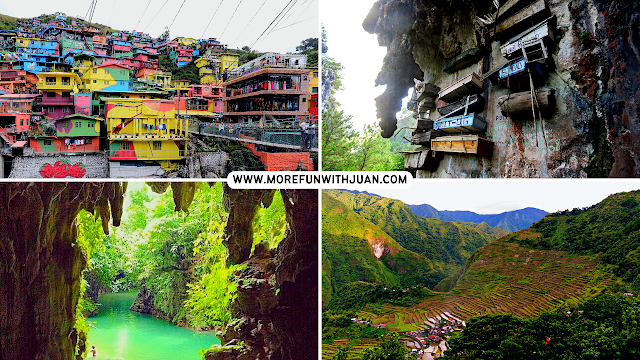
Also known as the Valley of Colors, it comprises of around 200 houses over an area of 18,000 square meters. 

Valley of Colors

If the sheer expanse of it is not enough to wow you, the vibrant hues of this massive art piece will.

Things to do: taking photos


La Trinidad Strawberry Farm

La Trinidad, the capital of Benguet, is about 30 minutes from the Baguio town proper. This municipality is where you'll find hectares of land dedicated to growing strawberries to supply the rest of the country.

The crowd at La Trinidad Strawberry Farm

It is one of the most frequented Benguet tourist spots.

Things to do: strawberry picking, buy fresh goods


Banaue Rice Terraces (Ifugao)

The most famous tourist spot in Ifugao, Banaue Rice Terraces are occasionally called the "Eighth Wonder of the World". 

Banaue Rice Terraces

It is commonly thought that the terraces were built with minimal equipment, largely by hand.

Things to do: hiking and appreciate nature


Apo Whang-Od (Buscalan, Kalinga)

If there is one person who could best represent the rich culture of Kalinga, a province located in the far north of the Philippines, it is none other than Whang Od, the oldest Filipino tribal tattoo artist. 

Apo Whang-Od 

Whang Od is said to be the last mambabatok.

Things to do: get a tattoo


Hanging Coffins (Sagada)

Instead of being placed into the ground, the coffins are hung either inside the caves or on the face of the cliffs, near the hanging coffins of their ancestors. 


The Sagada people have been practicing such burials for over 2,000 years, and some of the coffins are well over a century old. Eventually the coffins deteriorate and fall from their precarious positions.

Things to do: take photos


Other tourist spots to visit in the Cordilleras:


ATTRACTIONS TO SEE IN MANILA 

Klook.com

FOOD TO TRY IN CORDILLERA

Here are the culinary specialties and delicacies you should try in Cordillera:
  • Abra Miki Noodles (Abra)
  • Binungor (Apayao)
  • Etag (Benguet & Mountain Province)
  • Homemade yogurt (Mountain Province)
  • Ifugao coffee (Ifugao)
  • Kalinga Coffee (Kalinga)
  • Mountain rice (Kalinga)
  • Pinikpikan (Benguet)
  • Pinikpikan (Ifugao & Mountain Province)
  • Pinuneg (Benguet)
  • Pizza topped with Apayao delicacies (Apayao)
  • Sagada oranges (Mountain Province)
  • Strawberry taho (Benguet)


WHERE TO STAY IN CORDILLERA

Here are the lists of accommodation options in the region:

The Manor in Baguio

List of Regions in the Philippines

  • National Capital Region (NCR)
  • Ilocos Region (Region I)
  • Cagayan Valley (Region II)
  • Central Luzon (Region III)
  • Calabarzon (Region IV-A)
  • Mimaropa (Region IV-B)
  • Bicol Region (Region V)
  • Western Visayas (Region VI)
  • Central Visayas (Region VII)
  • Eastern Visayas (Region VIII)
  • Zamboanga Peninsula (Region IX)
  • Northern Mindanao (Region X)
  • Davao Region (Region XI)
  • Soccsksargen (Region XII)
  • Caraga (Region XIII)
  • Bangsamoro Autonomous Region in Muslim Mindanao (BARMM)
  • Cordillera Administrative Region (CAR)


ACTIVITIES AND TOURS IN MANILA


TRANSPORTATION TO AND FROM CORDILLERA

The best way to get to CAR depends on where you’re traveling from and your budget.

The fastest and most convenient method of travel a far distance in the Philippines is most often by plane, however in some cases, traveling by sea or land may be a better option and more cost-effective.

In CAR, only Baguio City has an airport that serves commercial flights in the county. Bus is the most commonly used transportation going to and coming from the region. Here's a list of bus transits for the region:
 
Victory Liner
 Image of Cordillera Administrative Region map Cordillera Administrative Region map Feedback cordillera administrative region provinces how many provinces are in the cordillera administrative region cordillera administrative region number cordillera administrative region colleges and universities cordillera administrative region destinations cordillera administrative region festival cordillera philippines

THE CORDILLERAS: All You Need to Know About Cordillera Administrative Region (CAR)