Showing posts with label DepEd. Show all posts

As the new school year approaches, the Department of Education (DepEd) is once again reminding all public elementary and secondary schools nationwide about the strict implementation of its "No Collection Policy." This long-standing directive aims to ensure that no student is deprived of education due to financial constraints, upholding the constitutional right to free basic education.


What is DepEd's "No Collection Policy"?

The "No Collection Policy" strictly prohibits all forms of mandatory contributions and fees from students, especially during enrollment and the crucial first months of classes. This measure is designed to alleviate the financial burden on parents and guardians, ensuring that access to public education remains unhampered for all, particularly for families from marginalized sectors.


Loading...

Key Provisions of the Policy

Based on various DepEd Orders, including DepEd Order No. 19, s. 2008, and reiterations in subsequent issuances like DepEd Order No. 41, s. 2012, and DepEd Memorandum No. 143, s. 2016, the policy specifies:

  • No Mandatory Fees: Schools are explicitly prohibited from collecting any fees or contributions from students, from kindergarten to Grade 12, at any time during the enrollment period.

  • Voluntary Contributions Only (with conditions): While Parent-Teacher Associations (PTAs) and other school organizations may accept voluntary contributions, these must be truly optional. They cannot be a prerequisite for admission, enrollment, or accessing school services.


  • Transparency and Accountability: If voluntary contributions are collected, these must be done with full transparency, proper accounting, and through resolutions made by PTAs or school organizations, not by school personnel themselves. Collection should also only occur later in the school year, usually after the initial enrollment period.

  • Prohibited Acts: Schools are forbidden from compelling students to purchase specific items (like school uniforms, graduation rings, or certain school supplies from specific vendors) as a condition for attendance or graduation.


DepEd's rationale behind this steadfast policy is to ensure that every Filipino child, regardless of their family's economic status, has equal opportunity to pursue basic education. The department provides various funds, including Maintenance and Other Operating Expenses (MOOE), to cover essential school needs and operations.


What Parents and Guardians Should Do

Parents and guardians are encouraged to be vigilant and report any instances of forced collections or mandatory fees imposed by schools or school personnel. Such reports can be made to the respective Schools Division Offices (SDOs) or directly to the DepEd Regional Offices.

By consistently enforcing the "No Collection Policy," DepEd reaffirms its commitment to providing accessible, quality, and equitable basic education to all Filipino learners.


RELATED ARTICLES


What is DepEd's 'No Collection Policy'?


In response to the sweltering temperatures sweeping across the nation, the Department of Education (DepEd) has issued a reminder to schools regarding the suspension of in-person classes in the event of extreme heat. The reminder comes amidst concerns over the health and well-being of students as the heatwave intensifies.


DepEd Spokesperson Michael Poa emphasized that schools have the authority to suspend face-to-face classes and transition to alternative delivery modes (ADM) when faced with adverse weather conditions.

The memo, issued on April 20, serves as a proactive measure to safeguard students' health and ensure optimal learning conditions.

"With varying situations in our schools, it will be the school heads who will determine the need for suspension," Poa stated. "We want to prevent the adverse effects of the scorching weather on our learners' health, so we remind school heads that they can swiftly switch to ADMs."

Loading...

The move comes in light of warnings from the Philippine Atmospheric, Geophysical, and Astronomical Services Administration (PAGASA) of even higher heat index values in the coming days.

Recent reports indicate alarming temperatures, with Metro Manila recording its highest temperature yet at 36.2 degrees Celsius. Pagasa forecasts a heat index of up to 56 degrees Celsius in Muñoz, Nueva Ecija, and 50 degrees Celsius in Cabanatuan.


Pagasa categorizes heat indices between 41 and 54 degrees Celsius as "dangerous," with the potential to cause heat-related illnesses such as cramps, exhaustion, and, in extreme cases, heat stroke. 

Senator Sherwin Gatchalian, Chairman of the Senate Committee on Basic Education, echoed concerns over the impact of the heatwave on students' health. He advocated for the adjustment of the academic calendar to accommodate summer vacation in April-May rather than July-August.


Gatchalian's proposal gains traction following an incident in Cabuyao City, Laguna, where over a hundred students fell ill during a fire drill conducted amidst hot weather. The incident underscores the urgency of addressing the challenges posed by extreme heat on students' safety and well-being.

As temperatures continue to rise, the DepEd's reminder serves as a timely precautionary measure to ensure the health and safety of students across the country. By empowering schools to make informed decisions regarding class suspension, DepEd aims to mitigate the adverse effects of the heatwave on the education sector.

Visit PAGASA's latest reports and updates to know the weather, temperature and heat index in your area.


ATTRACTIONS TO SEE IN MANILA 

Klook.com


DepEd Issues Reminder on Suspension of In-Person Classes Due to Hot Weather


To understand and to know more about DepEd, here's a comprehensive guide for you.


What is DepEd?

DepEd, an acronym for the Department of Education, stands as the cornerstone of the Philippines' basic education system. This government agency bears the significant responsibility of ensuring access to quality education for every Filipino learner.

In this comprehensive guide, we will unveil the essence of DepEd—what it represents, why it holds immense importance, and how it profoundly influences the educational journey of millions of students nationwide.

Loading...

History and Founding of DepEd

To comprehend the intricate tapestry of education in the Philippines, one must traverse the annals of history. From ancient tribal teachings to meticulously organized systems under various rulers, the Department of Education (DepEd) has consistently held a central position in the evolution of learning.


Before the Spanish Era

Long before the arrival of Spanish explorers, education was a humble affair, transpiring within the confines of homes and tribal areas. Parents and tribal tutors imparted practical skills, emphasizing utility over formal academics.


During the Rule of Spanish

With the advent of Spanish colonization, education underwent a significant transformation. Spanish Missionaries replaced tribal tutors, infusing religious teachings into the educational fabric. Initially limited to the elite class, educational accessibility expanded due to the Educational Decree of 1863.


American Influence and Educational Reform

Following the defeat of the Spanish, American authorities introduced sweeping changes. Closed schools were reopened, and Act No. 74 in 1901 made elementary education free and mandatory. The arrival of American teachers, known as Thomasites, heralded the establishment of a centralized public school system.


World War II and Curricular Adjustments

The tumultuous period of World War II brought about alterations in the education landscape. Japanese occupation led to the modification of subjects, with Tagalog, Philippine History, and Character Education reserved for Filipino students. The Department of Instruction underwent a renaming under the Department of Public Instruction.


Post-War Transformations

In 1947, the Department of Instruction transitioned into the Department of Education through Executive Order No. 94. Subsequent years witnessed further organizational shifts, culminating in the formation of the Department of Education, Culture, and Sports in 1987.


Education Act: The Creation of CHED and TESDA

The turning point arrived in 1982 with the enactment of the Education Act, establishing the Ministry of Education, Culture, and Sports. By 1994, an emphasis on basic education led to the creation of CHED and TESDA for higher and technical-vocational education.


Entering the 21st Century: The Birth of DepEd

In August 2001, Republic Act 9155 reshaped the landscape, transforming the Department of Education, Culture, and Sports into the Department of Education, known as DepEd. This legislation aimed to empower school leaders, fostering school-based management and equipping students with comprehensive skills, knowledge, and values for a well-rounded life.

As we navigate the intricate threads of history, it becomes evident that DepEd's pivotal role has profoundly shaped the educational trajectory of the Philippines. Its enduring commitment to providing quality education stands as a testament to its unwavering dedication to molding generations of informed and empowered citizens.


Mission, Vision & Mandate


DepEd’s Vision – A Dream for Filipinos:
Imagine a Philippines where its people love their country deeply and possess the values and skills to reach their full potential, actively contributing to nation-building. 

This is the dream of the Department of Education (DepEd). As a learner-centered institution, DepEd continually works to improve itself, ensuring better service to its stakeholders.

DepEd’s Mission – Ensuring Quality Education for Every Filipino:
DepEd is on a mission to protect and promote the right of every Filipino to a quality, equitable, culture-based, and complete basic education. 

In this mission:
  • Students learn in a child-friendly, gender-sensitive, safe, and motivating environment.
  • Teachers play a crucial role in facilitating learning and nurturing every learner.
  • Administrators and staff act as stewards, creating an enabling and supportive environment for effective learning.
  • Families, communities, and other stakeholders actively engage, sharing responsibility for developing life-long learners.

Core Values Guiding DepEd:
DepEd is guided by four core values that shape its actions and decisions:
  • Maka-Diyos (God-Centered)
  • Maka-tao (People-Centered)
  • Makakalikasan (Environment-Centered)
  • Makabansa (Nation-Centered)


DepEd Officers

In the hierarchy of the Department of Education (DepEd) in the Philippines, there are several key officers who play crucial roles in the formulation and implementation of educational policies, programs, and initiatives. These officers include the Secretary of Education, Undersecretaries, and Assistant Secretaries. Here's a brief overview of their roles and responsibilities:


Secretary of Education

The Secretary of Education is the head of the Department of Education and serves as the principal executive officer of the agency. Appointed by the President of the Philippines, the Secretary oversees the entire education system in the country. Their responsibilities include setting the direction for national education policies, implementing educational reforms, and ensuring the delivery of quality education to all Filipino learners. The Secretary of Education represents the DepEd in various national and international forums and plays a pivotal role in shaping the future of education in the Philippines.


Undersecretaries

Undersecretaries are high-ranking officials within the DepEd hierarchy. They are appointed by the President upon the recommendation of the Secretary of Education. Undersecretaries assist the Secretary in the overall management and administration of the department. They are typically assigned specific portfolios or areas of focus, such as basic education, curriculum development, finance, or legal affairs. Undersecretaries work closely with the Secretary to develop policies, programs, and projects that align with the department's goals and objectives. They also coordinate with various bureaus and offices under the DepEd to ensure the effective implementation of educational initiatives.


Assistant Secretaries

Assistant Secretaries are officials with significant responsibilities within the DepEd. They are appointed by the President upon the recommendation of the Secretary of Education. Assistant Secretaries assist the Undersecretaries in their respective areas of focus. They are involved in policy formulation, program development, and coordination of activities related to their assigned portfolios. Assistant Secretaries work closely with different divisions and offices within the DepEd to implement specific projects and initiatives. They contribute to the decision-making process and provide valuable insights into the development and improvement of the Philippine education system.


ATTRACTIONS TO SEE IN MANILA 

Klook.com

DepEd’s Historical Evolution and Present Mandate

The Department of Education’s origins can be traced back to the Education Decree of 1863, a historical document that marked its inception. Over time, the department has undergone various reorganizations, adapting to the evolving landscape of different administrations and charters.

In its contemporary form, DepEd's mandate finds its foundation in Republic Act 9155, commonly referred to as the Governance of Basic Education Act of 2001. This legislation outlines the department's fundamental roles and responsibilities.

DepEd is entrusted with the pivotal tasks of formulating, executing, and coordinating policies, plans, programs, and projects in both formal and non-formal basic education sectors. This oversight extends across all elementary and secondary educational institutions, encompassing both public and private entities, as well as alternative learning systems.

The department's unwavering commitment lies in establishing and sustaining a comprehensive, sufficient, and integrated basic education system that harmonizes with the overarching objectives of national development.

In essence, DepEd’s mission, vision, values, and mandated responsibilities synergize to cultivate a vibrant and inclusive educational landscape. This synergy ensures that every Filipino, regardless of background, is afforded the opportunity to access quality education, thereby illuminating the path to a brighter and more prosperous future for the entire nation.


ACTIVITIES AND TOURS IN MANILA

DepEd Main Office Contact Information

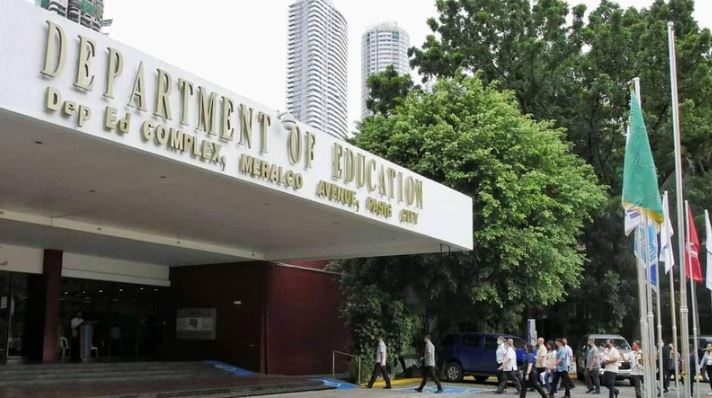
Address: 2nd Floor Department Of Education Building, DepEd Meralco Avenue, Pasig, 1605 Metro Manila
Contact Numbers: (+63 2) 8636 1663 | 8633 1942 | 8635-9817 | 8638-7530 | 8638-7531 | 8638-7529 | (+63 919) 456 0027 | (+63 995) 921 8461
Email: action@deped.gov.ph


Attached Agencies

The following agencies, councils and schools are attached to DepEd for policy and program coordination:
  • Ministry of Basic, Higher and Technical Education
  • Instructional Materials Council (IMC)
  • National Academy of Sports (NAS)
  • National Book Development Board (NBDB)
  • National Council for Children’s Television (NCCT)
  • National Museum of the Philippines
  • National Science Teaching Instrumentation Center (NSTIC)
  • Philippine High School for the Arts (PHSA)


Opportunities for Careers at the Department of Education (DepEd)

The Department of Education (DepEd) presents diverse career pathways catering to individuals at different stages of their professional journey.

Regardless of whether you are embarking on your career or bringing years of experience, DepEd opens doors in teaching, administration, curriculum development, and a myriad of support roles.

Teachers assume a pivotal role in shaping the future by nurturing students, while administrators contribute to the management and enhancement of the education system.

In addition, DepEd provides opportunities in research, policy development, and educational technology, making it an inclusive hub for those dedicated to the field of education.

For those eager to inspire student learning and development or contribute to the enhancement of the education landscape, DepEd offers a multitude of avenues to explore your passion and expertise.


Conclusion

In the realm of Philippine education, the Department of Education (DepEd) stands as a vital pillar, ensuring the delivery of quality education to all. With a steadfast commitment to providing equitable and comprehensive basic education, guided by unwavering core values and mandated by Republic Act 9155, DepEd is the bedrock upon which the nation's educational future is built.

For prospective applicants, here are some invaluable pointers:

Grasp the Mission: Immerse yourself in DepEd's mission and values. Aligning your aspirations with theirs can significantly enhance your appeal as a candidate.

Explore Diverse Avenues: Delve into the myriad of career opportunities within DepEd, spanning from teaching to administration, research, and technology. Identify the path that resonates with your skills and passions.

Stay Current: Stay abreast of educational policies, trends, and innovations. Keeping yourself well-informed underscores your dedication to staying abreast of the latest developments in the field.

Commit to Growth: Showcase your dedication to continuous learning and professional advancement. Highlight any additional certifications or training that augment your qualifications.

Highlight Your Impact: Demonstrate how your skills and experiences align with DepEd's objectives. Paint a vivid picture of how you can contribute meaningfully to the mission of delivering quality education to all.

By adhering to these insights, you can position yourself as a robust candidate, poised to make a substantial difference in DepEd's ongoing endeavors to shape the educational landscape of the Philippines. Best of luck on your journey!


What is DepEd: The Department of Education of the Philippines


Becoming a public school teacher in the Philippines is a noble and fulfilling career path that allows individuals to make a meaningful impact on the lives of students and contribute to the nation's educational system.


While the journey to becoming a public teacher requires dedication and commitment, it is an attainable goal for those who are passionate about education. In this comprehensive guide, we will walk you through the essential steps and requirements to embark on this rewarding career.

Loading...

Educational Preparation

To become a public school teacher in the Philippines, you must possess a bachelor's degree in education or a related field from a recognized and accredited institution. The most common degree for aspiring teachers is the Bachelor of Secondary Education (BSEd) for secondary education or Bachelor of Elementary Education (BEEd) for elementary education.

Ensure that your degree program is in line with your chosen teaching specialization, such as English, Math, Science, or Social Studies.

Here are some of the reputable universities that offer BSEd & BEEd programs:
  • University of the Philippines (UP Diliman)
  • De La Salle University (DLSU)
  • University of Santo Tomas (UST)
  • Ateneo de Manila University
  • University of the Philippines Manila (UP Manila)
  • Philippine Normal University (PNU)
  • University of the Philippines Visayas (UPV)
  • University of San Carlos (USC)
  • Saint Louis University (SLU)
  • University of the Philippines Baguio (UP Baguio)
  • Cebu Normal University (CNU)
  • Xavier University - Ateneo de Cagayan
  • Mindanao State University - Iligan Institute of Technology (MSU-IIT)
  • Polytechnic University of the Philippines (PUP)
  • Far Eastern University (FEU)
  • University of Southeastern Philippines (USeP)
  • Western Mindanao State University (WMSU)
  • Central Luzon State University (CLSU)
  • University of Northern Philippines (UNP)
  • Visayas State University (VSU)
  • University of the Cordilleras (UC)
  • Holy Cross of Davao College (HCDC)
  • Bicol University (BU)
  • University of San Jose-Recoletos (USJ-R)
  • University of Baguio (UB)


Licensure Examination

After completing your bachelor's degree, the next crucial step is to pass the Licensure Examination for Teachers (LET) administered by the Professional Regulation Commission (PRC).

The LET assesses your knowledge and competencies in your chosen teaching field. To prepare for the LET, consider enrolling in a review center or self-study diligently using recommended review materials.


Student Teaching or Practice Teaching

Many teacher education programs require aspiring teachers to complete a student teaching or practice teaching component. During this phase, you will gain practical classroom experience under the guidance of experienced teachers. This hands-on experience helps you apply your knowledge and develop effective teaching strategies.


Apply for Teaching Positions

Once you have passed the LET and obtained your teaching license, you can start applying for teaching positions in public schools. You can find job postings through the Department of Education (DepEd) website, local government units, or school division offices in your desired location.

Prepare your resume, transcript of records, teaching license, and other required documents for the application process. (See the list of requirements below)


Interview and Demonstration

The hiring process typically involves an interview and a teaching demonstration. Be prepared to discuss your teaching philosophy, classroom management techniques, and your approach to addressing the diverse needs of students. The teaching demonstration allows you to showcase your teaching skills and interact with students.


Acceptance and Orientation

If you pass the interview and demonstration, you will receive an appointment or hiring notice from the school or DepEd division office. Once accepted, you may undergo orientation and training sessions to familiarize yourself with the school's policies, curriculum, and administrative procedures.


Continuing Professional Development

As a public school teacher, you are encouraged to engage in continuing professional development (CPD) activities to enhance your teaching skills and stay updated with educational trends and innovations. Participating in workshops, seminars, and conferences can contribute to your growth as an educator.


Fulfillment of Teaching Duties

As a public school teacher, your primary responsibility is to provide quality education to your students. This includes preparing lesson plans, conducting classes, assessing student performance, and fostering a positive learning environment. You will also be involved in school activities, parent-teacher conferences, and other educational initiatives.


Requirements You Need to Become a Public Teacher

The requirements for applying for a public school teacher position in the Philippines may vary slightly depending on the specific school or school division office. However, the following are the typical requirements:

  • Educational Qualifications: A bachelor's degree in education or a related field from a recognized and accredited institution. The degree should match the teaching specialization you intend to pursue (e.g., Bachelor of Elementary Education for elementary teachers).

    A valid teaching license obtained by passing the Licensure Examination for Teachers (LET) administered by the Professional Regulation Commission (PRC).

  • Transcript of Records: Submit your official transcript of records (TOR) or diploma to verify your educational qualifications.

  • LET Result: Provide a copy of your LET result to demonstrate that you have passed the licensure examination.

  • Civil Service Eligibility: Some teaching positions may require Civil Service Commission (CSC) eligibility, such as the Civil Service Professional or Subprofessional eligibility. Check the specific job posting for eligibility requirements.

  • Resume or Curriculum Vitae: Prepare a comprehensive resume or curriculum vitae (CV) that includes your educational background, work experience, training, and any relevant certifications.

  • Teaching Demonstrations: Be prepared to demonstrate your teaching skills during the application process. This may include creating a sample lesson plan and delivering a teaching demonstration in front of a panel or a classroom of students.

  • Clearance or Certificate of Good Moral Character: Obtain a clearance or certificate of good moral character from your previous employer or school. This document attests to your ethical and professional conduct.

  • NBI Clearance: Secure a National Bureau of Investigation (NBI) clearance, which is a background check to verify your criminal record.

  • Recent Passport-Sized Photos: Typically, you will need to provide several recent passport-sized photos as part of your application.

  • Other Documents: Check the specific requirements listed in the job posting. Some positions may have additional document requirements, such as a letter of intent, recommendation letters, or a sample lesson plan.

  • Application Form: Fill out the official application form provided by the school or the Department of Education (DepEd) division office.

It's essential to keep your documents well-organized and ensure that they are up-to-date. Additionally, monitor job postings on the DepEd website or through local government units to find open teaching positions. Meeting the requirements and preparing thoroughly for the application process will increase your chances of securing a position as a public school teacher in the Philippines.


Where to Apply for a Public Teacher Position?

To apply for a position as a public school teacher in the Philippines, you can follow these steps and channels:

Department of Education (DepEd) Website
  • The official website of the DepEd often posts job vacancies and announcements for teaching positions.
  • You can visit the DepEd website (www.deped.gov.ph) and navigate to the "Careers" or "Job Opportunities" section to check for open positions.

DepEd Regional and Division Offices
  • Each region and division of the Department of Education has its own website and office.
  • You can visit the website of your respective DepEd division or physically visit the division office to inquire about job vacancies and submit your application.
  • They usually have a "Human Resources" or "HR" department that handles hiring.

Local Government Units (LGUs)
  • In some cases, teaching positions in public schools may be announced and managed by local government units, particularly in areas outside major cities. Check with your local municipality or city hall for job postings related to public school teaching positions.

Job Portals and Websites
  • Some job portals and websites in the Philippines may also feature teaching positions in public schools. Websites like Jobstreet, Indeed, and government job portals often list teaching vacancies.

Newspaper Classified Ads
  • Occasionally, teaching positions may be advertised in local newspapers, especially in provincial areas. Be sure to check classified ads sections for job postings.

Network with Educators
  • Networking with educators, teachers, and school administrators in your community can also be a valuable source of information regarding job openings. Attend educational seminars, conferences, and workshops to expand your network.

Education Job Fairs
  • Education job fairs are organized by universities, colleges, and educational institutions. These events often feature job opportunities in the field of education. Keep an eye out for job fair announcements and attend them to explore teaching positions.

Online Teacher Forums and Groups
  • Join online forums and social media groups dedicated to education and teaching in the Philippines. These communities often share job openings and provide insights into the application process.

When applying for a teaching position, be sure to follow the specific application instructions provided in the job posting. Prepare all required documents, including your resume, transcript of records, teaching license, and any additional documents specified in the vacancy announcement. Attend interviews and teaching demonstrations when required, and maintain a professional demeanor throughout the application process.


ATTRACTIONS TO SEE IN MANILA 

Klook.com

How Much is the Public Teacher Salary?

In the Philippines, the salary structure for public teachers is categorized into various salary grades, each reflecting the progression of experience and qualifications. These salary grades provide a structured framework for compensating teachers based on their experience and qualifications.

By 2023, Teacher 1 with a salary grade of 11 will receive ₱27,000, Teacher 2 with a salary grade of 12 will receive ₱29,165, and Teacher 3 with a salary grade of 13 will receive ₱31,320. To know more, visit my complete guide for Philippine Public Teacher Salary Grade


Becoming a public school teacher in the Philippines is a journey that requires dedication, continuous learning, and a genuine passion for education. While the path may have challenges, the rewards of shaping young minds and contributing to the future of the nation are immeasurable. By following the steps outlined in this guide and remaining committed to your professional development, you can embark on a fulfilling career as a public school teacher in the Philippines.


ACTIVITIES AND TOURS IN MANILA


Frequently Asked Questions (FAQs) About Public Teachers in the Philippines

Here are some frequently asked questions related to public school teachers in the Philippines:

What are the qualifications to become a public school teacher in the Philippines?

To become a public school teacher in the Philippines, you typically need a bachelor's degree in education or a related field, a valid teaching license obtained by passing the Licensure Examination for Teachers (LET), and compliance with other requirements set by the Department of Education (DepEd) or the school division.


How can I apply for a teaching position in public schools?

You can apply for teaching positions in public schools through the official website of the Department of Education (DepEd), DepEd regional and division offices, local government units (LGUs), job portals, newspaper classified ads, and networking with educators.


What is the Licensure Examination for Teachers (LET)?

The LET is a mandatory examination administered by the Professional Regulation Commission (PRC) in the Philippines. It assesses the knowledge and competencies of aspiring teachers and grants them a teaching license upon passing.


How often is the LET conducted?

The LET is typically conducted twice a year, with the first examination usually held in March and the second in September. Be sure to check the PRC website for the specific schedule and requirements.


What are the benefits of being a public school teacher in the Philippines?

Public school teachers in the Philippines receive various benefits, including competitive salaries, yearly bonuses, clothing allowance, cash gifts, and access to continuing professional development opportunities.


What is the role of the Department of Education (DepEd) in hiring teachers?

DepEd is responsible for overseeing the educational system in the Philippines, including the hiring of public school teachers. They announce job vacancies, set hiring guidelines, and provide support to school divisions in the recruitment process.


Are there opportunities for career advancement as a public school teacher?

Yes, public school teachers can advance their careers by pursuing graduate studies, attending training programs, and taking on leadership roles within the school or division. Advancements may lead to higher positions and increased responsibilities.


What is the probationary period for new teachers?

New teachers typically go through a probationary period, which may last for a specified number of years. During this period, their performance and suitability for a permanent teaching position are assessed.


How are public school teachers compensated?

Public school teachers receive salaries based on their salary grade and years of service. In addition to basic pay, they may also receive allowances and bonuses, such as the mid-year and year-end bonuses.


Is it possible to transfer to a different region or school as a public school teacher?

Yes, public school teachers can request transfers to different regions or schools, but this process is subject to certain conditions and the availability of vacant positions. The specific transfer guidelines may vary by division.


These FAQs provide insights into the process of becoming and working as a public school teacher in the Philippines. If you have more specific questions or need additional information, it's advisable to contact the Department of Education or the relevant school division for guidance.

Complete Guide to Become a Public School Teacher in the Philippines


The Department of Education (DepEd) issued guidelines on the cancellation or suspension of classes and work in schools in the event of Natural Disasters, Power Outages/Power Interruptions, and other Calamities under DepEd Order No. 37, Series of 2022.


This policy promotes the safety and protection and guidance of both private and public institutions, learners and personnels against danger due to natural disasters and calamities, ensuring their constitutional rights to life, health, safety, and property are always protected.

DepEd Order No. 37 series 2022

Visit my list of class cancellation or walangpasok announcements.

Loading...

EMERGENCY KIT AND ESSENTIALS

Here are the best options to shop for your emergency kit and life essentials:

Shopee is my go-to app for things I needed like the ones above. If you'd like discounts and vouchers, you may get the best offers here:

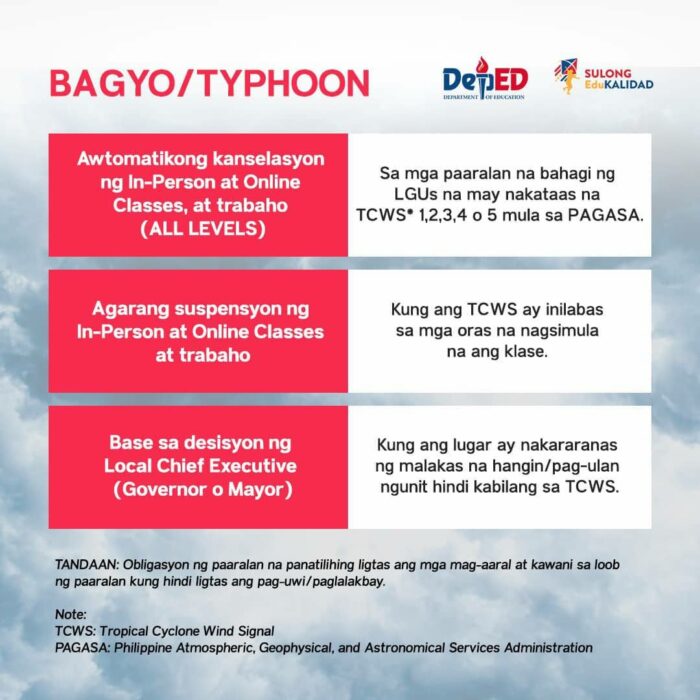
Here are the guidelines with regards to typhoon; In-person, online classes and work from Kindergarten to Grade 12 and Alternative Learning System (ALS) are automatically cancelled in schools situated in Local Government Units (LGUs) issued with Tropical Cyclone Wind Signals (TCWS) 1, 2, 3 ,4 or 5 by the Philippine Atmospheric, Geophysical, and Astronomical Services Administration (PAGASA).

You can get the latest weather updates and reports from PAGASA.

If the TCWS is issued at a time when classes have already begun, the school shall immediately suspend the classes and work and send everyone home, if it is safe to do so.

However, schools are obligated to keep the students and personnel safely in school if travelling has become unsafe.


1. Typhoon

Automatic Class Cancellation when there's a typhoon

In-person and online classes at all levels are automatically canceled in schools situated in Local Government Units (LGUs) issued with Tropical Cyclone Wind Signals (TCWS) 1, 2, 3,4, or 5 by the Philippine Atmospheric, Geophysical, and Astronomical Services Administration (PAGASA).

If the TCWS is issued at a time when classes have already begun, the school shall immediately suspend the classes and work and send everyone home if it is safe to do so. However, schools must keep students and personnel safe in school if traveling has become unsafe.

Local Chief Executives shall decide on the cancellation or suspension of classes in cases where there are strong winds in specific or all areas of the LGU but is not due to a typhoon.


2. Heavy Rainfall

Automatic Class Cancellation during Heavy Rainfall

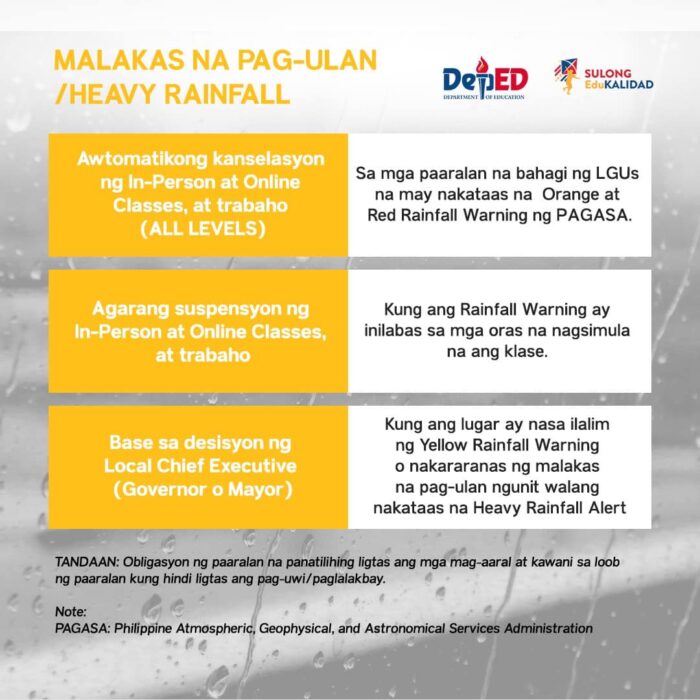
In-person and online classes at all levels are automatically canceled in schools situated in LGUs issued with Yellow, Orange, and Red Rainfall Warnings by the PAGASA.

If the Warning is issued when classes have already begun, the school shall immediately suspend the classes and work and send everyone home if it is safe to do so. However, schools are obligated to keep the students and personnel safely in school if traveling has become unsafe.

Local Chief Executives shall decide on the cancellation or suspension of classes in cases where there are torrential rains in specific or all areas of the LGU but is not issued a Heavy Rainfall Alert by PAGASA.


3. Flood

Class Cancellation when there’s a Flood

In-person and online classes in all levels are automatically canceled in schools situated in LGUs issued with a Flood Warning by the PAGASA.

If the Flood Warning is issued at a time when classes have already begun, the school shall immediately suspend the classes and work and send everyone home, if it is safe to do so. However, schools are obligated to keep the students and personnel safely in school if traveling has become unsafe.

Local Chief Executives shall decide on the cancellation or suspension of classes in cases where there is flooding in specific or all areas of the LGU but is not issued a Flood Warning by PAGASA.


ATTRACTIONS TO SEE IN MANILA 

Klook.com

4. Earthquakes

Class Suspension / Earthquake

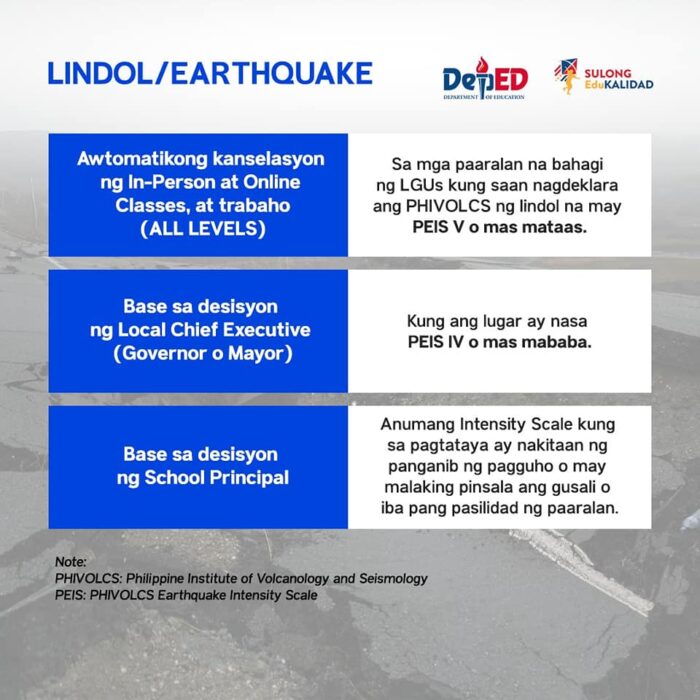
In-person and online classes in all levels are automatically canceled in schools situated in LGUs where the Philippine Institute of Volcanology and Seismology (PHILVOCS) declares an earthquake with PHILVOCS Earthquake Intensity Scale (PEIS) V or above.

Local Chief Executives shall decide on the cancellation or suspension of classes in cases where the PEIS is IV and below.

School Principals can cancel classes at any Intensity Scale if in their assessment, building and other structures are seen to be in danger of collapsing or is found to have major damage.

The School Disaster Risk Reduction and Management (DRRM) Team Head should clear the return of students and personnel in buildings and other structures.


5. Power Outages/ Power Interruptions/ Brownouts

Class Suspension during Power Outages

There will be no automatic cancellation or suspension of classes if there are power outages/power interruptions/brownouts in schools. If power outages/power interruptions and brownouts have resulted in a poor learning environment, school officials can cancel or suspend classes at their discretion.


6. Adjustments to Learning Delivery Due to Suspensions/Cancellations of Classes

If canceled or suspended classes occur, distance learning or make-up classes shall be implemented to ensure that learning competencies and objectives are still met.

In adherence to the provision of DepEd Order No. 14, s. 2021, learners who miss learning activities due to class suspensions brought about by various disruptions like disasters and/or emergencies due to natural or human-induced hazards shall be accorded due consideration in the completion of their learning tasks.


7. Maintenance of Workforce and Activation of DRRM Teams

Teaching school personnel, including ALS teachers, and non-teaching school personnel in schools, Division Offices, Regional Offices, and the Central Office, shall not be required to report to work, except those who are mandated to render security, safety, finance, engineering, sanitation, health, and disaster response duties.

Schools, on the other hand, must always be ready to implement remote work with measured output.

Central, Regional, and Schools Division Offices and schools shall activate their DRRM Teams to prepare, monitor, and respond to the situation. DRRM Team members, particularly DRRM Coordinators and Engineers, shall be required to report to work in the aftermath of the disaster to continue undertaking response, early recovery, and reporting based on established DRRM protocols (e.g., an inspection of school facilities to vet damages as reported by School DRRM Coordinators, detailed assessment of damaged facilities for purposes of developing the Program of Works for infrastructure costing in rehabilitation and recovery plans,  and participation in coordination meetings with LDRRMCs). Other DRRM Team members may likewise be required to report to work as needed.

Officials of private schools shall exercise discretion relative to the work arrangement of their DRRM personnel.


ACTIVITIES AND TOURS IN MANILA


8. Use of schools as Evacuation Center or COVID-19 Quarantine and/or Isolation Facility/Vaccination Center

Schools shall not be used as quarantine and/ or isolation facilities or vaccination centers. The authority given to Regional Directors in allowing schools to be designated as quarantine and/or isolation facilities/ vaccination centers under Office Memorandum OM-Osec-2020-004 (Guidance to Regional Directors for Action Requests by Local Government Units to Use DepEd Schools and Engage DepEd Personnel in Activities Related to COVID-19), is hereby lifted. Office Memorandum OM-OSEC- 2021-03-003 (Use of DepEd Classrooms and Other Facilities as Vaccination Centers) is likewise hereby repealed.

In other disasters, schools may be used as an immediate evacuation site that should not last more than fifteen days. LGUs should not use schools as long-term shelters for evacuees.


9. Conduct of Psychological First Aid

As the maintenance of a conducive learning environment requires addressing the immediate needs of affected learners and personnel in the aftermath of disasters, all Schools Division Offices, with the support of Regional Offices, shall assess Mental Health and Psychosocial Support needs and services and lead the conduct of Psychological First Aid (PFA). This shall include the mobilization of trained PFA providers and partners and if needed, referral pathways for learners and personnel identified for further specialized psychological support services. Required health standards shall always be applied.


10. Responsibility of Parents or Guardians

The DepEd still maintains that parents or guardians are responsible for determining whether their children should attend classes considering their physical and/or mental health during disasters and calamities. This applies even if no order for cancellation or suspension of classes has been issued.

However, it is also the responsibility of the parents or guardians to ensure that their child can catch up with the needed competencies that the learners should master.

For more information, read DO 37, s. 2022: https://bit.ly/DEPEDOR37


READ NEXT


New DepEd Class Suspension Guidelines (Order No. 37 S. 2022)


Here are the guidelines on the Suspension of Classes when typhoons and other calamities occur mandated by DepEd.


DepEd Class Suspension Guidelines

The Guidelines on the Implementation of Executive Order (EO) No. 66 dated January 9, 2012, entitled “Prescribing Rules on the Cancellation or Suspension of Classes and Work in Government Offices Due to Typhoons, Flooding, Other Weather Disturbances and Calamities, ” is issued to streamline the procedure on the suspension of classes and work in government offices in times of typhoons, floods, and other disasters or calamities to spare the pupils, students, teachers and government workers and the general public from unnecessary dangers to their lives and limbs.

RELATED: List of Emergency Numbers and Hotlines in the Philippines
Loading...


EMERGENCY KIT AND ESSENTIALS

Here are the best options to shop for your emergency kit and life essentials:

Shopee is my go-to app for things I needed like the ones above. If you'd like discounts and vouchers, you may get the best offers here:

Automatic Cancellation/Suspension of Classes

All concerned DepEd officials and personnel are directed to observe the weather bulletins of the Philippine Atmospheric Geophysical and Astronomical Services Administration (PAGASA) announced through various media outlets (radio, television, and internet).

You can get the latest weather updates and reports from PAGASA.


Storm Signal No. 1

When Signal No. 1 is raised by PAGASA, public and private preschool and kindergarten classes in the affected areas shall be automatically cancelled or suspended.


Storm Signal No. 2

When Signal No. 2 is raised by PAGASA, public and private preschool, kindergarten, elementary and secondary classes in the affected areas shall be automatically cancelled or suspended.


Storm Signal No. 3

When Signal No. 3 is raised by PAGASA, work in all DepEd offices in the affected areas shall be automatically cancelled or suspended.

DepEd Automatic Class Suspension Guidelines

Depending on signal numbers declared at 10:00 p.m. and 4:30 a.m. of the following day, classes in appropriate levels for the whole day are deemed automatically cancelled/suspended.

Afternoon classes in the appropriate levels in areas with signal numbers declared at 11:00 a.m. that day are likewise automatically cancelled/suspended.


Localized Cancellation/Suspension of Classes and Work

In the absence of typhoon signal warnings from PAGASA, localized cancellation/suspension of classes in both public and private schools and work in government offices may be implemented by local chief executives in their capacity as chairpersons of the Local Disaster Risk Reduction and Management (LDRRMC).

Concerned local DepEd and private school officials are directed to establish effective lines of communications with their respective local government units (LGUs).


ATTRACTIONS TO SEE IN MANILA 

Klook.com

Cancellation/Suspension of Classes and Work During Other Calamities

Decisions on and subsequent announcement of cancellation/suspension of classes in public and private schools and work in government offices in areas affected by disasters or calamities other than typhoons, such as but not limited to floods, earthquakes, tsunamis and conflagration, shall be made by the local government executive as chairperson of the LDRRMC, in coordination with the National Disaster Risk Reduction Management Council (NDRRMC), through all forms of mass media available under the circumstances.


Maintenance of Work Force

Regional and Division Offices shall activate their Regional or Division Disaster Risk Reduction Offices (DRRMO) to monitor the situation and keep lines of communications open.


Reporting

Standard reporting procedures between Regional and Division DRRMOs with the Central Office DRRMO applies.

Standard procedures in communicating with the LDRRMC and Regional Disaster Risk Reduction Management Council (RDRRMC) shall likewise apply.


ACTIVITIES AND TOURS IN MANILA


Announcements

The DepEd spokesperson, regional directors (RDs), schools division/city superintendents (SDSs), central, regional and division communication officers, in interviews, should only confirm or re-echo automatic cancellation/suspension of classes after it is officially published by PAGASA. No announcement should originate from the Department. If interviewed by media, announcement should always be made in reference to what PAGASA has already announced in areas under a typhoon signal, and to local chief executives in the absence of a typhoon signal.

Based on Section 3 of EO No. 66, announcement of local cancellation/suspension of classes shall be made by the local chief executives. In cases where urgent action is needed to prevent loss of life or bodily harm, the school head is expected to make the announcement and subsequently inform the local executive.


Absences of Tropical Cyclones/Storm Signal Warning

In cases where PAGASA has not raised any storm signal warning or declared the presence of a tropical cyclone, Regional and Division DRRMOs are directed to communicate with their counterpart RDRRMC and LDRRMC for any decision to cancel or suspend classes in their respective locality.


DepEd Class Suspension Guidelines