Showing posts sorted by relevance for query Baroque. Sort by date Show all posts
alamat ng paoay church paoay church buttresses paoay church history tagalog paoay church significance paoay church characteristics paoay church trivia paoay church period

Be amazed with this Baroque-style church in the Philippines!


I have visited this place twice (in 2012 and 2013) and both visits I was in awe of this church's beauty. It's truly a breathtaking scene you can only see here in Ilocos Norte.

Loading...

About Paoay Church

The Saint Augustine Church (Spanish: Iglesia de San Agustín de Paoay), commonly known as the Paoay Church, is the Roman Catholic church of the municipality of Paoay, Ilocos Norte in the Philippines.
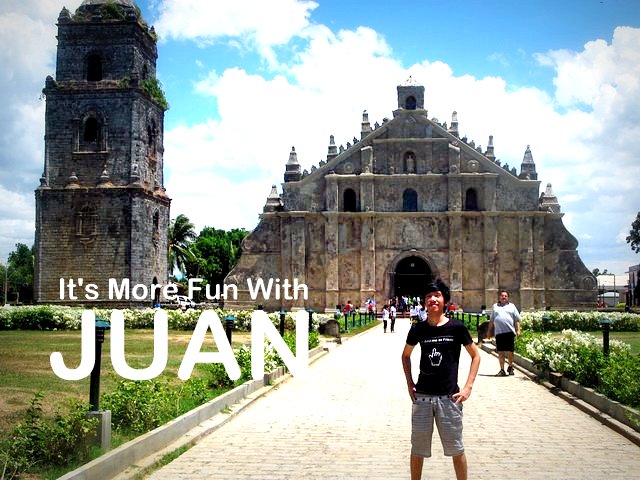
Me at Paoay Church in 2012

Completed in 1710, the church is famous for its distinct architecture highlighted by the enormous buttresses on the sides and back of the building.

The church is declared as a National Cultural Treasure by the Philippine government in 1973 and a UNESCO World Heritage Site under the collective group of Baroque Churches of the Philippines in 1993.


PAOAY'S PAST

The town of Paoay was originally called "Bombay" as the earliest inhabitants believed to have come from India. The earliest historical record of the area dates back to 1593, becoming an Augustinian independent parish in 1686.Building of the present church was started in 1894 by Augustinian friar Father Antonio Estavillo, completed in 1710 and rededicated in 1896.

Some portions of the church was damaged in the 1865 and 1885 earthquake but was later restored under the initiative of former First Lady Imelda Marcos.


Paoay church is the Philippines' primary example of a Spanish colonial earthquake baroque architecture dubbed by Alicia Coseteng, an interpretation of the European Baroque adapted to the seismic condition of the country through the use of enormous buttresses on the sides and back of the building. 

The adaptive reuse of baroque style against earthquake is developed since many destructive earthquakes destroyed earlier churches in the country. Javanese architecture reminiscent of Borobudur of Java can also be seen on the church walls and facade.


The Buttresses

The most striking feature of Paoay Church is the 24 huge buttresses of about 1.67 metres (5.5 ft) thick at the sides and back of the church building.

Paoay Church 2013

Extending from the exterior walls, it was conceived to a solution to possible destruction of the building due to earthquakes. Its stair-like buttresses (known as step buttresses) at the sides of the church is possibly for easy access of the roof.


The Walls
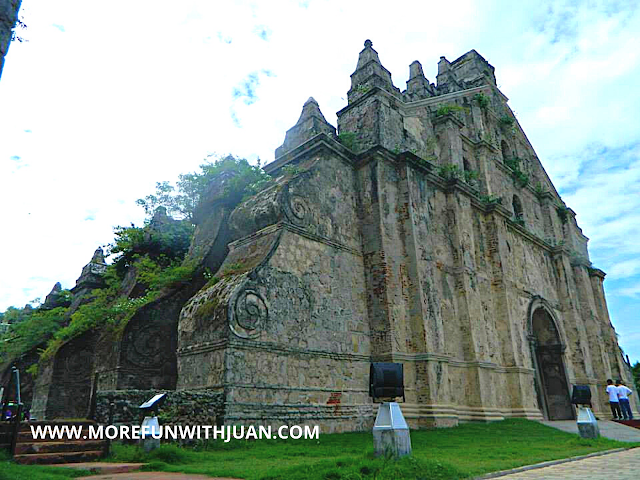
Paoay Church 2013

Its walls are made of large coral stones on the lower part and bricks at the upper levels. The mortar used in the church includes sand and lime with sugarcane juice boiled with mango leaves, leather and rice straw. Its walls suggests Javanese architectural styles.


The Façade 

The stone facade appear as massive pediment rising from the ground and is built leaning towards the front. Square pilasters and stringed cornices divide the facade vertically and horizontally respectively. Its bottom part is plain.

Paoay Church 2013

Gothic features are also present through the use of finials while the triangular pediment shows Chinese elements and Oriental strokes. Crenellations, niches, rosettes and the Augustinian coat of arms can also be seen. Façade is made of brick on the lower level and coral stones on the upper level.


The Bell Tower 

Adjacent to the facade is a three-storey coral bell tower constructed separately from the church building on the right side resembling a pagoda. It was in 1793 when the cornerstone of the bell tower was laid.

Paoay Church 2013

It stands at some distance from the church as a protection against earthquake. It served as observational post for Filipino revolutionaries against the Spaniards in 1898 and by Filipino guerrillas against Japanese soldiers during World War II.

ALSO READ: The Sinking Bell Tower of Laoag City

You may also want to see the church's ruined convent just across the street.


ATTRACTIONS TO SEE IN ILOCOS NORTE 

Klook.com

RESTORATION

Several projects for the restoration of Paoay Church is sought by government and non-government organizations due to possible question on its structural integrity.

The local government of Ilocos Norte through resolution is seeking the reconstruction of the church's convent presently in ruins and retrofitting of the church.

Here's me during my first (2012) and second (2013) visits.

TRAVEL TIPS:

  • Don't forget to visit the Jardin De San Agustin. It's picturesque and worth a photo-op for.
  • Make sure to drop by Herencia de Paoay across the church, where you can sit and eat, and buy some Ilocandia stuff at.
  • Try eating at Herencia Restaurant.
  • There's a lot of cafe and shop you can eat from.
  • There are also lodging houses nearby the area.


ACTIVITIES AND TOURS IN MANILA

Frequently Asked Questions (FAQs) About Paoay Church


  • Why is Paoay Church famous?
    Paoay Church is famous because of its historical significance and its baroque architecture. The historical church is famous for its distinct architecture highlighted by the enormous buttresses. Portions of the church were damaged by two major earthquakes

  • What is the famous church in Paoay?
    The Saint Augustine Church, famously known as the Paoay Church, takes you back to the Philippine's Spanish colonial era with its charming baroque architecture.

  • What is the purpose of the 24 heavy buttresses of Paoay Church?
    The most striking feature of Paoay Church is the 24 huge buttresses of about thick at the sides and back of the church building. Extending from the exterior walls, it was conceived to a solution to possible destruction of the building due to earthquakes.

  • What is the Paoay church made of?
    Known as the “Earthquake Baroque” church in the Philippines, Paoay church was built of baked bricks, coral rocks, salbot (tree sap) and lumber, and has 24 carved massive buttresses for support.

  • What makes Paoay Church outstanding from other well known churches around the country?
    What makes Paoay Church outstanding from other well-known churches around the country is its impressive pyramid-like structure considered as a primary example of the earthquake baroque style of architecture characterized by its thick walls made from coral stones and bricks.


HOW TO GET TO PAOAY CHURCH

Paoay Church is located in the Municipality of Paoay. There are tricycles you can rent from Laoag for a day tour around Paoay. Or you can book a hassle-free day tour via Klook. 

LAOAG CITY can be accessed by the following:

For complete details, visit - LAOAG TRANSPORTATION GUIDE

For airfare and transportation, you may check PISO FARE promos or you can directly compare air, sea and land travel fare and prices here:

WHERE TO GO IN ILOCOS?

Batac   Burgos   Laoag   Pagudpud   Paoay   Vigan


IMPORTANT NOTE: The rates, contact details and other information indicated in this post are accurate from the time of writing but may change without IMFWJ's notice. Should you know the updated information, please let us know by leaving a message in the comment box below.

PAOAY CHURCH: A UNESCO World Heritage Site in Ilocos Norte (San Agustin Church)


Everything you need to know about San Agustin Church in Intramuros, Manila.

This church is not only one of the oldest but one of the most beautiful churches in the Philippines. I'm glad that I got to see the church personally when I had my Intramuros walk tour last month.


The Church of Saint Augustine also known as the Archdiocesan Pontifical Shrine of Our Lady of Consolation and Cincture or the Immaculate Conception Parish, is a Roman Catholic church under the auspices of the Order of Saint Augustine located inside the historic walled city of Intramuros in Manila, Philippines. Completed in 1607, it is the oldest stone church in the country.

Loading...

In 1993, San Agustin Church was one of four Philippine churches constructed during the Spanish colonial period to be designated as a World Heritage Site by UNESCO, under the collective title Baroque Churches of the Philippines.

San Agustin Church during my photo walk in 2022

It was named a National Historical Landmark by the Philippine government in 1976.

Pope John Paul II granted a canonical coronation towards its enshrined Marian image of "Our Lady of Consolation" on 4 September 2000.


San Agustin Church in Details

Names:
  • Archdiocesan Shrine of Our Lady of Consolation and Cincture
  • Immaculate Conception Parish
  • Santuario Arquidiocesano de Nuestra Señora de la Consolación y Correa
  • Simbahan ng San Agustin
  • Iglesia de San Agustín

San Agustin Church facade
Location: Intramuros, Manila
Country: Philippines
Denomination: Roman Catholic
Former name: Iglesia de San Pablo de Manila
Founded: 1571
Founder(s): Order of St. Augustine (Province of the Most Holy Name of Jesus of the Philippines)
Dedication: St. Paul
Consecrated: 1607
Functional status: Active
Heritage designation: World Heritage Site
Designated: 1993
Architect: Juan Macías
Style: Baroque
Groundbreaking: 1586
Completed: 19 January 1607
Length: 67.15 m (220.3 ft)
Width: 24.93 m (81.8 ft)
Number of spires: 1 (a second bell tower was destroyed in 1880)
Materials: Adobe stones
Province: Manila
Archdiocese: Roman Catholic Archdiocese of Manila


UNESCO World Heritage Site

Official name: Immaculate Conception Parish - San Agustin Church
Part of: Baroque Churches of the Philippines
Criteria: Cultural: (ii)(iv)
Reference: 677bis-001
Inscription: 2037 (60th Session)
Extensions: 2013
Area: 2.43 ha (262,000 sq ft)
Buffer zone: 106.13 ha (11,424,000 sq ft)


San Agustin Church History

San Agustin Church is located in General Luna St, Manila, Metro Manila. The present structure is actually the third Augustinian church erected on the site.

The first San Agustin Church was the first religious structure constructed by the Spaniards on the island of Luzon. Made of bamboo and nipa, it was completed in 1571, but destroyed by fire in December 1574 during the attempted invasion of Manila by the forces of Limahong.

A second wooden structure built on the same site was destroyed in February 1583 by a fire that started when a candle ignited drapery on the funeral bier during services for Spanish Governor-General Gonzalo Ronquillo de Peñalosa.


The Augustinians decided to rebuild the church using stone, and to construct an adjacent monastery. Construction began in 1586, based on a design by Juan Macías. The structure was built using hewn adobe stones quarried from Meycauayan, Binangonan and San Mateo, Rizal.

The monastery was operational by 1604, and the church was formally declared complete on 19 January 1607 and named Church of St. Paul of Manila.

Cheapest Flights and Airline Tickets Online Booking

San Agustin Church during Earthquakes

On 3 June 1863, the strongest earthquake at that time hit Manila leaving widespread destruction to the city, with San Agustin Church the only public building left undamaged.

A series of strong earthquakes struck Manila again on 18–20 July 1880. This time, the tremors left a large crack in the east bell tower. The crack was eventually repaired, but the left tower was permanently removed with only the base remaining today.

San Agustin Church after the 1880 earthquake

The church withstood the other major earthquakes that struck Manila before in 1645, 1699, 1754, 1796, 1825, 1852, 1863 and 1880 and served as a hospital for several of those injured during the earthquake in 1863.


San Agustin Church Architecture

The San Agustin Church is patterned after some of the magnificent temples built by the Augustinians in Mexico. The present edifice was built in 1587, and completed, together with the monastery, in 1604. The atmosphere is medieval since "both church and monastery symbolize the majesty and equilibrium of a Spanish golden era."

San Agustin Church interior

The massive structure of the church is highlighted by the symmetry and splendor of the interiors (painted by two Italians who succeeded in producing trompe l'oeil) – the profile of the mouldings, rosettes and sunken panels which appear as three-dimensional carvings, a baroque pulpit with the native pineapple as a motif, the grand pipe organ, the antechoir with a 16th-century crucifix, the choir seats carved in molave with ivory inlays of the 17th century and the set of 16 huge and beautiful chandeliers from Paris.

The church was renovated in 2013, with its colorful facade replaced by a sedate stone-colored one. San Agustin Church is currently administered by the Augustinian friars of the Province of the Most Holy Name of Jesus of the Philippines.

A 2022 online study conducted by home services website Angi found out that the church is the "most beautiful building in the Philippines".


OTHER CHURCHES TO VISIT IN MANILA


Convento de San Agustin

San Agustin Church and its adjacent convent, Convento de San Agustin, served as the provincial house and headquarters of the Augustinian Province of the Most Holy Name of Jesus of the Philippines of Spain ever since the province's founding in 1575 until 1901, when it transferred to Madrid. It once again became the headquarters of the Province in 1927, during the tenure of Fr. Gaudencio Castrillo, O.S.A. until just after the Second World War.


San Agustin Museum

This is the museum with a collection of artifacts & artwork in a former monastery adjacent to a San Agustin Church.

The famous path inside San Agustin Museum

The San Agustin Museum and Cultural Center right beside it has two floors, several galleries, and hallways that showcase religious art. Notable displays include recreated pharmacy pots from the 16th century, litograph prints of Philippine flowers, and shelves with books dating all the way from 1522.


Famous Burials at San Agustin Church

The church, as in its custom in its heyday, contained niches for burials of bones and remains. The following are notable burials within the premises of the church.
  • Miguel López de Legazpi
  • Juan de Salcedo
  • Guido de Lavezaris
  • Juan Luna
  • Blessed Pedro Zuñiga
  • Francisco Alonso Liongson
  • Benito Natividad
  • Teodoro Agoncillo


How to Get to San Agustin Church

San Agustin Church is located in the heart of Intramuros, the walled district in Manila.

Getting to Intramuros by Train
The three main train lines running in Metro Manila can take you near Intramuros: Light Rail Transit (LRT) 1 and 2, and the Manila Metro Rail Transit. 

Anyone coming in from nearby cities or provinces can get off the station nearest to them and still reach Intramuros because all three lines are connected.

MRT and LRT1 connect at Baclaran and North Avenue Stations, MRT and LRT2 meet at Araneta-Cubao, and LRT1 and 2 are joined at Doroteo Jose.

The station closest to Intramuros is the LRT1 Central Terminal Station. LRT1 runs from Baclaran to Monumento.

Once you get to Intramuros, take a walk to General Luna St. cor Real St.

Getting to Intramuros by Jeepneys (PUJs)
Jeepneys are the KINGS of Manila's road. Of course, there's a jeepney route to Intramuros, too! Here are different routes you can take from several points in Metro Manila. See my full Intramuros Commuting Guide to know more.

Getting to Intramuros by a Private Car
If you plan to bring your own vehicle, please note that the parking in this area is limited. (Check out my list of best parking spots in Intramuros)

However, you can follow driver directions from Waze or Google Maps.


ATTRACTIONS TO SEE IN MANILA 

Klook.com

San Agustin Church

Address: General Luna St, Intramuros, Manila, 1002 Metro Manila
Phone Number: (02) 8527 2746


San Agustin Church Mass Schedule

  • 8:00 AM / 10:00 AM / 6:00 PM (Sunday)
  • 6:45 AM / 5:30 PM (Monday – Friday)
  • 7:00 AM / 5:30 PM (Saturday)


San Agustin Museum Entrance Fee

  • P200: Adults
  • P160: Students, PWDs, Seniors, & Frontliners


Attractions Near San Agustin Church

Here are famous tourist spots near San Agustin Church:


ACTIVITIES AND TOURS IN MANILA


WHERE TO STAY IN MANILA

Pearl Manila Hotel

Here's a list of hotel accommodation you can book in Manila:


IMPORTANT NOTE: The rates, contact details and other information indicated in this post are accurate from the time of writing but may change without IMFWJ's notice. Should you know the updated information, please let us know by leaving a message in the comment box below.

SAN AGUSTIN CHURCH: Guide to Immaculate Conception Parish (History & Mass Schedule)


All you need to know about one of the oldest churches in Manila, Philippines.


The Our Lady of Remedies Parish, also known as Malate Church (Spanish: Iglesia Parroquial de Malate), is a parish church in the district of Malate in the city of Manila, Philippines.

This Mexican Baroque-style church is overlooking Plaza Rajah Sulayman and, ultimately, Manila Bay. The church is dedicated to Nuestra Señora de los Remedios, the patroness of childbirth.

RELATED: List of Basilica Churches in the Philippines (and Where to Find Them!)

Loading...

A revered statue of the Virgin Mary in her role as Our Lady of Remedies was brought from Spain in 1624 and stands at the altar.

Malate used to be known as Maalat due to the saline waters of the bay; and as Laguio or Lagunoi, the name of the street which separated it from Ermita. It is located by Manila Bay, very close to the sea.

One main street crosses it at the center. It is wide and beautiful and leads up to Cavite. The numerous trees make this road a pleasant walk. It lies just three kilometers from the center of Manila.


Malate Church in Details

Nuestra Señora de los Remedios
Names: Our Lady of Remedies Parish, Iglesia Parroquial de Malate, Parroquia Nuestra Señora de los Remedios
Location Manila
Country: Philippines
Denomination: Catholic
Religious institute: Columbans
Website: malatecatholicchurch.org
Status: Parish church
Dedication: Nuestra Señora de los Remedios
Consecrated: 1588, 1624
Heritage designation: National Historical Commission of the Philippines
Designated: 1937
Architectural type: Parish church
Style: Baroque, Neo-Mudejar
Materials: Stone, Sand, gravel, cement, mortar and steel
Subdivision: Vicariate of Nuestra Señora de Guia
Archdiocese: Manila


Malate Church Foundation

The Augustinian Chapter held on 18 September 1581 accepted the house of Maalat as a house of the Order under the name of Lagunoi and the advocation of the Conception of Our Lady (Immaculate Conception). In the Chapter held on 17 May 1590, three resident priests of the monastery of San Agustin (Manila) were charged with the care of the natives of Malate; they were Frs. Alfonso de Castro, Diego Munoz and Ildefonso Gutierrez. The report of the Father Provincial of 1591 reveals that the house of Malate together with Lagunoi has 1,200 persons, convent and church. In 1639, the convent of Malate contributed to the patriotic campaign of Governor-General Sebastián Hurtado de Corcuera, former governor of Panama, who brought Peruvian soldiers to fight against pirates, with a donation of two bells of seven arrobas and seven libras (154 kg. & 220 g.).

In 1624, Fr. Juan de Guevara brought from Andalucía, Spain, the image of the Virgen de los Remedios which was said to be miraculous. It "had graceful features," says San Agustin, "was half vara high (417 mm.) and slightly brown." Fr. Castro's version is different. "I saw the image a thousand times," writes Castro, "but she never looked brown to me, but rather white with hands and face of white ivory." The devotion to the Virgen de los Remedios made Malate a very famous sanctuary. People flocked to venerate the image, especially on Saturdays. Women presented their babies to the Virgin.

Except for a short time, Malate was always administered by the Augustinians. The priest of Malate also administered the town of Ermita from 1591 to 1610, since the two barrios had been united by Governor-General Gómez Pérez Dasmariñas with the approval of Bishop Domingo de Salazar, O.P. Pasay separated from Malate under the name of Pineda on 17 May 1863.

View of Malate Church in 1831 as seen by French Captain Cyrille Pierre Théodore Laplace

Malate was also a place of recreation for the residents of the Walled City and a meeting place for noblemen, Tagalogs and their kings like Rajah Matanda and Rajah Soliman. It easily became "the most aristocratic barrio of Manila where Spaniards and mestizos dwelt."

Cheapest Flights and Airline Tickets Online Booking

Construction of Malate Church

In 1591, Malate had only one church and one convent. The church and convent dedicated to the Nativity of Our Lady (Conception) were damaged heavily by the 1645 Luzon earthquake. San Agustin describes the latter as "a magnificent work of arches and stone." Then in 1667, both structures were destroyed on orders of Gov. Sabiniano Manrique de Lara due to the threat posed by the pirate Koxinga.

In 1669, the father provincial placed the convent of Malate under his immediate care and authorized the prior to use the "repository of alms for the dead" for the construction of the buildings. Fr. Dionisio Suarez began the construction of a new church (the second one) and convent made of bricks and stone in 1677–1679. It was completed by Fr. Pedro de Mesa in 1680.


In 1721, the convent was in ruinous condition, and the coffers of the house empty. The father provincial sent a circular to the various ministries of the Tagalogs available. Furthermore, the convent was relieved of the obligation to pay rent to San Agustin Monastery. The money raised amounted only to 400 pesos, just enough to buy the materials. The construction work proceeded very slowly because the prior depended almost completely on funds of the provincial.

There was some restoration work which was headed by Fr. Nicolas Dulanto who was also responsible for the completion of the upper part of the facade between 1894 and 1898. The next decades saw the church attract more devotees. But when the holocaust of 1945 came, the church and convent ended up in complete ruins and the records were also burned to ashes.

Inside Malate Church in 1939

The old convent was demolished in 1929. Fr. Gary Cogan built a new one in 1930. One of the remaining bells displayed at the entrance of the new convent has this inscription: "Nuestra Senora de los Remedios. Se fundio en 30 de Enero de 1879."


Architecture of Malate Church

Malate Church is one of only two that has twisted columns and has in effect a retablo-type façade, the other being the Franciscan church in Daraga.

If Santa Ana was the summer resort by the Pasig River from the 17th to the 19th centuries, Malate was its counterpart by Manila Bay. Seaside villas beautified the place as a virtual college town emerged, with St. Scholastica's College and De La Salle College on the south, University of the Philippines and Ateneo Municipal on Padre Faura Street on the north and some, other private schools within the boundaries of the college town.

Malate Church was considered to be a dangerous stronghold if captured by enemy forces, as stone churches outside Intramuros can be a convenient cover. When the British occupied Manila in 1762 they operated from the church's tower and Manila was subsequently sacked.


Exterior

There is interplay of Muslim design and Mexican Baroque. Says one writer, "it is in the design of the facade where the significance of the Malate Church lies." The juxtaposition of Mexican Baroque and Muslim design has resulted in an interesting colonial style, "mudejarisimo Filipino," in the words of Alice Coseteng in her book, Spanish Churches in the Philippines.

The design of the church façade is unusual with the use of trefoil blind arches which clearly indicate an influence of the Moorish art. The large opening of the lower level is balanced by the blind trefoil openings of the second and the semi-circular niche of the third. Laid out across the tiers like cornices are diamond and rectangular designs, as well as the shallow, ornamental relief work which suggest Muslim art. Few openings suggest massiveness in the design. The attached bell towers give an impression of solidity and strength by their massiveness which tries to squeeze the middle part of the façade.

Malate Church Interior
Interior

Enshrined in the main altar is an image of Our Lady of Remedios. It was brought from Spain by the Augustinians who were administering the church in the 16th century. This image is popular with the mothers who have sick children; they manifest their devotion by lighting special candles and pouring forth their private petitions.


OTHER CHURCHES TO VISIT IN MANILA


ATTRACTIONS TO SEE IN MANILA 

Klook.com

How to Get to Malate Church

Malate Church can be easily reached by Jeepneys or a 15 minute walk from the nearest LRT Station (Quirino).

See the map below for directions and guide:


ACTIVITIES AND TOURS IN MANILA


Malate Church

Address: 2000 M. H. Del Pilar St, Malate, Manila
Phone Number: (02) 8400-5876 to 77, (02) 8523-2593
Telefax: (02) 8524-6866
Email Address: contact@malatecatholicchurch.org


Malate Church Mass Schedule & Other Services

MON to FRI
  • 7:00 AM
  • 6:00 PM

SAT
  • 7:00 AM
  • 8:00 AM (Children's Mass)
  • 6:00 PM (Anticipated Mass)

SUN
  • 6:00 AM (Tagalog)
  • 8:00 AM (Tagalog)
  • 9:30 AM (Tagalog)
  • 12:30 PM (English)
  • 3:30 PM (English)
  • 5:00 PM (Tagalog)
  • 6:30 PM (Tagalog)
  • 8:00 PM (English)

BAPTISM
Saturdays & Sundays
11:00 AM


WHERE TO STAY IN MANILA

Pearl Manila Hotel

Here's a list of hotel accommodation you can book in Manila:


IMPORTANT NOTE: The rates, contact details and other information indicated in this post are accurate from the time of writing but may change without IMFWJ's notice. Should you know the updated information, please let us know by leaving a message in the comment box below.


MALATE CHURCH: Guide to Our Lady of Remedies Parish (History & Mass Schedule)