Showing posts sorted by date for query belfry. Sort by relevance Show all posts

Siquijor Church, officially known as the St. Francis of Assisi Parish Church, is urrounded by waving palms and set against the backdrop of the coast, the church felt like the island’s gentle greeting—quiet, welcoming, and full of soul.

It’s not just a religious building. It’s a historic landmark that silently tells stories of Spanish rule, Filipino resilience, and the enduring faith of the people of Siquijor - Siquijodnons.


Fun Facts


The church is located near the welcome signage of Siquijor.

The freestanding bell tower across the road offers a picturesque frame for photos and a reminder of the island’s coastal defenses during Spanish rule.

Its location makes it a peaceful stop as you begin or end your Siquijor trip.

The church is often used for town events, religious processions, and festivals, especially during St. Francis of Assisi's feast day every October 4.


\

A Brief History and Cultural Importance


Built: Originally in 1795 by secular clergy, then expanded by the Augustinian Recollects

Patron Saint: St. Francis of Assisi, known for his humility and love for nature

Architecture: Typical Spanish colonial design made from coral stones and hardwood, with a detached bell tower (belfry) nearby

Belfry: Used historically as a watchtower against pirates—now a symbol of the town

Declared as: One of the oldest churches in Siquijor, and a cultural landmark in the province


This church has withstood earthquakes, storms, and time itself. Its thick coral walls, exposed wooden beams, and antique altars preserve centuries of religious and community life on the island.

Loading...

How to Get There

Located just a few steps from the Siquijor Port, the church is hard to miss.


From Siquijor Port: Less than 5 minutes by foot

From Larena: ~14 km or 20–30 minutes by tricycle/scooter

From San Juan: ~17 km or 30–40 minutes

By Tricycle: ₱300–₱500 round trip, depending on origin

By Scooter: ₱300–₱400/day

Perfect for your first or last stop on the island, especially if you’re arriving or departing via Siquijor Town.

For hassle-free experience, you can book a full-day tour on Klook. Get up to 5% discount when you use JUANKLOOK on your next booking!


Mass Schedule


Sundays: 6:00 AM, 8:00 AM, and 5:00 PM

(Check locally or on signage for updated schedules)


Best Time to Visit


Opening Hours: 6:00 AM – 6:00 PM

Best Time:

  • Early morning or before sunset for peaceful ambiance and beautiful lighting

  • Try to time your visit with a Mass to experience the local community


What to Bring and What to Wear


Water (shops nearby for snacks or refreshments)

Camera or phone (but be respectful during Mass)

A shawl or wrap if entering during service hours

Modest, respectful attire

Light clothes and comfy footwear (stone paths can be uneven)


Visiting Tips


Take a moment to sit inside and absorb the silence—it’s wonderfully meditative.

Walk around the area; you’ll find welcome signage, coastal views, and souvenir shops.

Pair your visit with a meal in one of the local eateries near the port before heading to or from your next adventure.


Siquijor Church is more than a religious site—it’s the heartbeat of the town. It stands quietly as a spiritual guardian to those coming ashore and a steady reminder of the island’s faith, culture, and deep connection to its history.


Compare Prices on Other Travel Apps

To make sure you are getting the best deals, always compare prices with other booking apps. Here are some of the top travel apps that I use frequently:

Explore Siquijor!

This is part of my exploration in Siquijor Island in 2014. Here are the places I visited in the Isla del Fuego:
North Haven Lodge in Larena

Where to Stay in Siquijor

Here are some recommended accommodations:

  • Coco Grove Beach Resort – A luxurious beachfront resort in San Juan.

  • White Villas Resort – A mid-range resort with excellent amenities.

  • U Story Guesthouse – A charming, budget-friendly option with a relaxing vibe.

  • Infinity Heights Resort – Offers stunning hilltop views.

  • North Haven Lodge – Affordable lodging near Larena Port.

SIQUIJOR CHURCH: Guide to St. Francis of Assisi Parish (History and Mass Schedule)


Looking for free things to do this weekend? Let's go to this historical places in Manila!


Planning to go to Intramuros soon? You might be thinking of things to do and places to visit inside the walled city. You're not alone. I, myself haven't explored most of Intramuros' spots and attraction given that I have already visited here for a few times. The fact that this piece of land in Manila is so wide, it would take you a whole day to tour around the district.

That's why I created this list for you to know the right spots perfect for selfies and update your Instagram feed without even touching your wallet!

Loading...

WHAT TO BRING FOR MANILA

Here are some things you might consider bringing with you for your day tour / adventure:

Shopee is my go-to app for things I needed like the ones above. If you'd like discounts and vouchers, you may get the best offers here:

Here's a list of best selfie spots in Intramuros:


Manila Cathedral

The Minor Basilica of the Immaculate Conception or Manila Cathedral is the seat of the Roman Catholic Archdiocese of Manila, making it one of the most important churches in the country.

Manila Cathedral

Since its inception in 1581, the church has been renovated and restored multiple times (most remarkably after the 1945 Battle of Manila), with the current style being Neo-Romanesque. It was consecrated in 1958. 

Best Selfie Spot: Facade of Manila Cathedral
Entrance: FREE
Best Time to Visit: 8am to 6pm
Location: Cabildo, 132 Beaterio St, Intramuros, Manila


Plaza Roma

Plaza Roma is bound by other notable destinations such as the Manila Cathedral, Palacio del Gobernador, and Ayuntamiento. It’s considered as the city’s plaza mayor or main square, where many public events like bullfights were held.

Plaza Roma

Plaza Roma was turned into a garden in 1797, with a monument of King Carlos IV of Spain at the center. The king was regarded for having dispatched a shipment of smallpox vaccine to the Philippines. 

Best Selfie Spot: near the fountain
Entrance: FREE
Best Time to Visit: 8am to 6pm
Location: In front of Manila Cathedral


Aduana Ruins

The Aduana Building, also known as the Intendencia, was a Spanish colonial structure in Manila, Philippines that housed several government offices through the years.

Aduana Ruins

It is located in front of the BPI Intramuros at Plaza España, Soriano Ave. corner Muralla St. in Intramuros.

Best Selfie Spot: façade of the building
Entrance: FREE
Best Time to Visit: 8am to 6pm
Location: Magallanes Dr, Intramuros, Manila


Ayuntamiento de Manila

The Ayuntamiento de Manila (Manila City Hall) is a building located at the corner of Andrés Soriano Avenue (formerly, Calle Aduana) and Cabildo Street, fronting Plaza de Roma in Intramuros, Manila.

Ayuntamiento de Manila

Also known as the Casas Consistoriales and also nicknamed as the Marble Palace, the Ayuntamiento was the seat of the Manila City Council, which consisted of two alcaldes (city leaders), eight oidores (judges), a clerk, and a chief constable. Destroyed in World War II and reconstructed thereafter, the building now houses the offices of the Bureau of the Treasury.

Best Selfie Spot: façade of the building
Entrance: FREE
Best Time to Visit: 8am to 6pm
Location: near Plaza Roma


Palacio Del Gobernador

The Palacio del Gobernador (transl. Governor's Palace) is a government building located in Intramuros, Manila, Philippines. It is located southwest from Plaza de Roma and built in its current form in 1976. The building's exterior was used in the Chuck Norris film Delta Force 2: The Colombian Connection for a scene set in Rio de Janeiro during a Brazilian Carnaval parade.

Palacio Del Gobernador

At present, the building houses the Intramuros Administration, the Commission on Elections and the Home Development Mutual Fund National Capital Region Office. It also previously housed the Bureau of the Treasury until it relocated across Plaza de Roma to the Ayuntamiento de Manila.

Best Selfie Spot: façade of the building
Entrance: FREE
Best Time to Visit: 8am to 6pm
Location: near Plaza Roma


Cheapest Flights and Airline Tickets Online Booking

Baluarte de Dilao

Built in 1592 by the Spanish government to deter threats and invasion by other countries. Renovated in 1622. The area was much larger than what it is right now, the area that you'll see is the restored structure, for the whole area was destroyed during the American liberation of Manila from the Japanese occupation in 1845.

Baluarte de Dilao

Best Selfie Spot: near the canons
Entrance: FREE
Best Time to Visit: 10am to 5pm
Location: east part of Intramuros


Intramuros Walls

I haven't known it for a long time but yes, you can actually walk on the walls of Intramuros.

Intramuros Walls

These walkways are about 2 meters wide and barricaded with bricks. Due to its oldness, most of the pathways are hard to walk on.

Best Selfie Spot: walkway on the walls
Entrance: FREE
Best Time to Visit: 9am to 6pm
Location: several parts of Intramuros


Muralla Street

Muralla Street is one of the longest roads in Intramuros. It runs from the south end through the east part of the walls until the north end near Plaza Espana.

Muralla Street

Just like Muralla, streets in the district are generally narrow as they were designed at a time when there were no motor vehicles like automobiles, jeepneys, buses or trucks. Today, Muralla Street is nicely paved with asphalt.

Best Selfie Spot: near the fountain
Entrance: FREE
Best Time to Visit: 8am to 6pm
Location: east side of the wall


Real Street

Because of its cobblestones, Real is the most visited street in Intramuros. Real St. runs through the heart of Intramuros and connects the eastern (Puerta del Parian) and western walls (Puerta de Santa Lucia).

Real Street

Famous landmarks located along Real St. are Casa Manila and San Agustin Church.

Best Selfie Spot: near Casa Manila
Entrance: FREE
Best Time to Visit: 8am to 6pm
Location: mid part of Intramuros

ALSO IN MANILA

San Agustin Church

Completed in 1607, San Agustin Church is the oldest stone church in the country. The church, together with the monastery nearby, was the only structure left standing after World War II. The current structure is actually the third version of the church which survived several natural disasters through time.

San Agustin Church

In 1993, San Agustin Church was one of four Philippine churches constructed during the Spanish colonial period to be designated as a World Heritage Site by UNESCO, under the collective title Baroque Churches of the Philippines. It was named a National Historical Landmark by the Philippine government in 1976.

Best Selfie Spot: façade of the church
Entrance: FREE
Best Time to Visit: 10am to 5pm
Location: General Luna St, Intramuros, Manila


ATTRACTIONS TO SEE IN MANILA 

Klook.com

Puerta del Parian

Puerta Del Parian is among the eight gates that serve as an entrance to the Walled City of Intramuros. The gates were called Puerta, which is the original Spanish word for "gate." Hence, the name Puerta del Parian means "Gate of the Market," signifying its crucial role in Philippine history. 

Puerta del Parian

From the Spanish colonial times to the British occupation is 1762-1764, as this was the place where many enterprising Chinese traded goods. Today, you can enter the gate for free to access the ASEAN Gardens from Muralla St.

Best Selfie Spot: façade of the gate
Entrance: FREE
Best Time to Visit: 9am to 5pm
Location: west part of the wall


ASEAN Garden

The ASEAN Garden was inaugurated in 1993 as an expression of the Philippines' solid commitment to ASEAN. Located near the Parian Gate, at the corner of P. Burgos Drive and Victoria Street, the Garden remind us that peace and prosperity thrives among these ASEAN nations.

ASEAN Garden

The garden is also a home to the busts of the founding fathers, from Southeast Asian nations. It features an assortment of trees and shrubs from the ten participating nations.

Best Selfie Spot: near the bridge and trees
Entrance: FREE
Best Time to Visit: 10am to 5pm
Location: north east of Intramuros walls


Baluarte de San Gabriel

Another entrance free bastion in Intramuros is the Baluarte de San Gabriel. This area is one of the 7 bastions in the wall city.

Baluarte de San Gabriel

Baluarte de San Gabriel is situated nearby to the park Plazuela Madre Francisca del Espiritu Santo de Fuentes and the garden Boy & Girl Scouts Memorial Triangle.

Best Selfie Spot: the open field
Entrance: FREE
Best Time to Visit: 9am to 5pm
Location: north east of Intramuros walls


Intramuros Walking Tour Map

Here's a map guide for Intramuros:


You can also download a copy of any of the following maps for your Intramuros tour:

For hassle-free and more educational tour, I suggest that you get a DOT Accredited tour guide for your visit to Intramuros. Or you can visit my complete DIY guide to the walled city.

If want to see more, check out my list of 20+ Most Famous Tourist Spots in Manila


ACTIVITIES AND TOURS IN MANILA


How to get to Intramuros

Since Intramuros is in the heart of the bustling city of Manila, land transportation is the most convenient means of getting there. But if you’ll be coming from locations outside Metro Manila or another country, don’t fret, it is still very accessible thanks to its proximity to airports and terminals. 

There are two international and domestic airports near Intramuros: Ninoy Aquino International Airport (NAIA) in Parañaque (for Terminal 1) and Pasay (for Terminals 2, 3, and 4) and Clark International Airport in Pampanga.


Where to Stay in Intramuros

Here's a list of hotels and accommodation inside and nearby Intramuros:


MANILA TOUR

Some other attractions to see and things to do near Intramuros:


IMPORTANT NOTE: The rates, contact details and other information indicated in this post are accurate from the time of writing but may change without IMFWJ's notice. Should you know the updated information, please let us know by leaving a message in the comment box below.


INTRAMUROS GUIDE: Free Selfie Spots For Your Instagram Feed


All you need to know about this historic church in Binondo, Manila.

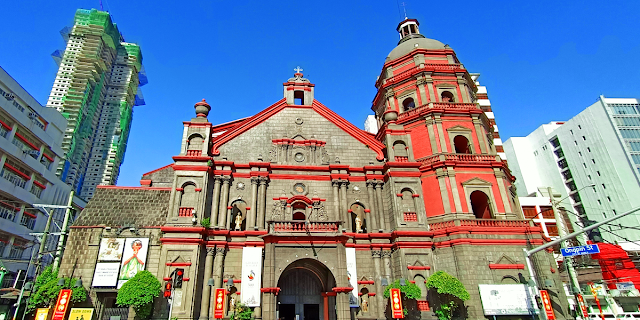
Whenever I visit Binondo for a food trip, I always make sure to pass this church in front of Plaza San Lorenzo Ruiz. Binondo Church's facade always make me in awe every time I see it. The church is one of the most picturesque places in Manila.


Binondo Church, formally known as the Minor Basilica and National Shrine of Saint Lorenzo Ruiz - Parish of Our Lady of the Most Holy Rosary (Spanish: Basílica Menor de San Lorenzo Ruiz y Parroquia de Nuestra Señora del Santísimo Rosario), is located in the District of Binondo, Manila fronting Plaza San Lorenzo Ruiz, in the Philippines.


This church was founded by Dominican priests in 1596 to serve their Chinese converts to Christianity.


Loading...

Saint Lorenzo Ruiz
The original building was destroyed in 1762 by British bombardment. A new granite church was completed on the same site in 1852 however it was greatly damaged during the Second World War, with only the western façade and the octagonal belfry surviving.

Saint Lorenzo Ruiz, who was born of a Chinese father and a Filipino mother, trained in this church and afterwards went as a missionary to Japan, where he and his companions were martyred for refusing to renounce Christianity.

Lorenzo is the Philippines' first saint, and was canonized by Pope John Paul II in 1987. A large statue of the saint stands in front of the church.

Interior of Binondo Church


Binondo Church in Details

  • Names: Minor Basilica and National Shrine of Saint Lorenzo Ruiz, Basílica Menor y Santuario Nacional de San Lorenzo Ruiz
  • Location: Binondo, Manila, Philippines
  • Country: Philippines
  • Denomination: Catholic
  • Website: rcam.org/minorbasilicaofsanlorenzoruiz
  • Status: Minor basilica
  • Founded: 1596
  • Founders: Dominican priests
  • Architectural type: Minor basilica
  • Completed: 1852
  • Number of domes: 1
  • Materials: Granite
  • Archdiocese: Manila


Even before the arrival of the Spanish to the Philippines there was already a community of Chinese traders living in Manila. The population of Chinese traders increased with the advent of Spanish colonization of the Philippines, due to increased trade between the islands.

Parish church of the barrio of Binondo in 1868

The upsurge in their population prompted the Catholic Missionaries to manage the conversion of the Chinese population to the Christian faith.

In 1596, Dominican priests founded Binondo church to serve their Chinese converts to Christianity as well as to the native Filipinos.

Cheapest Flights and Airline Tickets Online Booking

Binondo Church Architecture

Binondo Church was built by the Dominicans. Founded in 1596, a church had been constructed before 1614. When transferred to its present site in the 18th century, a new church was built to accommodate new churchgoers. In 1778, the roof was replaced with nipa as the wood was destroyed by termites. In 1863, the church was slightly damaged by earthquake.

The original structure has sustained damages during wars and various natural disasters. Domingo Cruz y Gonzales supervised the construction of the dome in 1781.


The current granite church was completed on the same site in 1852 and features an octagonal pagoda-like bell tower which suggests the Chinese culture of the parishioners. The church was burned during the British invasion of 1762. Another one was quickly built following the occupation. Improvements were made in the 18th century but the edifice was again destroyed in the 1863 earthquake.

It was rebuilt in the grandeur the remains on which we see today. Before the war, it was considered as one of the most beautiful churches in the country. Its bell tower was composed of five stories, octagonal in shape. At its top was a mirador (viewing window). This roof was destroyed during the 1863 earthquake.


The present church and convent was renovated between 1946 and 1971.


OTHER CHURCHES TO VISIT IN MANILA


ATTRACTIONS TO SEE IN MANILA 

Klook.com

Binondo Church Fun Facts

Here are some trivia about Binondo Church:

  • The current main altar of the church is loosely modeled after the façade of St. Peter's Basilica in Vatican City.
  • The basilica has been reconstructed many times due to natural calamities and only the belfry is what remains of the original 16th century structure.
  • Andrés Bonifacio and his second wife, Gregoria de Jesús were wed in Catholic rites in the church in March 1893 or 1894. The couple had also undergone a marriage ceremony under the Katipunan, the secret society that Bonifacio headed as part of the Philippine Revolution against the Spanish Empire.


How to Get to Binondo Church

Going to Binondo, Manila is made easy because of Metro Manila's transport system - where you can ride any of the following mode of transportation:

Via Train

If you are coming from North (Caloocan City) and from the South (Paranaque/Pasay), you can take LRT1 and drop off Carriedo station. Turn left at Rizal Avenue, and walk past Sta. Cruz Church towards Bustos. Turn left at Bustos, and walk about 1 block until you get to Ongpin. Chinatown begins there, right behind Sta. Cruz Church.

Nearest Train Station: LRT1-Carriedo

Via Bus

If you are coming from North (Quezon City), you can take a bus ride en route to Sta. Cruz, Manila or if you are from the South (Muntinlupa), you can take a bus ride en route to Lawton, then a jeepney ride to Sta. Cruz. Then take a short walk as previously suggested above.

Via UV Express

UV express is another option going to Binondo. Here are the available UV Express Routes: Divisoria-Roxas Blvd./Baclaran; Divisoria-Taft/Buendia/Baclaran

Via Jeepney

Here are the following jeepney routes you can take going to Binondo: Cubao-Divisoria; Divisoria-Roxas Blvd./Baclaran; Divisoria-Taft/Buendia/Baclaran; Espana-Divisoria; Morayta-Divisoria; North Avenue-Sta. Cruz; San Juan-Divisoria; Sta. Cruz-Binondo/Divisoria; Sta. Cruz-Taft/Buendia/Baclaran


ACTIVITIES AND TOURS IN MANILA


Binondo Church

Address: Plaza de San Lorenzo Ruiz, Binondo, Manila
Phone Number: (02) 8242-4850
Telefax: (02) 8242-4041
Email Address: binondochurch1596@gmail.com


Binondo Church Mass Schedule & Other Services


Church Mass
  • Monday-Saturday: 12:15nn | 5:00pm
  • Sunday: 8:30am | 10:00am | 12:15nn | 5:00pm

Baptism
  • Monday-Saturday: 10:30am
  • Sunday: 11:00am (Communal)

Wedding & Funeral Mass
  • By Appointment

Confession
  • Monday, Wednesday, Friday: 11:00am-12:00nn
  • Tuesday, Thursday, Saturday: 3:00-4:30pm

Sick call & Anointing
  • By Appointment


WHERE TO NEXT?


WHERE TO STAY NEAR BINONDO

Pearl Manila Hotel

Here's a list of hotel accommodation you can book in Manila:


IMPORTANT NOTE: The rates, contact details and other information indicated in this post are accurate from the time of writing but may change without IMFWJ's notice. Should you know the updated information, please let us know by leaving a message in the comment box below.


BINONDO CHURCH: Guide to Minor Basilica and National Shrine of Saint Lorenzo Ruiz (History & Mass Schedule)