Showing posts with label Comelec. Show all posts

The Commission on Elections (COMELEC) has officially resumed its nationwide voter registration drive, giving millions of Filipinos the opportunity to secure their right to vote in the upcoming Barangay and Sangguniang Kabataan (SK) Elections scheduled for November 2, 2026.


This crucial period, which runs from October 20, 2025, to May 18, 2026 (unless a new schedule is issued by the Commission), is vital for first-time voters, those who need to reactivate their status, and citizens seeking to update their records.

Registration will be conducted in all local Offices of the Election Officer (OEO) across the country from Mondays to Saturdays, 8:00 AM to 5:00 PM, including satellite registration sites announced by local COMELEC offices.


GET A FORM AND REGISTER HERE!


Essential Services Available Nationwide

All eligible Filipino citizens are encouraged to visit their local COMELEC office to avail of the following services:

  • Application for New Registration (First-time Regular and SK Voters)

  • Application for Reactivation of Registration Records

  • Application for Transfer of Registration Records (from one city/municipality to another, or within the same city/municipality)

  • Application for Change of Name/Correction of Entries in the Registration Record

  • Application for Inclusion of Registration Records and Reinstatement of Name in the List of Voters

  • Updating of Records for Persons with Disabilities (PWD), Senior Citizens, and members of Indigenous People (IP)/Indigenous Cultural Communities (ICC)


Application for Transfer from Foreign Service Post to Local


Note on the Register Anywhere Program (RAP): The COMELEC's Register Anywhere Program (RAP), which allows applicants to register outside their place of residence, will be available only until April 24, 2026.


What to Bring: Requirements for Regular Voter Registration
To facilitate a smooth registration process, applicants must submit one (1) photocopy of any valid, photo-bearing government-issued ID that includes their signature and current residential address.


Accepted Valid Identification Documents:


Student's ID or Library Card


Land Transportation Office (LTO) Driver's License or Student Permit

National Bureau of Investigation NBI Clearance


SSS/GSIS or other Unified Multi-Purpose ID

Integrated Bar of the Philippines (IBP) ID

Professional Regulatory Commission (PRC) License

Certificate of Confirmation from the National Commission on Indigenous Peoples (NCIP) for ICC/IP members

Other government-issued valid IDs


Crucial Document Guidelines


Proof of Address: For valid IDs that do not contain the applicant's address, a supporting document like a Proof of Billing (electric bill, water bill, internet bill, etc.) should be provided.

Originals Required: Applicants must present the original and submit one photocopy of their documents.

Non-Accepted IDs: The COMELEC will NOT accept Barangay Identification/Certification/Clearance, Community Tax Certificates (Cedula), and Police Clearance.


Special Requirements for SK Voters (Ages 15-17)

Filipino youth intending to vote in the Sangguniang Kabataan (SK) Elections must be at least 15 years old but less than 18 years old on Election Day, which means they must have been born on or before November 2, 2011. They should bring:

A. Valid IDs: (Any from the accepted list above, but common IDs for minors include)

  • PhilSys National Identification ID
  • PWD ID
  • Student's ID or Library Card
  • Philippine Passport


B. Birth Certificate

The Commission emphasizes the need for all eligible citizens to register early to avoid the rush. Do your part, register now, and ensure your voice is heard in the 2026 Barangay and SK Elections!

COMELEC Kicks Off Voter Registration for 2026 Barangay and SK Elections


The Voter Certification is an essential document issued by the Commission on Elections (COMELEC) that proves your active voter status in the Philippines.


In Makati City, obtaining this certificate is often a prerequisite for various transactions, including applications for the Makati Yellow Card. Since COMELEC stopped issuing PVC voter ID cards in 2017, the Voter Certification has become the official proof of voter registration.

This guide provides a detailed, step-by-step process to secure your Voter Certification in Makati.

Loading...

What is a Voter Certification?

A Voter Certification is an official document from COMELEC confirming that you are a registered and active voter in a specific precinct within a city or municipality. It contains key personal and voter registration details, authenticated by a dry seal and a QR code for verification. It serves as your official proof of voter status.


Eligibility for Voter Certification

Before proceeding with your request, ensure you meet these basic eligibility criteria:

  • Registered Voter: You must be a registered voter in Makati City.

  • Active Status: Your voter registration record must be in "active" status. If your record is "deactivated" (e.g., due to failing to vote in two consecutive national and local elections), you'll need to file an Application for Reactivation and have it approved by the Election Registration Board (ERB) before you can get a certification.

  • Biometrics Captured: Your biometrics (photo, signature, and fingerprints) must have been successfully captured during your voter registration.


Documents and Fees Required

Prepare the following before your visit:

Valid Government-Issued ID: Present one (1) original and valid government-issued ID that includes your photo, signature, and current address. Examples include:

  • Philippine Identification System (PhilSys) ID (National ID)
  • Passport
  • Driver's License
  • Unified Multi-Purpose ID (UMID)
  • Professional Regulation Commission (PRC) ID
  • Senior Citizen ID
  • PWD ID
  • Postal ID
  • School ID (for 18-year-old registrants)

Note: Community Tax Certificates (Cedula) and police clearances are generally not accepted for this purpose.


Certification Fee:

  • The standard fee for a Voter Certification is ₱75.00 per copy.

Exemption: Senior Citizens and Persons With Disability (PWDs) are exempt from this fee. Remember to present your Senior Citizen ID or PWD ID to avail of the exemption.


Where to Get Your Voter Certification in Makati

You must visit the Office of the Election Officer (OEO) for your specific legislative district in Makati City. Makati is divided into two congressional districts, each with its own COMELEC office.

  • COMELEC Makati - District 1 Office: If your registered barangay is in District 1 (e.g., Bangkal, Bel-Air, Carmona, Dasmariñas, Forbes Park, Kasilawan, La Paz, Magallanes, Olympia, Palanan, Pio del Pilar, Poblacion, San Antonio, San Isidro, San Lorenzo, Santa Cruz, Singkamas, Tejeros, Urdaneta, Valenzuela).

  • COMELEC Makati - District 2 Office: If your registered barangay is in District 2 (e.g., Cembo, Comembo, East Rembo, Guadalupe Nuevo, Guadalupe Viejo, Pembo, Pinagkaisahan, Pitogo, Post Proper Northside, Post Proper Southside, Rizal, South Cembo, West Rembo).

To find the exact address and current operating hours, it's best to:

  • Check the official COMELEC website (www.comelec.gov.ph) for their local office directory.

  • Search for "COMELEC Makati District 1" or "COMELEC Makati District 2" on Google Maps for the most up-to-date location.

  • Call the COMELEC hotline or check their official Facebook pages, as satellite offices or specific schedules might be announced.

General Operating Hours: COMELEC offices typically operate Monday to Friday, from 7:00 AM to 4:00 PM, but always confirm before your visit.


Step-by-Step Process to Obtain Your Voter Certification

The process is generally straightforward and can often be completed in a single visit:

  • Identify Your District: Confirm whether your registered address falls under Makati District 1 or District 2 to ensure you go to the correct COMELEC office.

  • Proceed to the OEO: Go to your assigned COMELEC District Office during their operating hours. Expect queues, especially during peak periods or near election seasons. Some offices may have an online appointment system, so check if this is available for Makati before your visit to save time.

  • Present ID and Verify Status: Upon reaching the desk, present your valid government-issued ID. The COMELEC staff will check your voter record and biometrics in their system.

  • Fill Out Request Form: You might be asked to fill out a short form requesting the Voter Certification, indicating your details and the purpose for the certificate (e.g., "for Makati Yellow Card application").

  • Pay the Fee: Proceed to the cashier to pay the ₱75.00 fee. Remember to present your Senior Citizen or PWD ID if you are eligible for exemption. You'll receive an official receipt.

  • Receive Your Certificate: After payment, wait for your Voter Certification to be printed. This usually takes around 5 to 10 minutes.

  • Review and Sign: Carefully review all the information on your printed certificate for accuracy. Once confirmed, you may be asked to sign a logbook to acknowledge receipt.


Important Considerations


Personal Appearance: In most cases, personal appearance is required as your identity and biometrics need to be verified against their system. Proxy filing is only allowed under specific, limited circumstances (e.g., with a notarized Special Power of Attorney for individuals who are abroad or hospitalized).

Validity: While the Voter Certification doesn't have a statutory expiration, many government agencies and private entities typically require a certificate issued within the last six (6) months to one (1) year to ensure the information is current. Always confirm the required validity period with the agency requesting it (e.g., Makati Health Department for Yellow Card).

Deactivated Status: If your voter record is deactivated, you must first file an Application for Reactivation with COMELEC and wait for its approval by the Election Registration Board (ERB). You cannot get a Voter Certification while your status is deactivated.

By following this guide, you'll be well-equipped to obtain your Voter Certification in Makati City, a crucial step for many civic and personal transactions.

How to Get Your Voter Certification in Makati City: A Complete Guide


Get ready to exercise your right to vote as voter registration resumes! This crucial process ensures that every eligible Filipino citizen has the opportunity to participate in shaping the future of our nation through the electoral process.


The voter registration period is set to commence from February 12, 2024, until September 30, 2024, giving eligible citizens ample time to ensure their voices are heard in the upcoming elections. However, there will be no Voter's registration on March 28, 29, 30, 2024 (Maundy Thursday, Good Friday, and Black Saturday).


In this guide, I will walk you through on how to register (new application), reactivate or transfer your voter registration.

Loading...

Where to Register

Here are the location for voter registration:

Office of the Election Officer in Your Area: Visit the designated Election Officer's office in your locality to begin the registration process.

Register Anywhere Program (RAP) Sites: Look out for RAP sites designated for convenient voter registration.

Satellite or Mall Registration Sites: Keep an eye out for registration booths set up in malls and satellite sites across your city.

In Taguig, Comelec has assigned a satellite office located at Vista Mall Parking Building.


Who May Register?

Any Filipino citizen who is NOT yet a registered voter may apply for registration, provided they meet the following qualifications:

  • Age Requirement: Must be at least eighteen (18) years old on the day of the National and Local Elections.

  • Residency: Must be a resident of the Philippines for at least one (1) year and in the place where they propose to vote for at least six (6) months immediately preceding the National and Local Elections.

  • Disqualification: Must not be otherwise disqualified by law.


Procedure for Registration


STEP 1 Identification: Present a valid identification document to the registration staff.

STEP 2 Interview: Be prepared for an interview conducted by the registration staff to verify your eligibility.

STEP 3 Application Form: Fill out the application form (CEF-1) accurately and completely.

STEP 4 Checking and Verification: Registration staff will check and verify the accomplished application form.

STEP 5 Biometrics Capture: Your biometrics, including fingerprints and photo, will be captured for verification purposes.

STEP 6 Issuance of Acknowledgement Receipt: Upon completion of the registration process, you will receive an acknowledgment receipt.


Why Register?

Voter registration is a crucial step in ensuring that your voice is heard in the democratic process. By registering to vote, you actively participate in choosing the leaders who will represent your interests and shape the policies that affect your community and the nation as a whole.

Don't miss out on the opportunity to make a difference. Register to vote today and be part of building a better future for our country.


ATTRACTIONS TO SEE IN MANILA 

Klook.com

For more information and updates on voter registration, contact your local Election Officer's office or visit the official website of the Commission on Elections (COMELEC). Let's make our voices count in the upcoming elections!


COMELEC Guide to Voter Registration Process (New Application, Reactivation and Transfer)


As the country gears up for the 2025 National and Local Elections, the Commission on Elections (COMELEC) announces the commencement of the Voter Registration period starting on February 12, 2024, and will run until September 30, 2024.


To participate in this crucial democratic process, eligible individuals are encouraged to register at their respective Election Officer's Office in their area.


If you missed to vote from last 2 consecutive elections and got deactivated, here's how to reactivate your voter registration.

Loading...

Voter Registration for 2025 Elections

Registration Period: The voter registration period spans from February 12, 2024, to September 30, 2024.

Office Hours: The Election Officer's Office will be open from 8:00 a.m. to 5:00 p.m., Monday through Saturday, ensuring flexibility for individuals to register at their convenience.


How to Register

Visit the Election Officer's Office: Head to the designated Election Officer's Office in your locality.

Operating Days: The registration services are available from Monday to Saturday, accommodating those with weekday commitments.

Holiday Inclusions: Take note that registration services will also be provided on holidays, ensuring that individuals have ample opportunities to register.

The voter registration process is a crucial step in ensuring that every eligible citizen has the opportunity to exercise their right to vote. By registering, individuals contribute to shaping the future of the nation through the electoral process.


First Time Voters Registration

First-time voter? Don’t be intimidated by the process—it’s easier than you think. Here's a step-by-step guide for the upcoming voter's registration:

  • Visit COMELEC's iRehistro website
  • Choose "Application Forms"
  • Fill out the CEF-1 online form
  • Print the CEF-1 on a long bond paper back-to-back. Do not sign or affix your thumbmark on the application forms just yet since this must be done in the presence of the Election Officer 
  • Bring the physical CEF-1 form and a valid government ID with signature on your visit to the local COMELEC office or RAP site

Remember: Accomplishing the online form does not automatically make you a registered voter. You still have to personally appear at your local COMELEC office or RAP site.


ATTRACTIONS TO SEE IN MANILA 

Klook.com

Reactivate or Transfer Registration

Meanwhile, those who are looking to reactivate or transfer registrations can file an online application until September 7. It should be sent to the official email addresses of the OEOs which can also be found on the COMELEC’s website. 


The COMELEC encourages all eligible citizens who are not yet registered voters to take advantage of this registration period. Your participation matters, and registering to vote is a vital part of the democratic process. Make your voice count in the 2025 National and Local Elections.

Voter Registration for 2025 Elections Opens on February 12


Voting is a fundamental right and a civic duty, and ensuring your active voter's registration is crucial. If you find that your COMELEC registration has been deactivated for any reason, here's a step-by-step guide on how to reactivate it.


Reasons for Deactivation

Your COMELEC registration may be deactivated due to various reasons, including:

  • Imprisonment for at least one year

  • Conviction of crimes against the duly constituted government (e.g., rebellion, coup d'etat, inciting to sedition)

  • Declaration of insanity or incompetence by authority

  • Failure to vote in two successive preceding regular elections (e.g., National elections in 2022 and barangay elections in 2023)

  • Loss of Filipino citizenship

  • Exclusion by a court order

Loading...

Confirming Deactivation

To confirm if your COMELEC registration is deactivated, follow these steps:

Send an E-mail: Reach out to voters_id@comelec.gov.ph with your complete name (including middle name), date of birth, address, date of registration, and contact number.

Call COMELEC's IT Department: Contact COMELEC's Information Technology Department at 8527-9365 or 8526-7769 for assistance.


Visit the Election Officer: Inquire with the Office of the Election Officer in your district, city, or municipality for information on your registration status.

Use COMELEC's Precinct Finder: Once online, log on to COMELEC's Precinct Finder on their website to check your registration status.


Reactivating Your COMELEC Registration Online

If you discover that your registration is deactivated, follow these steps to reactivate it:

Fill out CEF-1 Form: Go to the COMELEC website and fill out the CEF-1 form. Print a copy for your records.

Scan Documentary Requirements: Scan the filled-out CEF-1 form along with documentary requirements such as a valid ID and supplementary data form for special cases (senior citizens, persons with disabilities, persons deprived of liberty).

Email Documents: Send the scanned documents to the official email address of your city's or municipality's Election Officer (check COMELEC's website for the specific email addresses).

Wait for Confirmation: Expect confirmation through the mobile number or email address you provided. This confirmation will indicate the success of your reactivation.


ATTRACTIONS TO SEE IN MANILA 

Klook.com

By following these steps, you can successfully reactivate your COMELEC registration, ensuring that your voice is heard in the upcoming elections. Remember, participating in the democratic process is a responsibility that contributes to the nation's progress.

COMELEC Guide to Voter's Registration Reactivation


As a responsible citizen, the right to vote and participate in the democratic process is an important element of your civic duty.


In many countries, including the Philippines, voter registration requires valid identification documents to verify the identity of the registrant.

Loading...

In this guide, we will provide a comprehensive list of valid identification documents for the purpose of voter registration, along with additional provisions for those who may not possess these specific forms of identification.


LIST OF VALID IDENTIFICATION DOCUMENTS

4. Student's ID card or library card, signed by the school authority
6. LTO Driver's license/Student Permit
9. SSS/GSIS ID or other UMID card
10. Integrated Bar of the Philippines (IBP) ID card
11. Professional Regulatory Commission
12. Certificate of Confirmation issued by the National Commission on Indigenous Peoples (NCIP) for members of ICCS or IPs
13. Barangay Identification/Certification with photo

Community tax certificate (cedula), PNP clearance and employee's ID are not accepted.


In the absence of any of the above-mentioned identification documents, the applicant may be identified under oath by any registered voter of the precinct where he/she intends to be registered or by any of his/her relatives within the 4th civil degree of consanguinity or affinity. No registered voter or relative shall be allowed to identify more than 3 applicants.


ATTRACTIONS TO SEE IN MANILA 

Klook.com

It is important for individuals to be aware of the various valid identification documents accepted for voter registration to ensure a smooth and inclusive process.

By providing a comprehensive list, along with provisions for those who may not possess these specific forms of identification, election authorities can promote greater participation and inclusivity in the electoral process.

Comelec Guide to Valid ID Accepted for Voter Registration

how to find my precinct number philippines 2021 how to find precinct number in comelec online 2022 how to find my precinct number philippines 2020 precinct finder list of voters name philippines 2022 check voter registration status how to find my precinct number philippines 2016 precinct finder rappler

Registered voters may now check their actual polling precincts before election day.


To help voters, the Commission on Elections (Comelec) and the Department of Information and Communications Technology (DICT) on April 22 activated the online precinct finder, which allows voters to locate where they should vote and other key information about voting on Election Day.

Loading...

Here’s a step-by-step guide on how to find your polling precinct online.


Step 1

Visit the official COMELEC Precinct Finder website online at https://voterverifier.comelec.gov.ph/voter_precinct

Step 1 How To Find Your Election Precinct Online 2020 Result

Step 2

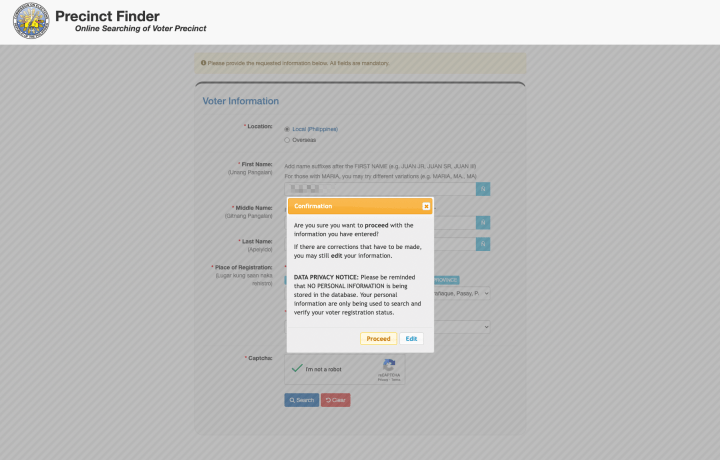
Once you have loaded the page, select your location (Philippines or overseas), and fill in a few key details such as your complete name, and the place (province, city/municipality) where you are registered as a voter.


While the website is very straightforward with its requirements, there may also be specific rules on how to put in your name. For example, you may need to abbreviate or spell out in full some names like Maria/Ma., Jr/Junior/III.

Step 2 How To Find Your Election Precinct Online 2020 Result

COMELEC notes that no personal information is being stored when you access this platform. Also, the website may take time in loading. If you happen to encounter this, patience is a virtue.

Precinct Finder 2022 Loading

If these steps still did not work, you may try to contact your local Commission on Elections (COMELEC) office that has jurisdiction over your registration. We hope this quick guide helped you in your search!


The voter precinct finder has been launched on April 22, 2022 in coordination with the Department of Information and Communications Technology (DICT), which hosts cloud services for COMELEC for this year’s elections.


ATTRACTIONS TO SEE IN MANILA 

Klook.com

‘Deactivated’ voters

In an interview, Gracia explained that registered voters who did not vote in the previous elections—the 2018 barangay and Sangguniang Kabataan (SK) elections and the 2019 senatorial elections—were already marked as deactivated voters for this year’s elections.


ACTIVITIES AND TOURS IN MANILA


You Can Now Check Your Voter Details With Comelec Precinct Finder Online Verification


All you need to know about Comelec.


Comelec
official logo
The Commission on Elections (COMELEC) is an independent constitutional body in the Philippines responsible for ensuring free, fair, and honest elections. Established to uphold the democratic process, COMELEC plays a critical role in organizing and overseeing national and local elections, referendums, and other electoral processes in the country.


Comelec in Details

  • Abbreviation: COMELEC
  • Predecessor: Department of Interior
  • Formation: August 22, 1940
  • Headquarters: Palacio del Gobernador
  • Location: General Luna Street corner Andres Soriano Jr. Avenue, Intramuros, Manila
  • Membership: 1 chairperson, 6 commissioners
  • Website: www.comelec.gov.ph


This overview provides insights into the history, functions, structure, and significance of the Commission on Elections.

Loading...

Historical Background

The creation of the Commission on Elections dates back to the Philippine Constitution of 1935, which established the body to oversee the conduct of elections in the Philippines. Over the years, its powers and functions have evolved to meet the changing needs of the democratic process.


Comelec Key Functions

Philippine Elections voting ballots

  • Election Administration: COMELEC is responsible for the administration of all aspects of elections, including voter registration, campaign regulation, ballot preparation, and vote counting. It ensures that electoral processes adhere to legal and ethical standards.

  • Voter Education: COMELEC promotes voter education to inform citizens about their rights, responsibilities, and the importance of participating in elections. This involves disseminating information about candidates, parties, and the electoral process.

  • Candidate Regulation: COMELEC screens and approves candidates for various elective positions. It ensures that candidates meet legal qualifications and adhere to campaign finance regulations.

  • Election Monitoring: COMELEC monitors election-related activities to prevent fraud, voter manipulation, and other irregularities. It investigates complaints and takes action against violations of election laws.

  • Proclamation of Winners: Once the votes are counted and validated, COMELEC officially proclaims the winners of elections and other electoral exercises.


Structure of Comelec

COMELEC is composed of a Chairman and six Commissioners, all of whom are appointed by the President with the consent of the Commission on Appointments. The Chairman serves as the head of the Commission and holds administrative and executive authority. Commissioners share the responsibilities of decision-making and policy implementation.


Independence and Autonomy

An important aspect of COMELEC is its independence from the influence of partisan politics. The body operates autonomously to ensure that electoral processes remain impartial and unbiased. This independence enhances public trust in the credibility of elections.


Local COMELEC Offices

COMELEC operates at various levels, with local offices in provinces, cities, and municipalities. These offices manage voter registration, address election-related concerns, and work closely with local government units to facilitate smooth elections.

Comelec head office at the Palacio del Gobernador

ATTRACTIONS TO SEE IN MANILA 

Klook.com

Challenges and Innovations

COMELEC faces various challenges, including voter education in remote areas, technological advancements, and adapting to changing political landscapes. To address these challenges, the body has embraced technology by implementing automated voting systems and enhancing its digital presence for voter engagement.


Significance of Comelec

The Commission on Elections plays a pivotal role in maintaining the integrity of the Philippine democratic process. By ensuring free and fair elections, COMELEC upholds the voice of the people, promotes transparency, and strengthens the foundation of Philippine democracy.


In conclusion, the Commission on Elections (COMELEC) is a cornerstone of Philippine democracy, tasked with organizing, overseeing, and safeguarding the electoral process. Its commitment to fairness, transparency, and public trust contributes to the continued success of democratic governance in the Philippines.


ACTIVITIES AND TOURS IN MANILA


COMELEC: Commission on Elections in the Philippines (Background & Functions)

how to find my precinct number philippines 2021 how to find precinct number in comelec online 2022 how to find my precinct number philippines 2020 precinct finder list of voters name philippines 2022 check voter registration status how to find my precinct number philippines 2016 precinct finder rappler

Registered voters may now check their actual polling precincts before election day.


To help voters, the Commission on Elections (Comelec) and the Department of Information and Communications Technology (DICT) on April 22 activated the online precinct finder, which allows voters to locate where they should vote and other key information about voting on Election Day.

Here’s a step-by-step guide on how to find your polling precinct online.

Loading...

Step 1

Visit the official COMELEC Precinct Finder website online at https://voterverifier.comelec.gov.ph/voter_precinct

Step 1 How To Find Your Election Precinct Online 2020 Result

Step 2

Once you have loaded the page, select your location (Philippines or overseas), and fill in a few key details such as your complete name, and the place (province, city/municipality) where you are registered as a voter.

While the website is very straightforward with its requirements, there may also be specific rules on how to put in your name. For example, you may need to abbreviate or spell out in full some names like Maria/Ma., Jr/Junior/III.

Step 2 How To Find Your Election Precinct Online 2020 Result

Step 3

Once you have filled the forms, you are required to run the captcha test and get it verified before pressing the blue button (search). If the database recognizes your details, the page will present your precinct information including the location (polling place) and precinct number. 

The status of your voter registration is also presented. Remember to take note of the data or have a screenshot for your reference.

How To Find Your Election Precinct Online 2020 Result

COMELEC notes that no personal information is being stored when you access this platform. Also, the website may take time in loading. If you happen to encounter this, patience is a virtue.

Precinct Finder 2022 Loading

If these steps still did not work, you may try to contact your local Commission on Elections (COMELEC) office that has jurisdiction over your registration. We hope this quick guide helped you in your search!

The voter precinct finder has been launched on April 22, 2022 in coordination with the Department of Information and Communications Technology (DICT), which hosts cloud services for COMELEC for this year’s elections.


‘Deactivated’ voters

In an interview, Gracia explained that registered voters who did not vote in the previous elections—the 2018 barangay and Sangguniang Kabataan (SK) elections and the 2019 senatorial elections—were already marked as deactivated voters for this year’s elections.
6

STEP-BY-STEP GUIDE: How To Find Your Voting Precinct Number Online with COMELEC Voter Verifier