




Did you know that Starbucks is now selling reusable cups for P100 only?


The Biggest Floating Playground in ASIA & Home to the Unicorn Island!
Feel like a kid again as you spend a fun filled day in Subic's Inflatable Island. Enjoy a floating playground filled with slides, towers, bridges, human launchers, swings, and so much more!
Loading...
ABOUT INFLATABLE ISLAND
The first of its kind in the Philippines, Inflatable Island holds the reputation of being the biggest and wildest inflatable playground in all of Asia!Feel the excitement of bouncing and splashing into the cool water at Inflatable Island in Subic. This pristine spot is newly expanded to over 4,200 square meters, as big as eight basketball courts!
The floating water park features inflatable slides, towers, bridges, as well human launchers, swings, and so much more.
 |
| Unicorn Island |
Challenge your friends to an obstacle course and take your family's beach trip to the next level in the biggest and wildest inflatable playground in Subic.
Snap some photos in the Insta worthy Pink and Purple Bali Lounge and relax at the stunning beach as you sip some drink after the fun activities.

WHAT TO BRING FOR SUBIC, ZAMBALES
Here are some things you might consider bringing with you for your day tour / adventure:
- Stylish face mask
- Water container/tumbler to rehydrate
- Sunscreen for skin protection
- Goggles for swimming or snorkeling
- Stylish Swimsuit
- Travel backpack / luggage
- Reusable vacuum storage packs
- Selfie stick
- Waterproof phone case
- Acion cam
- Camping tent
- WiFi kit
- Power bank
Shopee is my go-to app for things I needed like the ones above. If you'd like discounts and vouchers, you may get the best offers here:

ACTIVITIES AND AMMENITIES YOU WILL ENJOY
- Rainbow and Unicorn Island
- Floating zoos and animal cabanas/floats
- Access to Samba Beach
- Pink & Purple Bali Lounge
- Pink Jungle
- Sunflower Lounge
 |
| Unicorn Island |
 |
| Pink & Purple Bali Lounge |
ALSO IN ZAMBALES
- GUIDE TO LIWLIWA: Surfing Spot in Zambales (List Of Resorts + Things To Do)
- ZAMBALES: Casa Angelina, a beachfront resort at Clearwater Beach in Cabangan
- Seven Must-Visit Beaches Near Manila
- ZAMBALES: What-to-See and What-to-Experience at Sampaloc Cove
 |
| Floating Island |
 |
| Pink Jungle |
HOW TO GET ACCESS TO FLOATING ISLAND'S AMMENITIES
Choose your preferred date, time and the kind of pass you want. Please know that you can book multiple kinds of passes. Book online so you can save up to 10%!
Sprinkle (1-hour pass) Splash (2-hour pass), Spray (half day pass) & Soaked (all day pass) Play Passes on the Inflatable Island. All play passes have WHOLE DAY ACCESS TO the beach and its attractions. Plus Php 100 for walk-in.

NOTE: All bookings are final and non-refundable. If you are unable to make it, we can offer you RESCHEDULING instead.
Please note that RESCHEDULING is subject to a Php 200 rescheduling fee per person. After that, unused slots after 7 days of booked date will be considered forfeited.
Coming with a big crowd? You may want to check their group packages. Also, since space is limited at the lounges, it’s a first-come-first-serve basis. Otherwise, there are normal chairs and tables, especially by the restaurant/food area.

Frequently Asked Questions (FAQs) About Inflatable Island
- How can I get to Inflatable Island?
See the ‘How To Get To Inflatable Island’ below (after this section). - Do you have a hotel?
Inflatable Island Subic doesn't have onsite accommodations but they do have Bali lounge and Dining Pavilion. Small tables on the Bali Lounge can accommodate 4pax maximum and Long tables can accommodate 6pax maximum for a first come, first serve basis. Inclusive on all of the play passes. You can also check the recommended hotels around Subic Bay area on the Hotel List below.
- How young are the kids that can come? Do you have a height requirement?
There is no age limit, however, for younger children (3 feet to 4 feet), they require a 1:1 adult-kid radio. Inflatable Island requires all participants to be at least 3.5 feet. - Can I bring my own food and drinks?
Unfortunately, you can’t. But don’t fret, they have stalls near the lounges where you can buy food and drinks. (For Samba Beach area, they have a corkage fee that starts at Php 500 for 1-7 pax). - How deep is the water? What if I can’t swim?
It’s about 4 to 20 feet, that’s why once you go to the inflatables, it’s a requirement for everyone to wear life vests, no matter if you’re good at swimming. Rest assured, they have tons of lifeguards who are on duty at the inflatables. - Are life jackets free?
YES, they can only be used at the inflatables or water park area. - Can I use a selfie stick while I’m on the inflatables?
They used to allow action cameras and cellphones, but due to recent cases wherein too many have been lost by accident at sea, it is no longer allowed. - Are there lockers for storing my stuff?
Yes! The rental fee for the big lockers is Php 100 (half day) and Php 150 (whole day). As for the small lockers, it’s Php 50 (half day) and ₱100 (whole day). - Is there a first aid area?
Yes, it’s right beside the spot where you will claim your life jacket. Ensuring everybody’s safety is Inflatable Island’s priority. - Does the park ever close because of weather? The park is open rain or shine, however if a lightning is spotted near the the area, wind warnings, strong typhoons or upon the advise of the Philippine Coast Guard, they are liable to close.
- We are a big group coming, are there discounts? Can we hold parties?
They do have discounts for 30 people and above. For more specialized requests, contact 0917 835 2665 at least 5 days in advance of your intended date. Rest assured there are bigger cabanas near the Inflatable Island that can be occupied by your group. - What should I wear once I’m on the Inflatable Island itself?
Swimsuits, board shorts, bikinis, speedos, etc. can be worn. But they do HIGHLY recommend the use of rash guards and/or swim leggings to prevent sunburn and rashes — besides, this is a slip and slide adventure! Additionally, make sure that you’re not wearing anything with buttons, zippers, or any sharp objects. This also includes earrings, watches, or rings since it might damage the inflatable floats. Once you’re on shore, naturally, you may wear whatever you desire!
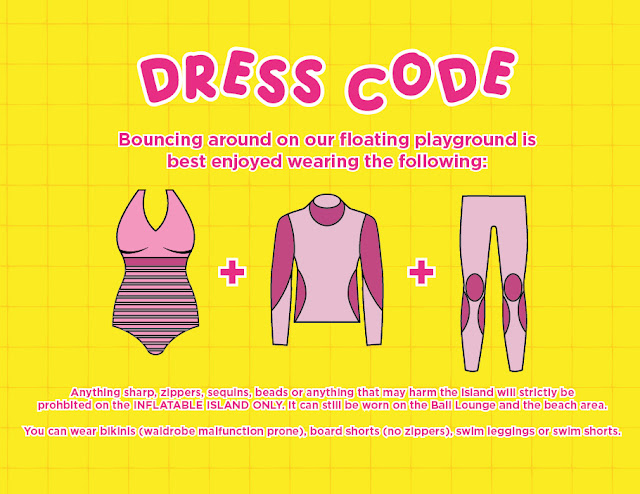 |
| Inflatable Island Dress Code |
HOW TO GET TO INFLATABLE ISLAND
By public transportation:
- From Manila: Head to Cubao (via LRT/MRT) and ride one of the buses that head to ‘Olongapo’ or you can also ride a bus that heads to Iba, Zambales and then ask the driver to drop you off at the address of Inflatable Island
- Once in Olongapo, ride a jeep and ask them to drop you off at Samba Blue Water Resort.
 |
| How To Get To Inflatable Island |
By private vehicle:
- From Manila, head to NLEX (North Luzon Expressway) to SCTEX (Subic-Clark-Tarlac Expressway).
- Take the Subic Bay Freeport Zone exit, and then take a right to Rizal Highway.
- Take a left at Burgos Street (beside Remy Field) and go right to Canal Road. Keep following this road until you reach Dewey Avenue.
- Exit to Kalaklan Gate (way to Zambales). Turn left, and then keep straight for 2 to 3 minutes until you see the Samba Bluewater Resort (formerly Subic Halfmoon Beach) — and that’s it! You’ll find the Inflatable Island ticket stall and entrance inside.
Parking is FREE but space is subject to availability (first-come-first-serve basis). If you don’t have a private vehicle, you can rent a car or van here.
Inflatable Island Subic
Address: Subic Bay Waters, National Highway, Lower Kalaklan, Olongapo City, Zambales, Philippines
Park Schedule: 8:00AM - 6:00PM daily
Contact No.: 09171501103 / 09178352665
Email address: play@theinflatableisland.com
Facebook: Inflatable Island Ph
All photos are courtesy of Inflatable Island Ph
THINGS TO REMEMBER
- Inflatable Island is approximately 3 hours (one way) from Metro Manila. If you are coming from Metro Manila, you may also book a CAR CHARTER SERVICE for your travel convenience
- What to bring: Swimwear, rash guard (highly recommended), towel, and a change of clothes

WHERE TO STAY IN SUBIC, ZAMBALES
Inflatable Island SUBIC is only a day tour venue. But they do have a partner resort where Inflatable Island is located called Samba Bluewater Resort where they have accommodation.
Please see below for the accredited hotels in the area. You can stay on most Subic Bay Freeport Hotels with no worries. They suggest booking through AGODA.COM for the best deals.
Here's a list of best and affordable hotels and resorts in Subic, Zambales:
- Subic Bay Peninsular Hotel
- Subic Grand Seas (starts at Php 2,000 per night)
- The Reef (starts at Php 2,600 per night)
- Moonbay Marina Villas
- Seorabeol Grand Leisure Hotel
- Subic Coco Hotel
- Court Meridian
- Grand Hoyah (starts at Php 1,995 per night)
- Horizon Hotel (starts at Php 1,400 per night)
OTHER ATTRACTIONS AND THEME PARKS IN THE PHILIPPINES
Here are other amusement and theme parks to try around the country:
- STAR CITY COMPLETE PARK GUIDE - Your Biggest Amusement Park in Manila
- MANILA OCEAN PARK - What To See, Things To Do and Discounted Pass
- SKY RANCH TAGAYTAY - Amusement Park Guide, List Of Rides, Ticket Price
- INFLATABLE ISLAND - Guide to Asia's Biggest Floating Playground in Subic, Zambales
- RAINFOREST ADVENTURE PARK - Things To Do and Attractions To See at Pasig RAVE
- KINDERCITY - Fun in the Playground (Entrance Fee, Schedule, How to Book)
- PARADIZOO - A Theme Farm in Mendez, Cavite
- BAGUIO CITY GUIDE: Burnham Park (Facts and Activities)
- FANTASY WORLD - A Guide To The Abandoned Disneyland Of The Philippines (Lemery, Batangas)
- VIGAN CITY: What to see at Baluarte Zoo (Entrance Fee + Things To Do)
- THE PUZZLE MANSION - Guide to the Largest Jigsaw Puzzle Collection in the World
- TALES OF ILLUMINA - Interactive Way of Learning Philippine Folklore
- This huge Gingerbread House in the Philippines is found in Alfonso, Cavite
- TAGAYTAY: Picnic Grove (Directions, Activities and Amenities)
- TORRES FARM AND RESORT - Around the World experience in Naic, Cavite

WHERE TO STAY IN ZAMBALES:
inflatable island subic inflatable island zambales overnight inflatable island subic hotel inflatable island subic metrodeal unicorn island subic inflatable island metrodeal inflatable island review inflatable island hotel package



As a country that almost entirely lies along the Pacific Ring of Fire, the Philippines is an earthquake-prone country. Many Filipinos have experienced earthquakes at some point in their lives. Although most earthquakes do not lead to significant damage or human harm, one should still be prepared for when a major earthquake strikes.
BEFORE
- Secure items, such as televisions, and objects that hang on walls. Store heavy and breakable objects on low shelves.
- Practice Drop, Cover, then Hold On with family and coworkers. Drop to your hands and knees. Cover your head and neck with your arms. Crawl only as far as needed to reach cover from falling materials. Hold on to any sturdy furniture until the shaking stops.
- Create a family emergency communications plan that has an out-of-state contact. Plan where to meet if you get separated.
- Make a supply kit that includes enough food and water for at least three days, a flashlight, a fire extinguisher, and a whistle. Consider each person’s specific needs, including medication. Do not forget the needs of pets. Have extra batteries and charging devices for phones and other critical equipment.
- Consider obtaining an earthquake insurance policy. Standard homeowner’s insurance does not cover earthquake damage.
- Consider a retrofit of your building to correct structural issues that make it vulnerable to collapse during an earthquake.
DURING
- Drop, Cover, then Hold On like you practiced. Drop to your hands and knees. Cover your head and neck with your arms. Hold on to any sturdy furniture until the shaking stops. Crawl only if you can reach better cover without going through an area with more debris.
- If in bed, stay there and cover your head and neck with a pillow.
- If inside, stay there until the shaking stops. DO NOT run outside.
- If in a vehicle, stop in a clear area that is away from buildings, trees, overpasses, underpasses, or utility wires.
- If you are in a high-rise building, expect fire alarms and sprinklers to go off. Do not use elevators.
- If near slopes, cliffs, or mountains, be alert for falling rocks and landslides.

AFTER
- Expect aftershocks to follow the largest shock of an earthquake.
- Check yourself for injury and provide assistance to others if you have training.
- If in a damaged building, go outside and quickly move away from the building.
- Do not enter damaged buildings.
- If you are trapped, cover your mouth. Send a text, bang on a pipe or wall, or use a whistle instead of shouting so that rescuers can locate you.
- If you are in an area that may experience tsunamis, go inland or to higher ground immediately after the shaking stops.
- Save phone calls for emergencies.
- Once safe, monitor local news reports via battery operated radio, TV, social media, and cell phone text alerts for emergency information and instructions.
If you are indoors during an earthquake
Ensure you do the following if you are indoors during an earthquake:- DROP to the ground; take COVER by getting under a sturdy table or other piece of furniture; and HOLD ON until the shaking stops. If there isn’t a table or desk near you, cover your face and head with your arms and crouch in an inside corner of the building.
- Stay away from glass, windows, outside doors and walls, and anything that could fall, such as lighting fixtures or furniture.
- Stay in bed if you are there when the earthquake strikes. Hold on and protect your head with a pillow, unless you are under a heavy light fixture that could fall. In that case, move to the nearest safe place.
- Do not use a doorway except if you know it is a strongly supported, load-bearing doorway and it is close to you. Many inside doorways are lightly constructed and do not offer protection.
- Stay inside until the shaking stops and it is safe to go outside. Do not exit a building during the shaking. Research has shown that most injuries occur when people inside buildings attempt to move to a different location inside the building or try to leave.
- DO NOT use the elevators.
- Be aware that the electricity may go out or the sprinkler systems or fire alarms may turn on.
If you are outdoors during an earthquake
Ensure you do the following if you are outdoors during an earthquake:- Stay there.
- Move away from buildings, streetlights, and utility wires.
- Once in the open, stay there until the shaking stops. The greatest danger exists directly outside buildings, at exits and alongside exterior walls.
If you are in a moving vehicle during an earthquake
Ensure you do the following if you are in a moving vehicle during an earthquake:- Stop as quickly as safety permits and stay in the vehicle. Avoid stopping near or under buildings, trees, overpasses, and utility wires.
- Proceed cautiously once the earthquake has stopped. Avoid roads, bridges, or ramps that might have been damaged by the earthquake.
If you are trapped under debris
Ensure you do the following if you are trapped under debris during or after an earthquake:- Do not light a match.
- Do not move around or kick up dust.
- Cover your mouth with a handkerchief or clothing.
- Tap on a pipe or wall so rescuers can locate you. Use a whistle if one is available. Shout only as a last resort. Shouting can cause you to inhale dangerous amounts of dust.
It is also worth noting that minor earthquakes, while not necessary requiring the above responses, can trigger anxiety or panic attacks. Communicate with your friends and loved ones who experienced an earthquake and be ready to provide emotional support.
After all, safety first is always our priority! Comment down if you have any other tips or suggestions that can help anyone during earthquakes.
TAGS: earthquake safety tips before during and after earthquake safety steps earthquake safety procedures earthquake preparedness pdf safety measures during earthquake wikipedia how to prepare for an earthquake earthquake preparedness checklist safety steps during earthquake
TAGS: earthquake safety tips before during and after earthquake safety steps earthquake safety procedures earthquake preparedness pdf safety measures during earthquake wikipedia how to prepare for an earthquake earthquake preparedness checklist safety steps during earthquake


Here is a full list of the new monthly contribution rates of the Social Security System (SSS) effective April 2019.
In the Philippines, a lot of people are member of the Social Security System (SSS), a social insurance program under the Philippine government. Most of its members are workers of private companies.
Loading...
A lot of self-employed Filipinos are also members of the SSS. Every month, a member should pay for the contribution rate to be eligible for the benefits and coverage of the social insurance program.
Among the benefits and offers of the Social Security System are the SSS Housing Loan, SSS Death Claim, and SSS Business Loan. A member may be eligible for it by reaching the prescribed number of monthly contributions.
With regards to the rates for the monthly contribution, the social insurance program has recently released the SSS contribution rate 2019 for employed, self-employed, voluntary, and non-working spouse of members.
HELPFUL ITEMS YOU CAN USE TO SAVE MONEY!
Here's my list of useful items for you to save or earn money wisely:
- Coin banks
- Informative books about money, saving and investments!
- Money organizer
Shopee is my go-to app for things I needed like the ones above. If you'd like discounts and vouchers, you may get the best offers here:
The state-run insurance program also posted the SSS contribution rate 2019 for Household Employers and Kasambahay and as well as Overseas Filipino Worker (OFW) members.
For a more detailed list, please see table below:

Based on the official schedule posted by the Social Security System, the contribution of the non-working spouse will be based on 50% of the salary credit of his or her working partner.
With regards to the Kasambahay contribution, under the Kasambahay Law, the employer should be the one to pay for the whole monthly contribution of the worker if the latter’s salary is below Php 5,000.00.
There is a proposed bill to increase contribution from 11% to 12.5%. Maximum salary credit is also set to increase to P20,000 if the bill passes. For the meantime, the prevailing rate of 11% is still applicable.
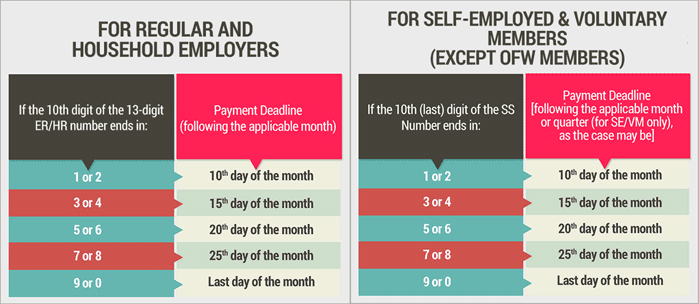
SSS is imposing penalties to late payments so make sure to pay on time to the SSS Office or their designated payment centers. Also, make sure that your employer is paying for your SSS on time.
Acknowledgement: This article is sponsored by Usapang Hanapbuhay.
Bisitahin ang Usapang Hanapbuhay Facebook Group para sa iba pang tips at mga diskarte sa pera!

sss contribution table 2022 sss contribution voluntary sss contribution table 2023 sss contribution table 2022 self-employed sss contribution table 2022 pdf sss contribution table 2022 excel file sss contribution payment how much is sss contribution for unemployed


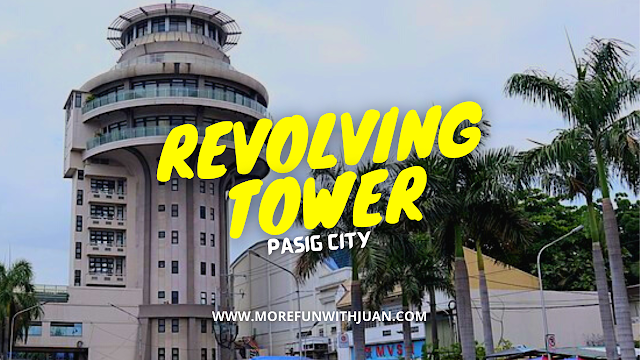
Know more about this Pasig city's iconic tower.

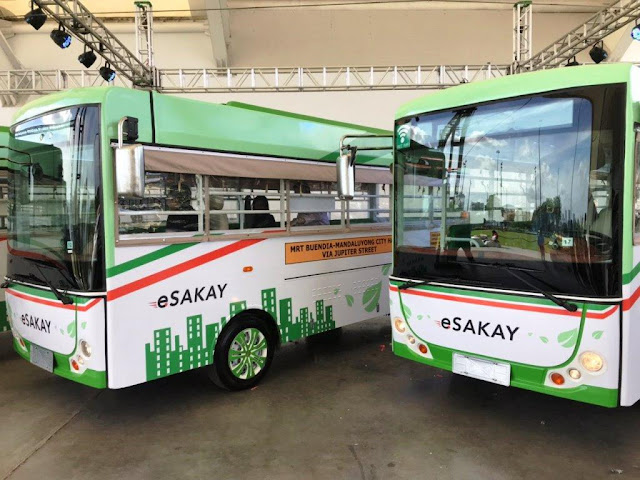
If you’re one who goes through the daily commute in and out of the city, then you’ll be happy to hear about this great news.




If a flight was cancelled, could passengers demand for hotel accommodation? If a passenger is sick and was denied to board the aircraft, could he or she sue the airline?
Air passengers have many rights under the law. The question is, how well does one know these rights?
Let's dissect the Air Passenger Bill of Rights as explained by Civil Aeronautic's Board chief legal officer, Wyrlou Samodio.

Let's dissect the Air Passenger Bill of Rights as explained by Civil Aeronautic's Board chief legal officer, Wyrlou Samodio.
Loading...
TRAVEL ESSENTIALS
Here are some things you might consider bringing with you for your day tour / adventure:
- Stylish face mask
- Water container/tumbler to rehydrate
- Sunscreen for skin protection
- Goggles for swimming or snorkeling
- Stylish Swimsuit
- Travel backpack / luggage
- Reusable vacuum storage packs
- Selfie stick
- Waterproof phone case
- Acion cam
- Camping tent
- WiFi kit
- Power bank
Shopee is my go-to app for things I needed like the ones above. If you'd like discounts and vouchers, you may get the best offers here:
First, he noted that passengers need to be protected. "Airlines might commit many mistakes, but passengers should not suffer from these," he said.
While airlines have the responsibility to inform passengers about their rights, Samodio said the Supreme Court (SC) says passengers should read the airlines' terms and conditions on their offers and services.
"According to the SC, airlines have the obligation to inform and explain to passengers the terms and conditions, including restrictions, of their tickets. But passengers also have the obligation to read them," he emphasized.
Let's see what are the basic rights or air passengers, and some examples.
1. Right to information
It is important that passengers be informed of the specific details of airline tickets. It should be clear to him or her what kind of ticket did he or she purchased -- is it a regular ticket or a promo ticket?
Know if the ticket is rebookable, reroutable, refundable, the ticket's expiry or validity, seats available, travel period, and other conditions.
"Accurate information aids the passengers to make the right choice of they are going to buy the ticket or not," Samodio said.
2. Right to service purchased
* Passengers should not be considered "late" or "no show" if they are within the carrier's cord in the check-in area at least an hour before the estimated time of departure.
Samodio said passengers must know that the extra two hours they are often advised to be at the airport is actually essential, since there might be long queues at the check-in counter. The Bureau of Immigration may also question some documents of the passengers, so one really needs to allot extra time.
* A passenger who was considered "late" may be denied check-in, but he or she should be directed to a rebooking counter.
* For international flights, the airlines are required to open the check-in counters at least two hours before the expected time of departure.
* There should be designated counters for persons with disabilities, senior citizens, and others needing assistance. Samodio said these counters don't necessarily mean physical counters, because there are airports that may be too small to have additional counters. What's important is that airlines should give priority to these individuals.
"These passengers, however, must note that not all of their companions will be accommodated in the priority lane. Of course if they are with 10 people, for example, not all of them will be accommodated. A PWD does not need 10 people to assist him or her," Samodio explained.
Especially for those who have booked their tickets online, they need to inform the airline staff if they need assistance or if they are PWDs.
“It's not always obvious if someone is a PWD," he emphasized.
Exceptions to the right to board
Yes, passengers have rights, but there are exceptions.
Among these are safety and security reasons, health concerns, non-appearance to the boarding gate.
Samodio said a passenger who is sick but Is not infectious, should be allowed to board the aircraft.
In case of government requisition of space, a person may be denied to board. For example, police authorities caught a criminal somewhere far and they would need to transport him or her immediately, they can get the seats or space that they need. Note, however, that they should seek a permit first from the CAB before they can get a space. Also, they need to pay the passengers for the seats that they will get.
3. Right to compensation
Are airlines liable for every delayed or cancelled flight? Samodio said it's not the airline's fault if the flight cancellation was caused by a severe weather condition. Thus, they are not obliged to provide passengers with hotel accommodations.
Passengers should note these rights whenever they experience flight delays:
* For delays of at least three hours, whether or not the carrier is at fault, they are entitled to refreshments or meals, free phone calls and email, and first aid, if necessary. Airlines should also rebook their tickets (without additional charge) to the next flight available, or within 30 days.
They can also opt to refund the fare value, including taxes and surcharges. Passengers may also be endorsed to another air carrier without paying any air fare difference.
* For tarmac delay of at least two hours (meaning, you passengers are already inside the aircraft), the airlines should provide them with sufficient food and beverages. The pilot shall give updates every 30 minutes. If the delay reaches three hours, passengers should be offloaded.
* If a flight was cancelled and it was not the airline's fault (e.g. caused by typhoon; due to security reasons), passengers may refund the value of the fare, including taxes and surcharges. They can also rebook their ticket.
* For complaints regarding lost or damaged baggage, Samodio emphasized that a passenger should first approach the air carrier to complain, as it is also the carrier that is responsible for their baggage.
"We follow the Montreal Convention. Under this, carriers are liable for proven damages up to 100,000 SDR (special drawing rights), a mix of currency values established by the IMF (International Monetary Fund)," he said.
He also highlighted that passengers must declare if they have valuables inside their luggage.
"Sometimes, to avoid paying duties, passengers don't declare their valuables. Then they would complain if their jewelry, for instance, is missing. How would the airline know if it's true if they did not declare it?"
ATTRACTIONS TO SEE IN MANILA
Klook.comMeanwhile, Samodio reiterated that when we talk about the "right to compensation", compensation does not automatically refer to monetary compensation.
"Compensation could either be in the form of cash, or in the form entitlements such as food, vouchers, tickets, accommodation," he explained.
He also noted that compensation comes from the airline, not from the government.
ACTIVITIES AND TOURS IN MANILA
Here's a summarized explanation of Air Passenger Bill of Rights according to CAAP:

Subscribe to:
Posts (Atom)


